
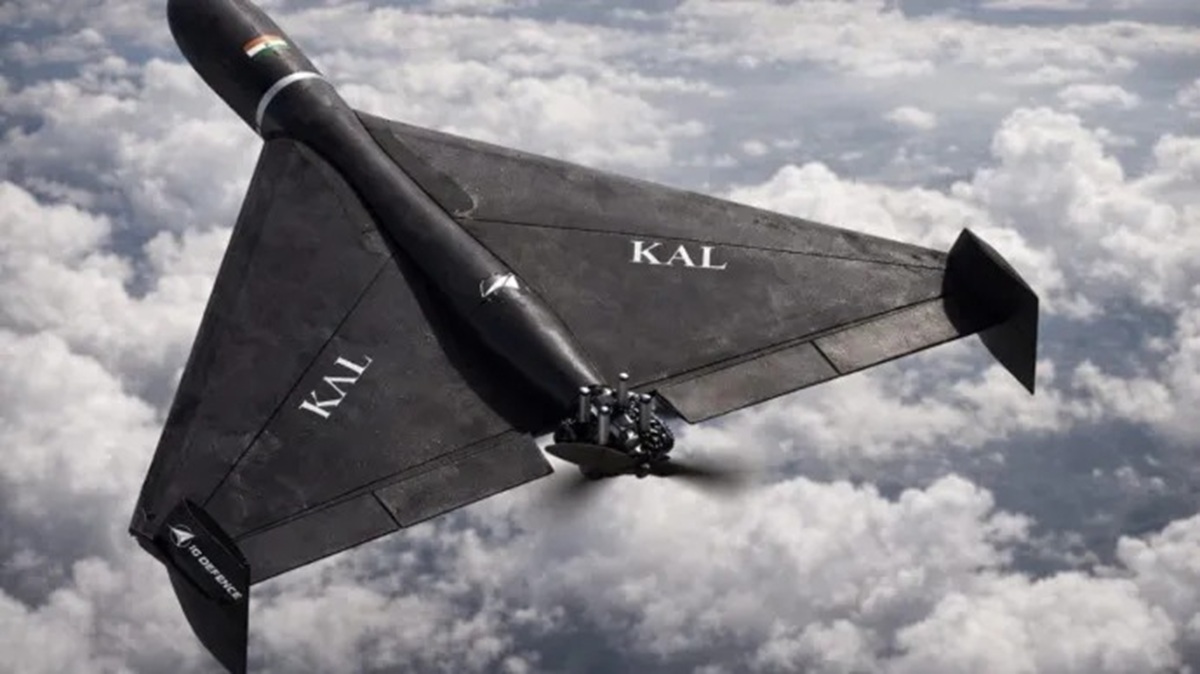
KAL drone equipped with capabilities like strike, surveillance, electronic warfare and swarm attack

IG Defence’s ‘Project KAL’ drone is emerging as an important achievement towards strengthening India’s indigenous defense technology. This advanced unmanned combat system has been developed keeping in mind the future combat requirements of the Indian Army. Its biggest feature is its modular structure, due to which it can be rapidly prepared for different combat roles.
Project KAL has been designed to seamlessly switch between strike missions and real-time ISR (Intelligence, Surveillance and Reconnaissance) operations. The long range operation capability enables it to reach deep into the enemy’s sensitive areas. At the same time, the advanced EO/IR sensors installed in it help in high-resolution surveillance and intelligence gathering in various weather and combat conditions.
The drone is provided with an encrypted SATCOM based communication system, which enables secure data transfer over long distances. Additionally, the electronic warfare-resistant navigation system enables it to protect itself from enemy jamming and signal interference attempts.
The biggest strength of Project KAL is considered to be its multi-role capability. As per requirement it can be configured for kamikaze strike missions, surveillance, decoy operations or electronic warfare. In kamikaze mode it can carry out precise attacks on important enemy military targets, while in surveillance mode it can keep an eye on enemy activities for a long period of time.
In decoy operations it can confuse enemy air defense systems, while in electronic warfare configuration it is capable of disrupting the communication networks and radar systems of the opposing side. According to experts, having so many diverse capabilities in a single platform makes it a “force multiplier”.
Another important feature of Project KAL is its swarm warfare capability. This drone can operate in a coordinated manner in groups and overload the enemy air defense system through collective attacks. In this technology, many drones carry out coordinated combat operations by sharing data among themselves. This is being considered extremely important in modern warfare as conventional air defense systems find it difficult to deal with large numbers of autonomous drone attacks.
Defense experts believe that Project KAL can become the main basis of India’s future drone war policy. It is being developed as a full-fledged war-capable combat system, not just a supporting surveillance platform. Its long range, electronic protection, autonomous operations and multi-role capability make it suitable for modern multi-domain warfare.
This project also strengthens India’s self-reliant India defense campaign. The integration of indigenous design, advanced autonomous technology, secure communications and electronic warfare capabilities shows that India is now moving rapidly towards developing its own independent warfare technology rather than solely relying on foreign defense systems.
Also read:
Suspect killed in Secret Service encounter near White House; Chaos due to indiscriminate firing, President Trump is safe
Indian government’s advisory due to Ebola: Do not travel non-essentially to Congo, Uganda and South Sudan
India’s preparations against Pakistan’s Turkish drones, brainstorming on purchasing MQ-28 Ghost Bat UCAV intensifies

Comments are closed.