
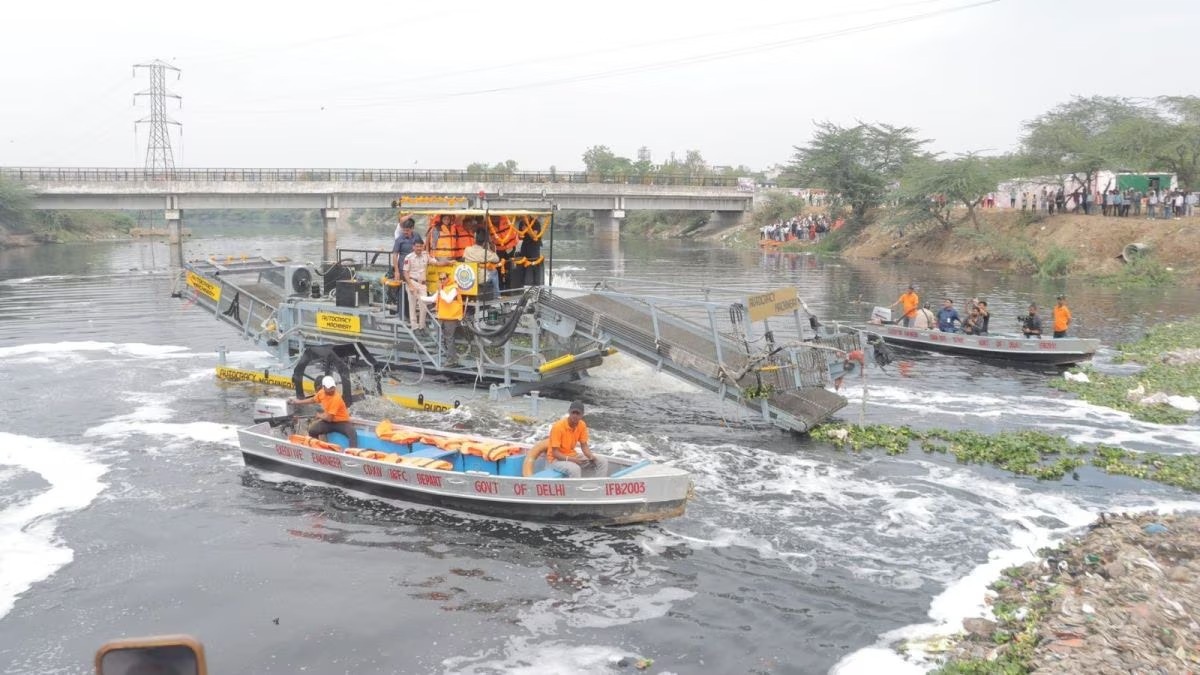

Delhi government has approved a big project to reduce the increasing pollution in Yamuna river. The government has launched a plan to set up 12 decentralized sewage treatment plants (DSTP) along the Najafgarh drain at a cost of ₹860 crore. Najafgarh drain is considered to be the biggest source of pollution going into Yamuna.
The project is part of the BJP government’s broader plan to increase Delhi’s total sewage treatment capacity to 1,250 MGD (million gallons per day) by June 2027.
According to government officials, the new DSTP plants will be set up at a total of 12 locations including Kair, Kakrola, Ghalibpur, Jafarpur and Kazipur Shikarpur. Work orders have also been issued for these projects.
Delhi Water Minister Parvesh Sahib Singh said untreated sewage from many villages and colonies in the Najafgarh area is still released directly into the drain, which ultimately reaches the Yamuna. He said that this has been a serious environmental problem for years and the government is now preparing a permanent solution to it.
According to the government, the new plants will treat sewage near the source, which will significantly reduce the level of pollution reaching the drain and ultimately the Yamuna. Officials say that this will improve the sanitation system in about 120 unauthorized colonies and 27 villages of outer Delhi.
Apart from this, problems like waterlogging and floods are also expected to reduce during monsoon. Every year during heavy rains in Najafgarh area, the problem of water logging in low-lying areas has been coming to the fore.
The entire project will be financed under the Atal Rejuvenation and Urban Transformation Mission Scheme of the Central Government. Launched in the year 2015, this scheme aims to strengthen the water supply and sewage system in urban areas.
The approved cost of ₹860 crore includes the cost of construction of the plants as well as their operation and maintenance for the next 15 years. The company implementing the project will also be responsible for the maintenance of these facilities for the same period.
At present Delhi Jal Board is operating 27 sewage treatment plants in the capital, out of which the upgradation work of 18 is in progress. Last year, the Delhi government had also approved setting up 40 decentralized sewage treatment plants across the capital.
According to officials, Delhi’s current sewage treatment capacity is around 600–700 MGD. 12 new plants to be built in Najafgarh will add additional 40 MGD capacity.
A major reason for the growing concern about Najafgarh drain is its huge catchment area. Named after the Mughal commander Mirza Najaf Khan, this drain is considered to be the last part of the Sahibi River. This river, about 120 kilometers long, originates from the Aravalli hills and joins the Yamuna after passing through Delhi.
Dirty water from about 123 small drains comes into this drain with a catchment area of about 918 square kilometres. Najafgarh area of south-west Delhi is a densely populated area and about 70 villages are located around it.
A recent urban drainage study also found worrying levels of plastic pollution in the Najafgarh drain. According to the study, the level of microplastic here was recorded at 5,400 MPs per cubic meter before monsoon and 2,400 MPs per cubic meter after monsoon. These included pollutants such as plastic pieces, films, fibers, pellets and foam.
Also read:
The football statue designed by Mamata Banerjee was removed from the stadium, the new BJP government demolished it.
Government lawyer caught red handed taking bribe in Vasai court premises; Health deteriorated after ACB action
Big ‘fidayeen’ attack on train in Quetta, Pakistan; 24 killed, 47 injured

Comments are closed.