
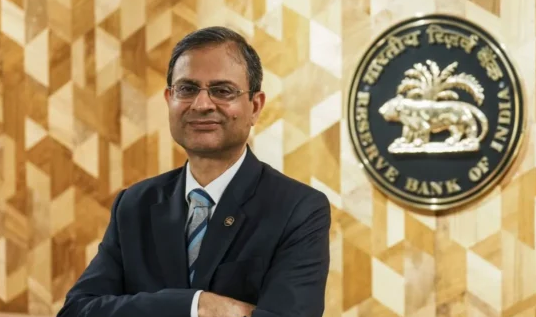

In a significant move aimed at sustaining India’s “Goldilocks zone” of strong growth and low inflation, the Reserve Bank of India (RBI) on Friday cut its benchmark repo rate by 25 basis points to 5.25%—its first rate reduction in six months. The announcement followed the central bank’s Monetary Policy Committee (MPC) meeting held from 3–5 December.
RBI Governor Sanjay Malhotra, in his televised address, said the committee voted unanimously in favour of the rate cut while retaining a neutral policy stance, signalling a balanced approach toward growth and inflation management.
Rate Cut, Forecast Revisions and Liquidity Boost
The MPC delivered a series of key decisions aimed at supporting economic momentum:
- Repo rate reduced by 25 bps to 5.25%.
- Neutral stance maintained for future policy direction.
- FY26 GDP growth forecast raised to 7.3%, up from 6.8% earlier.
- Inflation projection lowered to 2% for FY26, compared to the earlier 2.6%.
- Announcement of ₹1 lakh crore in Open Market Operation (OMO) purchases, aimed at infusing liquidity into the financial system.
- A $5 billion dollar–rupee swap scheduled for December to ease currency pressures.
Read More : Understanding the Lifespan and Reliability of Hybrid Bearings
Governor Malhotra said India is currently in a “rare Goldilocks period”, with low inflation and robust growth providing policy flexibility.
“Despite an unfavourable and challenging external environment, the Indian economy has shown remarkable resilience,” he said.
“The headroom provided by the inflation outlook has allowed us to remain growth supportive.”
Market Reaction and Economic Context
The decision was widely anticipated—a Bloomberg survey of 44 economists showed a majority expecting a 25 bps cut. With inflation comfortably below the 4% target, the central bank had space to ease rates. However, concerns lingered as the rupee recently hit a record low below 90 per dollar and the economy faces global trade headwinds.
Read More : Rising Satellite Numbers Pose New Challenge for Space Telescopes
Following the announcement, the rupee strengthened by 0.2%, trading at 89.7750 against the dollar. India’s benchmark 10-year government bond yields fell by 6 basis points to 6.46%, reflecting positive market sentiment.
The RBI had kept rates unchanged for two consecutive meetings. Last month, Governor Malhotra hinted at upcoming cuts, saying there was “definitely scope.” Since then, new data has shown the Indian economy remains resilient—even amid 50% US tariffs and currency pressures.
Economists say the latest move balances India’s needs well.
Dhiraj Nim of Australia & New Zealand Banking Group noted that the rate cut is unlikely to weaken the rupee significantly, given expectations of a US Federal Reserve rate cut in December, which would preserve the interest-rate gap.
“We believe this could be the last rate cut,” Nim added. “From here on, the RBI will mostly support via liquidity.”

Comments are closed.