
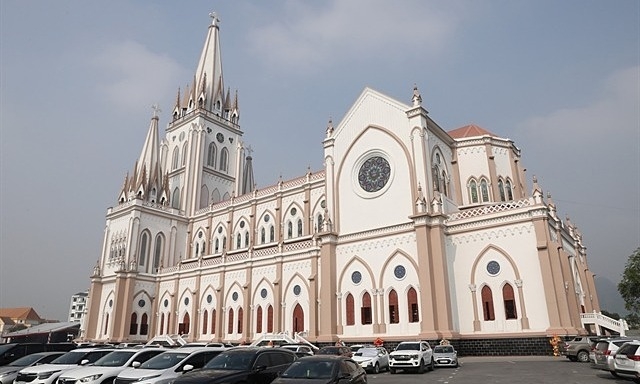

The church sits on a sprawling 14,200-square-meter campus in the Phat Diem Diocese, long known for its blend of Vietnamese and European religious architecture. Lang Van takes that tradition and amplifies it: nearly 4,000 square meters of floor space arranged in the form of a cross; a nave wide enough to hold 5,000 worshippers; and a vertical profile that dominates the flat rural landscape, local media reported.
The main bell tower soars close to 110 meters including the cross, placing it among the tallest bell towers nationwide, flanked by two 60-meter auxiliary towers that create a striking three-tower façade visible from kilometers away, Vietnam News Agency reported.
Engineers had to build the structure as if it were a small skyscraper. The foundation of the central tower rests on 1.6-meter-wide bored piles drilled 40–50 meters deep into bedrock, ensuring the stability of the enormous Gothic-style complex. Inside, pointed arches, soaring vaults and long sightlines give the sanctuary its dramatic sense of height and space.
For the nearly 4,000 parishioners of Lang Van, more than 1,200 of whom work as builders, this project represents a generational dream. Their previous church, built in 1933, could hold only about 1,000 people. As the community grew, so did the desire for a grander place of worship, Tien Phong newspaper reported.
Site clearance began in 2014 and the first stone was blessed in early 2015, marking the start of one of the most ambitious parish-led construction efforts in modern Vietnam.
Hidden beneath the sanctuary is another unexpected feature: a 1,000-square-meter underground hall, 15 meters deep, with room for 700–800 people. Designed both as a community gathering place and an emergency shelter, it reflects the parish’s vision of the church as a space for worship and resilience alike.
With its monumental scale, sharp Gothic arches and rare architectural ambition, Lang Van Church is emerging as one of Vietnam’s newest must-see landmarks.
Visitors to Ninh Binh, a province already famous for karst mountains and ancient temples, now have a towering new destination rising proudly above the rice fields, built by the hands of the very community it serves.

Comments are closed.