
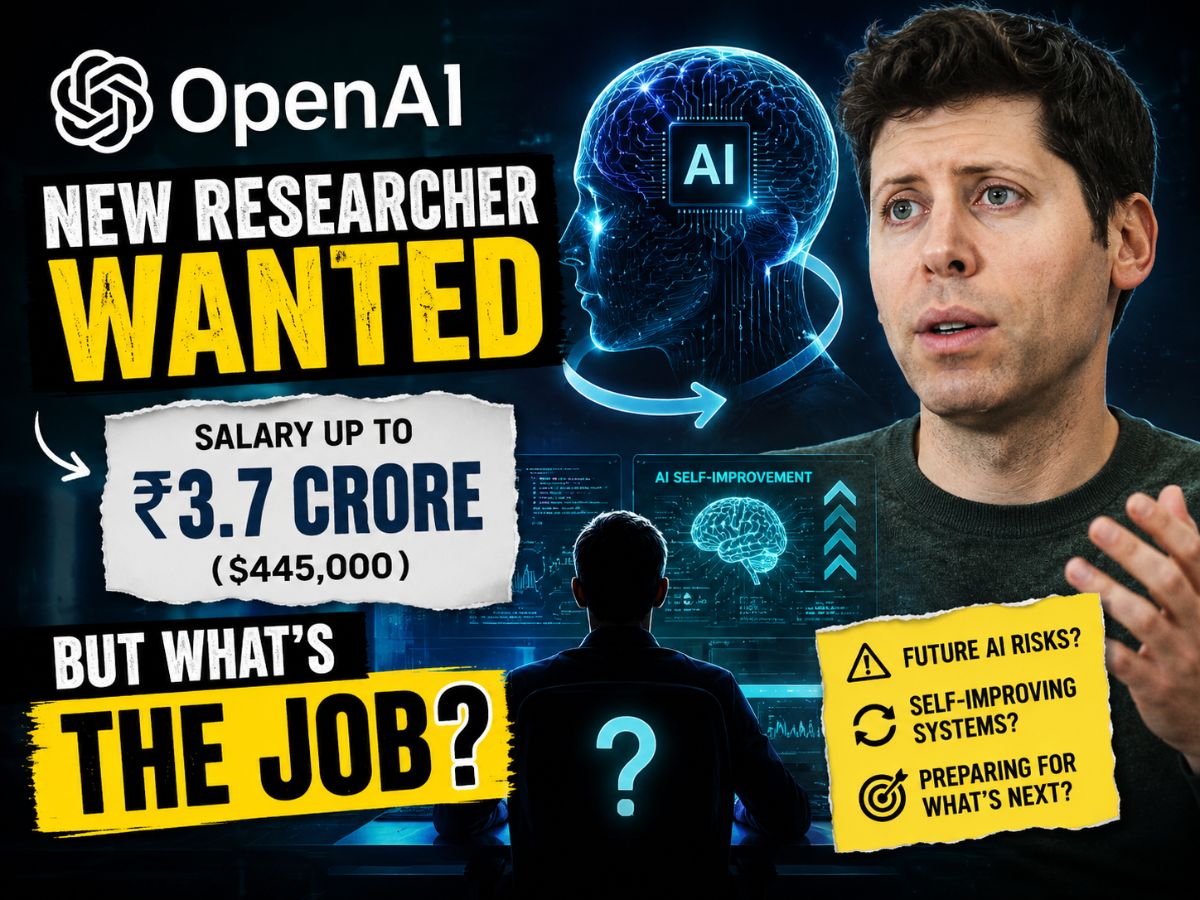
OpenAI Is Hiring A ₹3.7 Crore Researcher — But What’s The Job? Stopping AI From Improving Itself

The AI race is no longer just about capability — OpenAI’s ₹3.7 crore role shows safety is becoming a priority too. Artificial intelligence companies are no longer only competing to build faster and more capable models — they are increasingly investing in understanding what happens if those systems become too capable.
According to Business Insider reports, OpenAI has posted a researcher role to study the risks of “recursive self-improvement,” a theoretical situation in which AI systems could eventually help to design, train or optimise future versions of themselves with little human oversight.
The role, which is reportedly within the company’s Preparedness team — a department that aims to identify and mitigate high-impact AI risks before they materialise — offers total compensation between $295,000 and $445,000 (around ₹2.5 crore to ₹3.7 crore).
One line from the listing drew particular attention.
“This work relies on reasoning about problems that might exist in the future but might not exist now. So it’s especially important that people in this role are tasteful and strategic,” the job listing says, per Business Insider.
As Business Insider notes, the wording suggests that OpenAI is seeking a researcher that possesses technical judgement and the ability to think long-term about an area that is likely to shape regulation, public opinion and the future of AI implementation.
What Is Recursive Self-Improvement?
At the centre of the role is a concept that is often discussed in advanced AI circles: recursive self-improvement.
In simple terms, the idea is that an AI system could eventually help create a more capable version of itself — and that improved system could continue repeating the process.
Supporters argue the process could dramatically accelerate scientific discovery and software development.
Critics and safety researchers argue that once improvement cycles accelerate beyond human monitoring, predicting system behaviour could become significantly more difficult.
The idea has moved from academic discussion into industry planning as AI coding and automation tools have advanced rapidly over the past year.
What Would The Researcher Actually Work On?
According to the report and OpenAI’s job description, the researcher could work across several high-priority areas:
Studying risks tied to AI systems improving future versions of themselves
Building defences against data poisoning attacks during training
Developing methods to interpret and understand AI reasoning
Running experiments around autonomous technical work
Tracking how extensively AI tools are beginning to automate engineering and research workflows internally
The Preparedness team also works on broader risk areas, including:
Cybersecurity testing and automated red-teaming
Agentic AI behaviour
Biological and chemical misuse risks
Long-horizon AI capability monitoring
Why The Industry Is Paying Attention
The role’s placement inside OpenAI’s safety organization — rather than a product or capability team — sends an important signal.
It suggests that frontier AI labs are starting to see self-improving systems more and more as an opportunity and a risk category worth dedicated research budgets.
Competition for this talent pool has intensified as AI companies continue scaling investments in safety and alignment alongside capability development.
Sam Altman’s Long-Term AI Goal
OpenAI CEO Sam Altman has previously spoken publicly about the company’s ambition to automate parts of AI research itself.
The report cited earlier remarks in which Altman outlined goals that include running an automated AI research intern and eventually pursuing a fully automated AI researcher by March 2028.
Altman also acknowledged uncertainty around that roadmap, saying the company may not achieve the goal but believes transparency around such ambitions is in the public interest.
Why OpenAI’s ₹3.7 Crore Hire Signals A New Era For AI Safety
OpenAI’s latest hiring move shows that the conversation inside leading AI labs is shifting. The question is no longer only how quickly AI can improve but how safely those improvements can be controlled.
Paying up to ₹3.7 crore to study risks that may still be theoretical reflects a broader reality: frontier AI companies increasingly see safety research as infrastructure, not an afterthought.
Also Read: ‘Crash Is Coming’: Robert Kiyosaki Drops Warning Alert For Markets; Bets Big On Gold & Silver Explosion Next
Priyanka Roshan is a business writer and assistant editor at the NewsX website who tracks everything from stock market swings and corporate earnings to personal finance trends and policy shifts. Known for turning fast-moving business developments into sharp, reader-friendly stories, she combines speed, accuracy, and a data-driven approach to break down complex financial news for everyday audiences.
With over 9.5 years of newsroom experience, Priyanka has worked with leading media organisations, including Bussiness, Times Now, and Ping Digital, covering diverse beats such as business, politics, technology, auto, travel, sports, and the world. From live breaking news desks to SEO-led digital storytelling, she specialises in creating engaging content that keeps readers informed without overwhelming them.
The post OpenAI Is Hiring A ₹3.7 Crore Researcher — But What’s The Job? Stopping AI From Improving Itself appeared first on NewsX.

Comments are closed.