
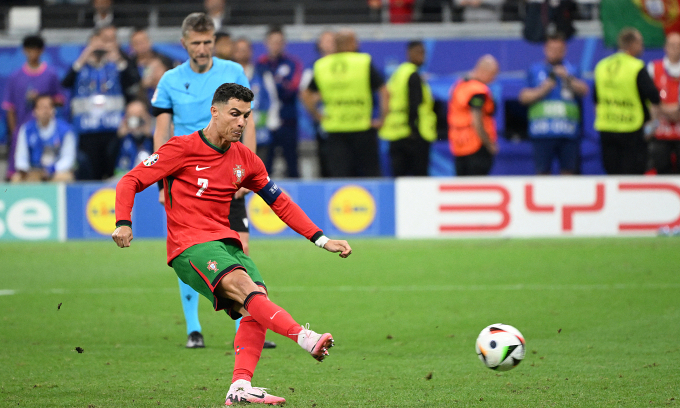

Cristiano Ronaldo takes the first penalty in the Portugal-Slovenia match at the Wald Stadium in Frankfurt, Germany, in the Euro on July 1, 2024. Photo by AFP |
FIFA has released the final squad lists for the expanded 48-team tournament, confirming a record 1,248 players heading to North America.
Besides the fierce competition expected on the pitch, the official data regarding player physiques, squad ages, and domestic club representations reveal fascinating insights into the teams competing across the United States, Mexico, and Canada from June 11 to July 19.
Physical facts
Bosnia & Herzegovina arrives in North America with the most physically dominating roster. Led by veteran striker Edin Džeko, the European side tops the height charts with an average of 1.87 m across the 26 registered players. Norway (1.87 m) and Sweden (1.86 m) follow closely behind.
European nations thoroughly dominate this physical metric, with Belgium, the Czech Republic, Germany and Switzerland all ranking in the top seven. Tournament favorites France and the Netherlands share an average height of 1.85 m, tying for eighth. Defending champion Argentina rank 44th overall at 1.79 m, nearly 8 cm shorter than the Bosnians.
Asian and African representatives anchor the bottom of the height rankings. Saudi Arabia field the tournament’s shortest squad at 1.78 m, followed closely by South Africa, Qatar, and Mexico.
Individually, Austrian goalkeeper Florian Wiegele is the tallest player at the 2026 World Cup, standing a staggering 2.05 m. Right behind him are Bosnian defender Stjepan Radeljić and Colombian goalkeeper Álvaro Montero, both measuring 2.01 m.
Goalkeepers dominate the top 10 list alongside defenders or strikers like Saša Kalajdžić, Tomáš Chorý, and Harry Souttar.
On the opposite end, Panama midfielder César Yanis is the tournament’s shortest player at 1.6 m. The height difference between Yanis and Wiegele is a staggering 45 cm.
Age spectrum
Experience is a priority for several nations, with Iran boasting the tournament’s oldest squad at an average age of 30.46 years. Colombia and Panama tie for second at 30.38 years. The fact that the three oldest squads exceed a 30-year average highlights a heavy reliance on veteran players over young talents.
Defending champion Argentina ranks ninth overall (29.04), while Qatar, Scotland, Uruguay, and Brazil also feature among the oldest rosters, with the average age ranging from 29.27 to 29.58.
Ivory Coast bring the youngest squad, averaging just 25.92 years, narrowly edging out Ecuador (26.08). Bosnia & Herzegovina are not only the tallest squad but also the third youngest, averaging 26.42 years. North African nations like Morocco (26.46) and Tunisia (26.65) also boast young squads. Spain, known for their policy of utilizing young talents, ranked 43rd on the list with an average age of 26.73.
When looking at individual players, Scotland goalkeeper Craig Gordon is the oldest player at the tournament at 43 years old. He is closely followed by Portugal captain Cristiano Ronaldo, who is preparing for his historic sixth World Cup at age 41.
Other prominent stars who have crossed the 40-year threshold include Mexico’s Guillermo Ochoa, Croatia’s Luka Modrić and Germany’s Manuel Neuer. While Argentina’s Lionel Messi didn’t make the top 10 oldest players list, the 39-year-old is only a few months behind the leaders.
Among the 10 oldest players in the tournament, six are goalkeepers. This reflects the nature of the position, which relies less on speed and physical fitness than other roles on the field.
 |
Gilberto Mora attends the Mexico national team’s press conference in Pasadena, California on May 29, 2026. Photo by Reuters |
The 2026 World Cup will also serve as a stage for teenage players. Mexican midfielder Gilberto Mora is the youngest player at the World Cup at just 17 years old. Born in October 2008, Mora arrived in the world just two months before Ronaldo won his first Ballon d’Or.
Other teenage prospects include the Czech Republic’s Hugo Sochurek, Germany’s Lennart Karl, Senegal’s Ibrahim Mbaye and Morocco’s Ayyoub Bouaddi. The age gap between Gordon and Mora is 26 years.
Club and league dominance
The official rosters also reflect the dominance of Europe’s elite domestic clubs. English powerhouse Manchester City contributed the most players to the tournament with 19. Bayern Munich are second with 18, while Champions League finalists Arsenal and Paris Saint-Germain are sending 16 players each. A notable surprise is Premier League side Crystal Palace, which tied for fifth place with 12 representatives, matching Manchester United and Saudi powerhouse Al Hilal.
Among the domestic leagues, the English Premier League dominated with 163 players heading to the World Cup. Germany’s Bundesliga follows with 101, ahead of Spain’s La Liga (81), France’s Ligue 1 (80) and Italy’s Serie A (62). Backed by massive investments, the Saudi Pro League ranks sixth with 47 players, narrowly edging out North America’s Major League Soccer (44).
Comments are closed.