
Made in India: A Titan Story writer Niraj Dasa: Ratan Tata’s passing made it sensitive to fictionalise him

An interesting takeaway from Made in India: A Titan Story is how similar the Tatas are in real life. One scene involving JRD Tata facing an insult from a Swiss watchmaker reminds you of a story about a Ford executive humiliating Ratan, only for him to acquire the American company’s cars years later. Niraj says that the story about JRD and the Swiss watchmaker is “loosely based on real incidents” involving Jamsetji Tata. He adds, “There is a story of Jamsetji Tata about why he opened the Taj Mahal Palace Hotel in Bombay. Apparently, he was not allowed inside the Watson Hotel by Britishers, which is why he built his own hotel. These are all stories that have been passed on from one generation to the next, and there are people who do believe in it. So, there is no written proof of it, but we have taken the liberty of what we have heard from people we have met.”
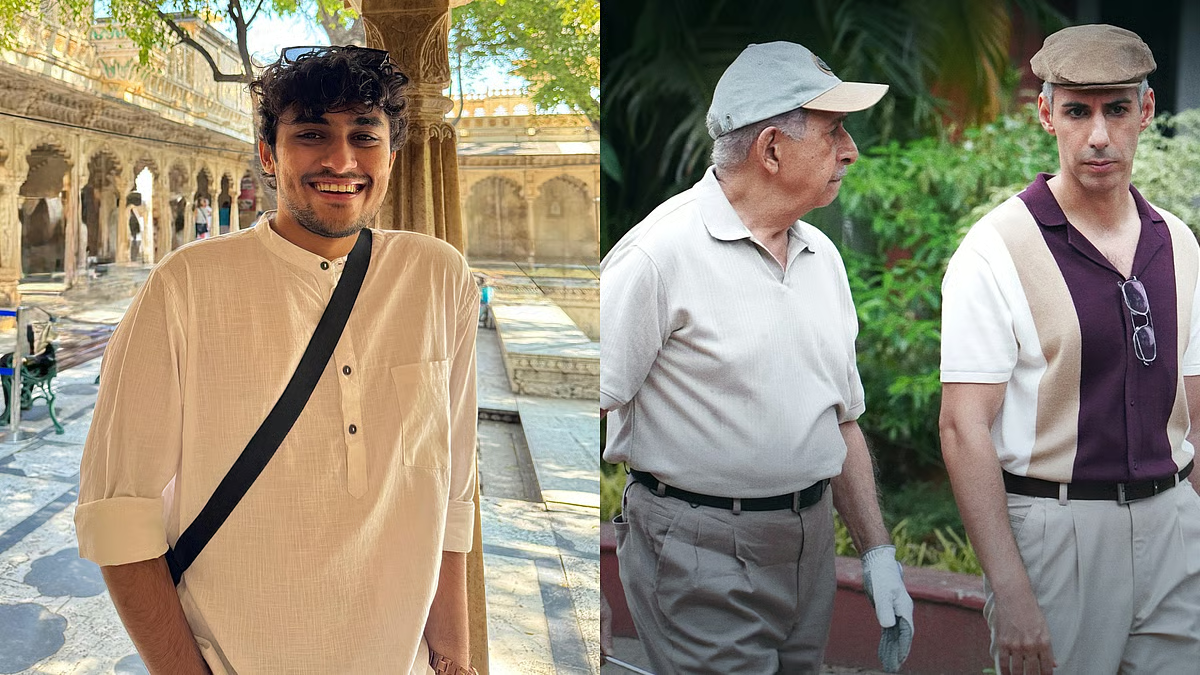
Despite taking cinematic liberties, Made in India: A Titan Story uses real stock footage of Tata and its heritage establishments to ensure authenticity. This also applies to the introductory scene of JRD Tata (Naseeruddin Shah), who flies in to meet his team. Niraj explains, “It is original footage. He was the first Indian to get a pilot license. And even at the age of 50-60, he used to fly by himself. He was very fond of flying and is the founder of Air India. He is called the father of Indian aviation for a reason. India had its first airlines thanks to him. So, we tried our best to sprinkle as much as we could about his real character, like who that guy really was.”
Niraj also credits cinematographer Aditya Kapur, editors Akash Bundhoo and Nibedya Samal, and director Robbie Grewal for the authentic look and feel of the series and the immersion into its period. “The direction is great, as is the editing. The cinematographer has also done a very good job with the location. It all makes you feel like you are traveling back in time,” Niraj shares.
However, not everything has been smooth sailing for Niraj and his writing team. Coming from a novel writing background, Niraj initially found it difficult to adjust to the demands of screenplay writing, and the script itself had its own challenging nuances. Speaking about the transition, Niraj shares, “Novel writing and screenplay writing ke beech main zameen-aasman ka farak hain (It is like the difference between the Earth and the sky),”. He adds, “In novel writing, you have to describe every single thing for the reader to visualise, such as the colour of the character’s clothing and even that of the furniture. In screenwriting, you just have to describe the characters, the mood, and the dialogue. I had zero idea about screenplay writing. It was just something I was curious about and wanted to try. It took me almost three to four years to actually learn how to write a screenplay, especially the grammar of it. However, I am grateful for it.”
On the other hand, discussing the adjustments for the period nuances, he shares, “Karan is the oldest of the lot, and he is only in his mid 30s. We had to ensure that the dialogues sounded authentic for the 1980s, which meant reworking a lot in the dialogue department. Even if it sounds cliche, even though it sounds caricature, that is how people used to talk back then.”
Comments are closed.