
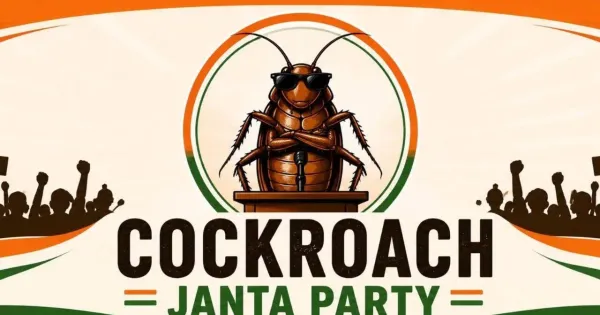

A digital movement has emerged, which started not with any political platform, protest or speech, but with a single word – ‘Cockroach’. Within no time, ‘Cockroach Janata Party’ became so viral on social media that it challenged even traditional political parties in terms of digital popularity.

Rajesh Jain, senior journalist
From time to time, such movements have emerged in Indian politics, which have given a new direction to the system. Some movements brought lakhs of people on the streets, some emerged from universities and some even impacted the Parliament, but in the year 2026, a digital movement emerged, which started not with any political platform, dharna or speech, but with a single word – ‘Cockroach’. Within no time, ‘Cockroach Janata Party’ i.e. ‘CJP’ became so viral on social media that it challenged even the traditional political parties in terms of digital popularity.
Initially it was considered an internet meme, troll culture or a momentary resentment of the youth, but gradually it became clear that it is not just a joke but has become a new language of deep restlessness and political dissatisfaction of the Indian youth. The whole controversy started when Chief Justice of India Justice Surya Kant’s alleged remarks during a hearing in the Supreme Court went viral on social media.
In this comment, unemployed youth and internet activism were linked with words like ‘cockroach’ and ‘parasite’. It was later clarified that the context of the comment was related to fake degree holders and professional infiltration, not the youth, but by then an atmosphere of anger, sarcasm and resistance had formed on social media. In the world of internet, any symbol has the ability to turn into a movement in a moment and the same happened here too.
It was from here that a young communication strategist named Abhijeet Deepke started the digital experiment of Cockroach Janata Party. It may have started as satire, but it gave millions of youth a platform where they could express their unemployment, frustration and anger towards the system through humor and memes.
The biggest question is why so many people joined a satirical digital campaign? The answer is not just viral content. Behind this are the real conditions of Indian society. India is considered the youngest country in the world. Every year lakhs of students graduate with degrees, but employment opportunities are not increasing at the same pace. Paper leaks are no longer an uncommon occurrence in competitive exams. Many recruitments remain stuck for years. Job instability and low salaries in the private sector are depressing the youth.
On the other hand, social media has given every youth a platform to express their views. Earlier political expression was limited to TV channels, newspapers and political parties. Now Instagram reels, X-posts, memes and YouTube videos have also become political weapons. Cockroach Janata Party captured this mood. It transformed youth anger into memes, satire into movement and digital frustration into collective identity. This is its biggest strength.
This party declared itself ‘secular, socialist, democratic and secular’. The requirements for becoming a member are also ironic – being unemployed, being online all the time, being professionally frustrated and frustrated with the system. At first glance it seems humorous, but in reality it was a self-satire.
Today’s youth constantly hear allegations like ‘useless’, ‘lost in mobile’, ‘reel making generation’ and ‘anti-system’. CJP reversed these allegations and made it a symbol of resistance. This is why millions of youth on the Internet turned the word cockroach into an identity rather than an insult.
Today’s generation does not easily connect with long speeches. She is affected by short, sharp and sarcastic messages. CJP’s manifesto also went viral rapidly. It included many such points which people thought were jokes, but in reality they were serious democratic questions.
The manifesto included issues like ban on sending judges to Rajya Sabha after retirement, 50 percent reservation for women, long ban on leaders who defect, questions on corporate control of media and demand for clear policies regarding employment of youth. That is, there was real political criticism present within the satire. This is why many educated youth, journalists, social workers and political observers refused to consider it as mere entertainment. (These are the personal views of the writer)

Comments are closed.