
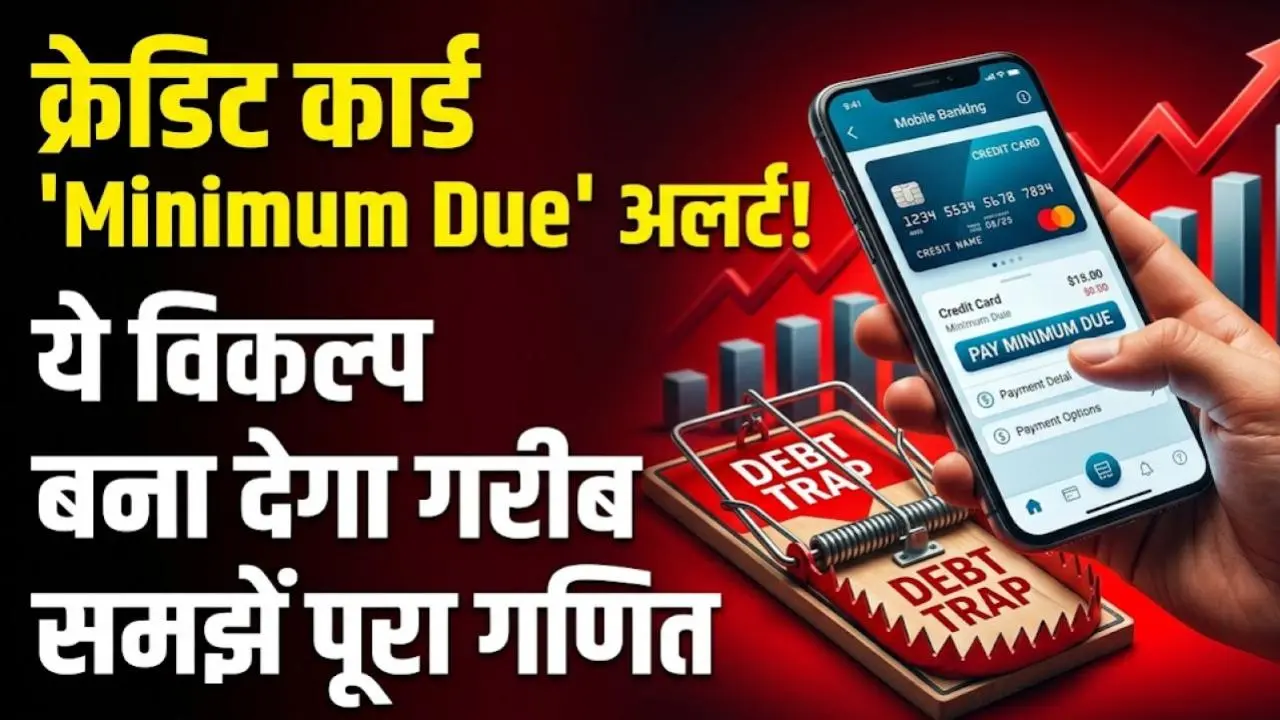
Credit Card Minimum Due Trap: The habit of paying only the minimum amount may make you poor, know its dangerous mathematics.

Credit Card Minimum Due Dangers: In today’s modern and digital era, credit card has become the new king of our pockets. From buying your favorite mobile on no-cost EMI to booking foreign travel tickets, it has made everything very easy. But behind this financial glamor there is a very dangerous and invisible trap hidden, which in technical language is called ‘Minimum Due’.
Millions of middle-class credit card holders in the country feel secure by paying just this small amount every month when the bill comes. They think that they have escaped late fees, but without knowing it, they get trapped in a tight and deep whirlpool of compound interest, from which it becomes impossible to get out later. Financial experts have a strong warning that this habit can gradually push any happy family into the abyss of huge debt.
Anxiety when bill comes and the real truth of 5% minimum due
When a huge credit card bill arrives at the end of the month, most people panic. Suppose, your total outstanding amount is Rs 50,000. As per bank rules, its minimum due is fixed at only 5 percent of the total bill, which in this example comes to just Rs 2,500.
Banks and credit card companies give you the option to deposit this small amount so that your card remains active and you are not charged a late fee of Rs 500 to Rs 1,000. But this is where the real game begins—as soon as you pay just the minimum due, 3 to 4 percent monthly interest starts immediately on the huge balance of Rs 47,500. If we look at it on an annual basis, this stringent interest reaches 36 to 48 percent, which is many times more expensive than any personal loan or business loan.
Horrible compound interest math: 4 times the burden in 10 years
This revolving credit system of credit card works entirely on compound interest. According to RBI rules, credit card companies calculate interest on the outstanding balance not monthly, but Daily Basis But she does.
A small example: If you keep paying only 5 percent minimum due every month on an outstanding balance of Rs 50,000, then by the end of the first year, you will not only be able to reduce the principal amount but will have paid more than Rs 20,000 in interest alone. In the second year, this amount of interest will cross Rs 35,000 due to compounding. If this trend continues continuously, then after 10 years you will earn a total of More than Rs 2 lakh You would have made huge repayments of Rs. 100,000—that is, a financial burden of four times the original amount.
Strict comparison of bill payment options
To avoid credit card debt and keep your financial health in good shape, go through the comparison table given below:
| Payment Option | annual interest charged | Impact on CIBIL score | Danger of debt trap |
| Total Amount Due | 0% (completely interest free) | becomes harder and stronger | absolutely zero |
| EMI Conversion (Smart EMI) | 12% to 18% per annum | remains normal and safe | Extremely low (if filled on time) |
| Minimum Due Payment | 36% to 48% annually | Huge loss due to worsening credit utilization | Excessive (70% of users remain stuck within 2 years) |
Long term fatal blow to CIBIL score
Many people live under the illusion that since they are paying the minimum due on time every month, they are not defaulters and their CIBIL score is completely safe. Technically you are not considered a defaulter, but it affects your credit utilization ratio (CUR).) But it has a very fatal effect.
Suppose your total credit card limit is Rs 1 lakh and your balance always remains above Rs 50,000, then your utilization ratio crosses 50 percent. CIBIL’s algorithm considers this a ‘red flag’ (a sign of financial distress). If this continues for a long time, your credit score may drop by 100 to 200 points, after which you will face huge difficulties in getting a new home loan, car loan or business loan in future.
Complete end of ‘interest-free period’
Another biggest disadvantage of paying minimum due is that your interest-free grace period (20 to 50 days of interest-free time) ends immediately. This means that until the old dues are completely cleared, any new small purchases (like groceries or fuel) you make with that card will start charging steep interest from the very first day of the transaction.
According to a recent survey of financial advisors, almost 70 percent of users who have a minimum payment habit get completely trapped in the terrible debt trap within just two years. According to National Payments Corporation of India (NPCI) data, the average outstanding on credit cards in India stands at Rs 25,000 per card. If even 10 percent of the youth are making only the minimum payment, then lakhs of families are unknowingly losing their hard-earned money in interest.
Wise Solution: How to get rid of this trap?
To get out of this tight financial maze of credit cards, you have to take some smart and disciplined steps:
Habit of full payment: The most strict and infallible rule is to pay 100% of your bill every month before the due date.
Smart EMI Option: If there is a cash crunch in a month and you are not able to pay the entire bill, then instead of paying the minimum due, immediately convert the dues into EMI for 6 or 12 months. Here you will have to pay only 12-18% simple interest instead of 36-48%.
Balance Transfer: You can shift the balance of your high interest card to a credit card of another bank with lower interest rate through the ‘Balance Transfer’ facility.
Personal loan support: If the mountain of debt has become very big, then pay off the entire credit card dues in one go by taking a personal loan from a bank at a low interest rate and block or control the card.
Auto-Pay and Budgeting: Always keep your expenses within 30 percent of the credit limit and set auto-pay on ‘Total Due’ through PhonePe, Paytm or Net Banking so that there is no chance of forgetting.
Basic mantra of true economic freedom: Always use the credit card as an emergency tool, not as a means to fulfill your everyday luxuries and indulgences. Be alert, spend wisely and get out of this trap of minimum dues today.

Comments are closed.