
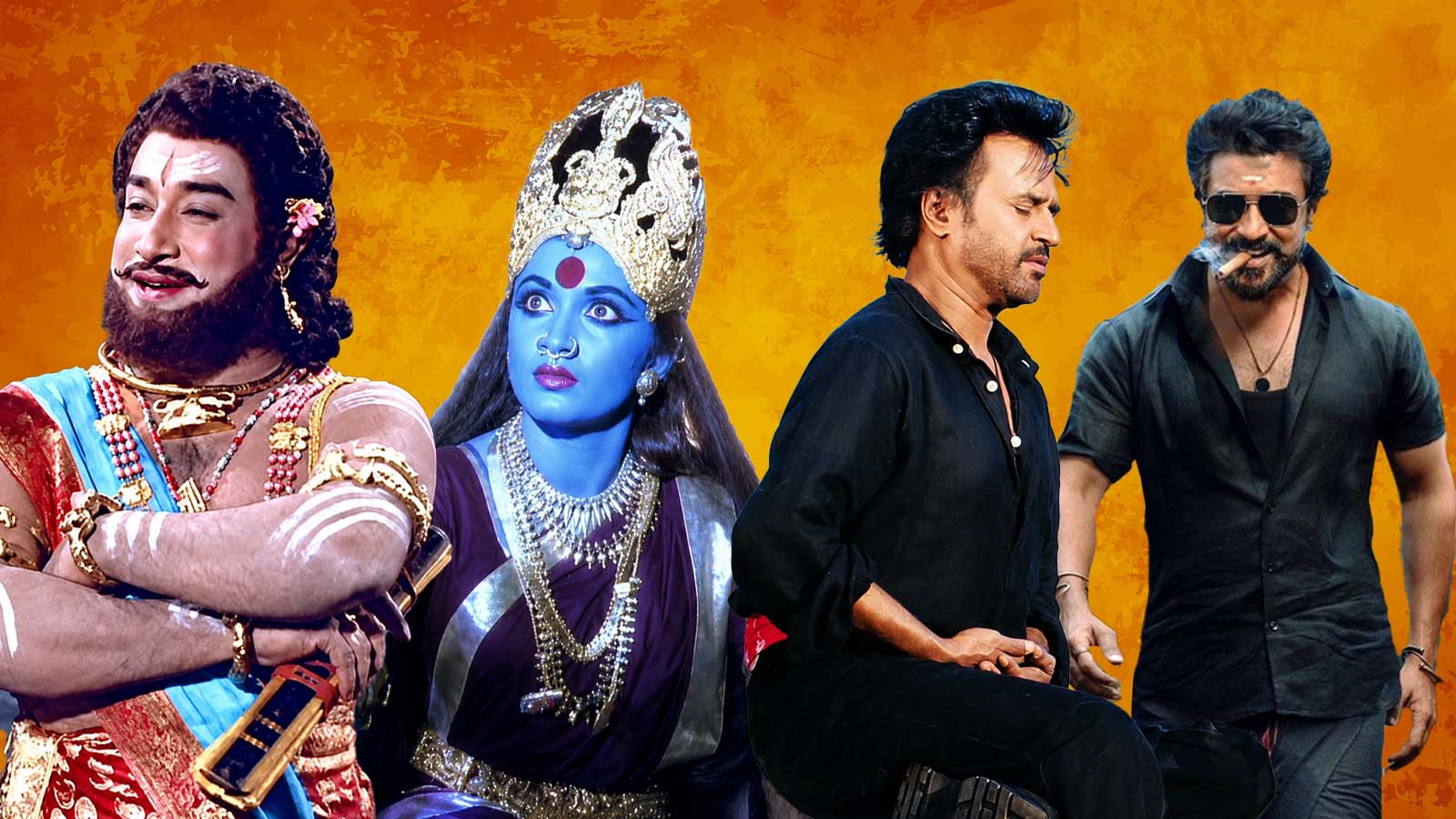

Suriya’s Karuppu enters its tenth day successfully. According to Scalnik, on Day 9, the film jumped 56.4 per cent over the previous day, collecting ₹12.20 crore net. By the end of that ninth day, its worldwide gross stood at ₹217.74 crore, with India net at ₹133.85 crore, against a budget of ₹130 crore.
It is Suriya’s career-best, the biggest Tamil film of 2026, the first Tamil film this year to cross ₹100 crore in Tamil Nadu alone and his first success in a decade.
Also Read: RJ Balaji’s Karuppu review | Suriya-Trisha’s god film loses faith in itself
At the heart of Karuppu is deity Karuppuswamy, who accepts a challenge, takes the form of a normal human and takes on a corrupt judiciary. It is a specific, contemporary premise. But it also belongs to one of Tamil cinema’s oldest and most enduring traditions of devotional films.
However, over the years god has changed. Era by era, cinema imagines god differently — from what god looks like to what god is angry about to whose side god is on. Here’s a look at the evolution with the examples.
The classical era: God as God
In the beginning, there was no ambiguity. God was God, myth was myth, and the Tamil screen was a devotional space.
Thiruvilayadal (1965)
The benchmark of the classical era, directed by AP Nagarajan, an icon who made these kinds of films a thing. Sivaji Ganesan plays Lord Shiva, who comes to the mortal world in disguise — as a poet, a labourer, a firewood seller — to dispense divine justice. But at no point does anyone forget who he is. The film’s most famous dialogue is its thesis: “Idhai unarthavae yaam indha thiruvilaiyaadalai nigazhndhom” — we created the conflict only to teach mortals a lesson.
Saraswathi Sabadham (1966)
Also directed by Nagarajan, released a year later. The trinity goddesses of Hinduism — Saraswathi, Mahalakshmi and Parasakthi — representing learning, wealth and strength respectively, argue over which force matters most in mortal life. The human world is merely the arena for their divine debate.
Kandhan Karunai (1967)
The third of Nagarajan’s defining trilogy of the decade. Sivakumar plays Lord Murugan as a compassionate deity directly involved in human affairs, with Sivaji Ganesan in the cast. Murugan, the most distinctly Tamil of the Hindu gods, had by now become a recurring presence on screen. The classical era’s logic held firm: the god is the protagonist, the scripture is the source, and the film is devotion made visible.
The Amman wave: God as protector
By the 1990s, a unique phenomenon unfolded, Amman films. Till then, the narratives were mostly about the big Hindu gods.And the narrative was cosmic. With the Amman, a goddess who is worshiped in small towns and villages, the conflict also became small. Amman was not out to prove her power and establish supremacy in these films. She just took on villains who made her devotees’ lives hard.
Also Read: The Sanskritisation of Tamil Nadu’s village gods
Amman / Ammoru (1995)
The Tamil dubbed version of the Telugu film Issuesdirected by Kodi Ramakrishna, was the catalyst that launched the wave. Ramya Krishnan played the village goddess, and the film was such a huge success that it set the template for an entire sub-genre of mythological fantasy films, noted as much for their visual effects as for their emotional register.
The formula was established: an impoverished or orphaned woman, a cruel family, and a local deity who descends as a human friend and protector. Where Thiruvilayadal‘s Shiva taught lessons to an entire kingdom, Amman‘s goddess had one job, to protect one woman.
Rajakali Amman (2000)
Director Rama Narayanan, who had been making films in this vein since the late 1980s with titles like Durga (1990), returned to the genre after Issues‘s success. Ramya Krishnan plays Goddess Rajakali Amman, who appears in human form to protect siblings from evil forces. Produced under legendary director K Balachander’s Kavithalayaa banner.
The Amman films leaned into supernatural spectacle — snakes, elephants, and monkeys as divine aides, and visual effects that were benchmarks for their era.
Palayathu Amman (2000)
Also directed by Rama Narayanan. Meena plays the lead role as goddess Amman. By now Ramya Krishnan and Meena had become the default faces of divinity on the Tamil screen. The Amman genre was a sub-industry unto itself.
The transition years: God gets complicated
By the early 2000s, the Amman wave had commercially exhausted itself. God did not disappear from Tamil cinema, but the form changed. The didactic certainty of the classical era and the folk protectiveness of the Amman films gave way to something more searching — films that used the divine to ask questions rather than deliver answers.
Baba (2002)
Rajinikanth’s character Baba is an atheist, who is perceived to be something more than a mere mortal by people around him. However, he discards beliefs, and pessimism about world order, and leads a hedonistic life of drugs. A life-changing incident occurs, and he is bestowed with seven boons by Mahaavatar Babaji. With the boons, Baba begins his life of spiritual journey to save the people.
Arai En 305-il Kadavul (2008)
Directed by Chimbu Deven and produced by S Shankar, this is one of the most conceptually audacious films in the tradition. Two unemployed men — Rasu (Santhanam) and Mokka (Ganja Karuppu) — are broke, directionless, and at their lowest point do what most people only do privately: they blame God.
To their horror, God shows up. Prakash Raj plays the Almighty, who turns up at their apartment in Room 305 and stays — on one condition: they must not reveal who he is.
The masterstroke is what comes next. God controls the universe through a supercomputer. The two men discover this “Galaxy box,” steal it, and seize divine powers for themselves — misusing it spectacularly for petty personal gain. God, stripped of his powers, is forced to live as a mortal among the very people who blamed him.
The film asks a harder question than whether God exists: what would you do with God’s power, and would you do any better? The answer, predictably, is no. God’s message — love thy fellow beings — lands not from a celestial throne but from a deity living on the ground floor, watching ordinary people destroy themselves with the omnipotence they once demanded.
In this era, God has left the temple entirely. He is in a Chennai apartment. The divine has become a mirror.
Seedan (2011)
Dhanush plays Lord Murugan, who descends to help a devotee. A throwback to the classical form in outline, but the mass-hero casting signals a shift — the god must now also function as a commercial Tamil film protagonist.
The contemporary era: God in the modern city
Naveena Saraswathi Sabatham (2013)
A direct, comedic reboot of the classical model. Lord Shiva is depicted in a modernised heavenly realm as a divine overseer who instructs Narada to select four ordinary mortals for his own Thiruvilayadal — a test of purity and devotion in the modern world.
The twist: heaven now has Shiva and Parvathi conversing in English, Ganesha burning fat on a treadmill, Murugan playing Temple Run on his iPad, and Saraswathi being addressed simply as Saras. The gods are the same. The world they inhabit has been updated to match ours.
Oh My Kadavule (2020)
The most significant departure from the tradition. God appears with no divine name, no iconography, no temple — just Vijay Sethupathi in ordinary clothes, sitting in a family court. He predicts what is about to happen with uncanny accuracy and gives the protagonist a golden ticket — a second chance to go back in time and make things right. The problem God is asked to solve is not injustice or evil. It is a failing marriage. The cosmic has become entirely personal.
Mookuthi Amman (2020)
RJ Balaji brought the goddess back — but repurposed for the present. Goddess Mookuthi Amman, played by Nayanthara, descends to Earth and uses a television reporter to expose fraudulent godmen. The enemy is not a demon or a cruel family, but the industry of fake religiosity itself. The goddess has become an investigative journalist.
Vinodhya Sitham (2021)
A divine bureaucratic figure who manages the afterlife intervenes directly in a human life. God here is an administrator navigating paperwork and cosmic red tape — a comic, mordant take on divinity in an age of institutions.
Karuppu (2026): God of the Margins
RJ Balaji, who revived the devotional genre with Mookuthi Ammanreturns to it for his third film — this time with Suriya as his instrument and Karuppuswamy as his deity.
The choice of god is the story. Tamil cinema’s classical era reached for the great Saivite and Vaishnavite gods — Shiva, Vishnu, Murugan. The Amman wave elevated the regional village goddess. Karuppu goes further still, to Karuppuswamy — a folk deity worshipped particularly by working-class communities, the god of the village boundary and of those at the edge of the formal world.
What makes Karuppu compelling is not just that it revisits familiar territory — the hero is not a righteous vigilante but literally God, with all the power that implies, choosing to use it against a broken court system.
Also Read: RJ Balaji breaks down as Karuppu morning and noon shows are cancelled
What Thiruvilayadal’s Shiva did in a Pandyan court, Karuppuswamy does in a Chennai courtroom. The setting has moved from epic myth to civil society. The enemy has shifted from demonic kings to a corrupt judiciary. And the deity has moved from the Vedic pantheon to the folk shrine at the village boundary.
The impulse, 60 years on, remains exactly the same: to bring the divine into the human world and ask it to fix what humans have broken.

Comments are closed.