
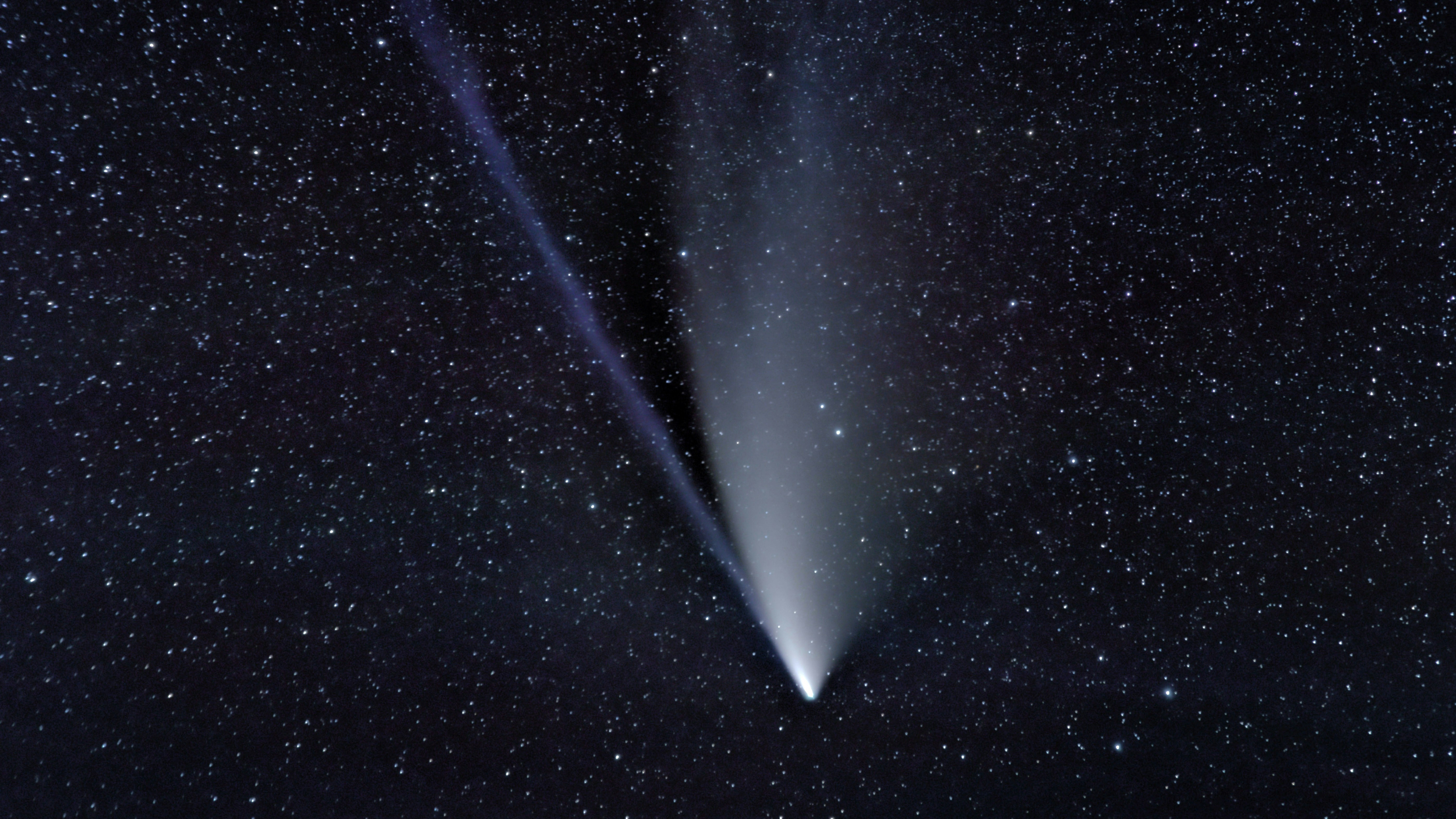

The third confirmed interstellar object, comet 3I/ATLAS (C/2025 N1), discovered by Chile’s ATLAS telescope on July 1, 2025, is passing our Solar System at a speed of 50 km/s on a hyperbolic path that is not bound by the Sun’s gravity. NASA’s Lucy spacecraft photographed it from 240 million miles away, revealing a faint coma and small eastward dust tail—the hallmarks of a natural icy wanderer from another star system. Nevertheless, some of its distinguishing features—a nucleus of about 20 km (a million times more massive than ‘Oumuamua), a high ratio of CO₂ to H₂O (8:1), a rapid release of water (40 kg/s from 8% of the surface), and a plume of dust to the west toward the Sun (an anti-tail, not a true tail)—have aroused curiosity.
Harvard astrophysicist Avi Loeb ranks 3I/ATLAS a “4” on his 0–10 “Loeb Scale” for technological things (0: definitely natural; 10: definitely artificial), citing eight anomalies such as ecliptic alignment (0.2% chance), no gas spectra, and non-gravitational acceleration that would indicate propulsion. Is. In a December 2025 New York Post interview and Medium post, Loeb offered a provocative “pedagogical exercise”: What if this were the “seed ship” of an “interstellar gardener”—an advanced civilization sending microbes to terraform the world through directed panspermia? “Inhabitants of past stars had plenty of opportunities to visit… If there is an interstellar gardener, it must have deliberately sown life on Earth,” he thought, estimating that meter-sized rocks collide with Earth every ten years—about 500 million collisions in 4.5 billion years, which could potentially bring hardy alien life.
Loeb emphasizes that this is “mostly natural,” but older stars (billions of years before the Sun) have given aliens plenty of time for cosmic gardening. JWST and Hubble data show familiar ice (H₂O, CO₂, CO) and cyanide/nickel that are similar to those in Solar System comets, according to ESA/NASA—which rejects the technical claims. Anti-tail? Large dust particles that are resisting the solar push, not the thrusters. Critics such as Jason Wright describe Loeb’s remarks as “ill-intentioned” clickbait, spreading misinformation (e.g., the fake “Cassandra leak”).
Perihelion passed on October 30, 2025; Moving outwards now, 3I/ATLAS is getting fainter (mag 14.2 in September), and will exit by mid-2026. The discussion on Mainstream consensus: A strange comet, not ET—fueling panspermia debates without evidence. As Loeb says, ignoring technological alternatives “is not a sign of intelligence.”

Comments are closed.