
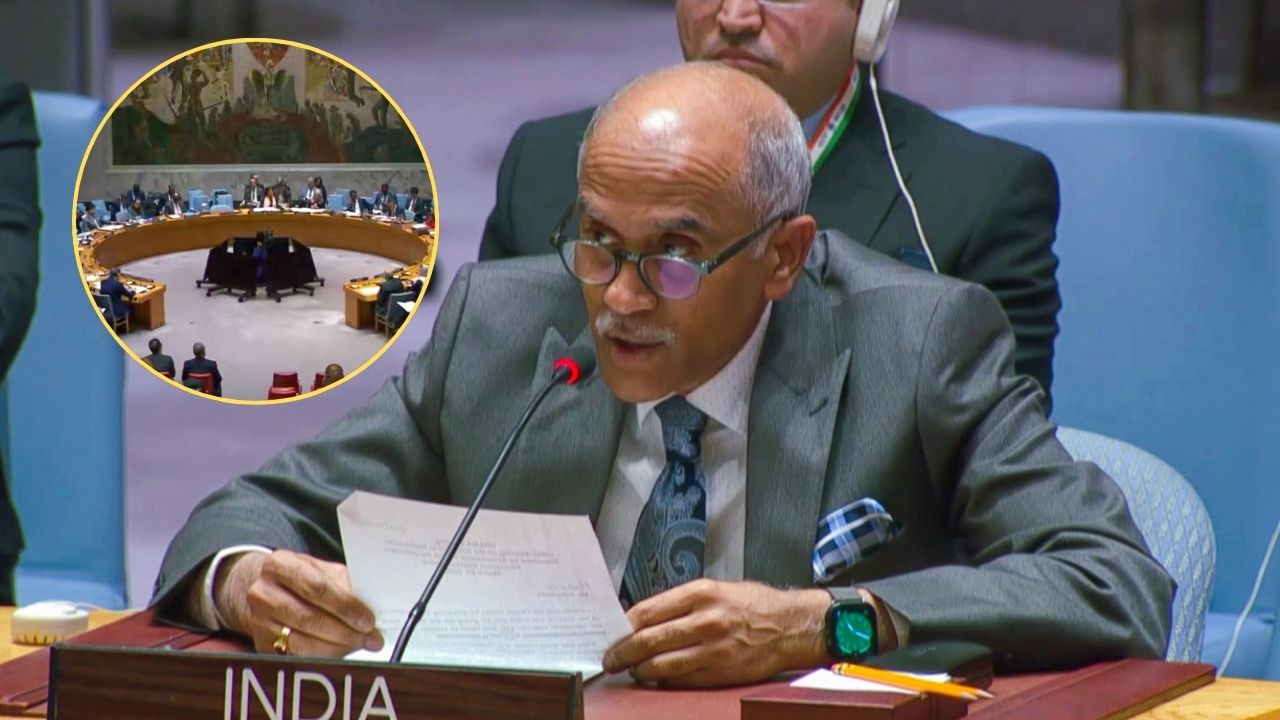

In the recent meeting of the United Nations Security Council (UNSC), India took a very tough stance towards Pakistan. India has reacted sharply to Pakistan declaring some terrorist groups as ‘Fitna al-Hindustan’, calling it a strategy of spreading propaganda and misinformation. Indian representative Harish Parvathaneni said that such terminology is being used to increase regional tensions and serve domestic political objectives.
Not only this, India also raised questions on issues related to Afghanistan and Pakistan’s military policies. India’s Permanent Representative to the United Nations, Ambassador Harish Parvathaneni, made several serious comments criticizing Pakistan’s policies. Let us understand what is this whole controversy and why did India make such sharp allegations against Pakistan?
What is the Fitna al-Hindustan controversy?
The Government of Pakistan had officially categorized some terrorist groups and organizations operating in Balochistan in the category of ‘Fitna al-Hindustan’ in 2025. Pakistan claimed that these groups were a threat to the security and stability of the country. However, India expressed strong opposition to this naming, saying that it is an attempt to divert attention from real problems and run a political agenda by using religious sentiments.
What is the meaning of Fitna al Hindustan?
Fitna is an Arabic word which means ‘disturbance’, ‘rebellion’, ‘civil war’. Apart from this, Al Hindustan means ‘of India’ or ‘connected to India’. From Pakistan’s perspective, Fitna al Hindustan means ‘disturbance or rebellion instigated by India’. Pakistan uses it to link insurgent and terrorist groups creating unrest in its country with India.
What did India say in UNSC?
Harish Parvathaneni, India’s permanent representative to the UN Security Council meeting, criticized Pakistan’s move, saying, “This is the result of an organized factory of hatred run by Pakistan’s secret apparatus, which aims to keep its citizens in a state of permanent hostility with India so that they can remain in power and maintain their control over national resources and distract them from the main political and economic problems.”
Why did India call it propaganda?
Harish Parvathaneni says that this strategy adopted by Pakistan is an attempt to divert attention from the real facts. According to India, defining a group in religious terms does not solve the problem but rather complicates it.
India also targeted Pakistan’s military system and political structure in its statement. Referring to the increasing role of the army in Pakistan, the Indian representative raised questions on the power structure of the country. This comment is being seen in the context of giving expanded powers to Army Chief General Asim Munir and changes in the defense structure in Pakistan.
What did India say on Afghanistan issue?
In the United Nations meeting, India also expressed concern about Pakistan’s military actions in Afghanistan. India says there have been civilian deaths during cross-border military operations and this has affected regional stability. On this issue, Parvathaneni said, “I want to reiterate again. Calling a massacre a military operation does not absolve the culprit. Killing, maiming and orphaning civilians is not an anti-terrorism action.”
India also said that Pakistan continuously tries to blame neighboring countries for its internal challenges and failures. Such strategies are neither beneficial for regional peace nor can they solve the internal problems of any country.
What impact can it have on regional politics?
According to the report, sharp statements between India and Pakistan on global platforms like the United Nations can further increase the tension in the relations between the two countries. However, India insisted that the international community should adopt a clear and fact-based approach on issues like terrorism, propaganda and regional security.

Comments are closed.