
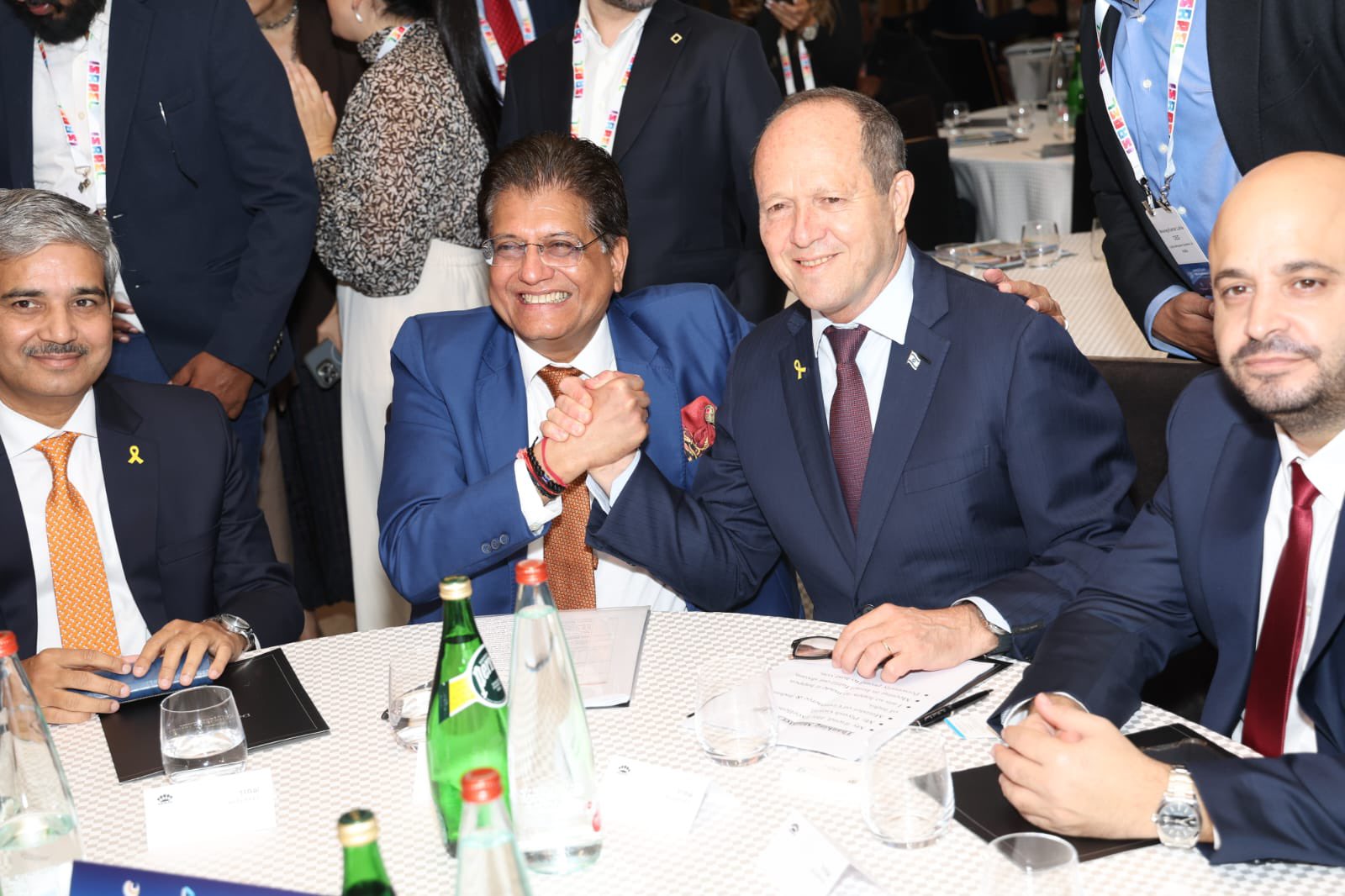

Jerusalem: The ties between Israel and India are “very strong”, and there are “endless opportunities” for collaboration between the two countries, Israeli officials have said while describing the India-Middle East-Europe Economic Corridor (IMEC) project as a “very good” initiative.
They also said the two countries can work together, along with partners in the international community, to encourage states to assert their authority over all activities within their borders and ensure that non-state actors do not play a significant role.
“The ties between Israel and India are very, very strong and getting even stronger. Both civilian and I think also in terms of military cooperation, defence cooperation,” a senior Israeli foreign ministry official said here while talking to a group of Indian journalists.
Another official from the foreign ministry said there are “endless opportunities” for the two countries to work together.
Speaking about the IMEC project, the official said that for Israel, it’s a “very, very good initiative”.
“It’s something that we are really looking into. At the moment, there are two countries which are not part of the signatory – Jordan and Israel. And for the first stage, this is what we’re looking to see: these two countries are part of the larger framework,” the official said.
The IMEC, a transformative initiative aimed at boosting connectivity, trade, and sustainability across three regions, was formed on the sidelines of the G20 Summit in Delhi in September 2023.
An agreement was signed by India, Saudi Arabia, the European Union, the UAE, the US and some other G20 partners for the corridor.
Less than a month after the IMEC launch, Hamas launched a multi-front attack on Israel October 7 that impacted the project.
“It’s true that the 7th of October attack actually put a lid on the moment on all these initiatives… There’s a lot of hesitation for other countries as to how they should be included when there’s still a war going on. And even though there’s a ceasefire, there’s a peace plan by (US President Donald) Trump, there’s still hesitation. What if a war breaks out again?” said the senior diplomat.
“So, I think it would still take time. There’s nothing at the moment Israel can do to persuade or to progress unless Saudi Arabia sees some kind of progress in Gaza, because Saudi Arabia clearly said that it has to give something to the Palestinians…any gesture that can pacify the Palestinians before it goes on and normalises relations with Israel,” the official said.
“Until that happens, we don’t see how we can move forward, but we are laying the foundation with Americans, with the Emirates…with other neighbouring countries. So when the time comes, we can pick up from where we left off….” the official added.
The senior diplomat described the IMEC as an “amazing project”, saying it would stabilise the area and the regional countries could gain from it.
Many strategic affairs watchers have described the IMEC as perhaps an answer to China’s Belt and Road Initiative (BRI), a multi-billion-dollar infrastructure and connectivity project that involves dozens of countries.
The official also said Israel is pushing India, as well as the rest of the world, to designate Hamas as a terror outfit.
“Is there a doubt that Hamas is a terrorist organisation after the October 7 (attack)? Is there doubt about what they have (done)? Their actions… the way they operate… their activities?” the official asked.
The official said that India’s listing of Hamas would have a “strong global impact”.
It will send a “very strong message” to the world, because there are a lot of neighbouring countries that look up to India, and when India declares something, it has a great impact.
“It sends a message that India has clearly seen what Hamas is doing, and no operative should step on Indian soil,” the official said.
On the two-state solution, the official said India has a very clear understanding of policy, promoting the two-state solution, seeing the two nations living side by side, and it has never neglected this policy.
“We respect that. We don’t see the vision at the moment of this happening, especially when you don’t have the right reforms and conditions from the Palestinian side,” the official added.
Speaking on condition of anonymity, another official said that there was a thought in Israel that possibly Iran would shift its approach and maybe stop the proxy war after what happened to Hezbollah, Hamas and the Operation Rising Lion.
“But the understanding now is that there was no shift, and Iran is doubling down and reinvesting in the proxy system with slight changes as to where to put the emphasis,” the official said.
The unnamed official said that America’s maximum pressure campaign against Iran has to be “much more maximum” than it is. Iran is still a “big threat”, he added.
Maj Gen (Res.) Amir Baram, Director General of the Israel Ministry of Defence (IMOD), recently said that Israel is “deeply engaged” in developing next-generation breakthrough technologies for potential future confrontations with Iran, in both defensive and offensive capabilities.
“All fronts are still open, and our enemies are learning and preparing. This transitional period brings uncertainty and risks, but also significant strategic opportunities for those who understand the moment,” he said.

Comments are closed.