
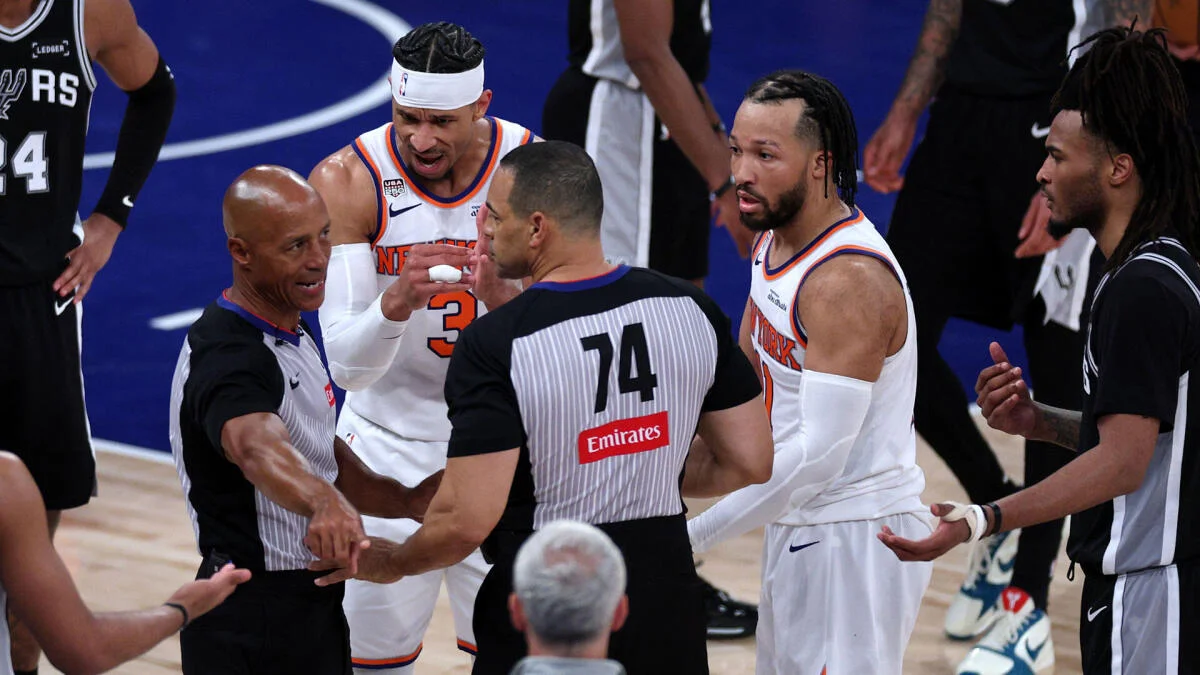

Coming into the NBA Finals, it was fair to assume the San Antonio Spurs would draw more whistles than the New York Knicks. In the 2025-26 regular season, the Spurs averaged 3.6 more free-throw attempts per game than their opponents, while the Knicks averaged 1.4 fewer than their opponents. New York has improved in the postseason, but San Antonio still has a better free-throw margin, and that has proven out through the first three games.
Despite the extended data, officiating has become one of the stories of these NBA Finals. In the first two games, the Spurs attempted 19 more free throws than the Knicks, excluding attempts taken by Mitchell Robinson upon being intentionally fouled. This discrepancy persisted into Game 3. While the Knicks attempted six more first-half free throws than the Spurs, the visitors had a 24-8 advantage at the charity stripe in the second half.
Knicks coach Mike Brown was not happy. While he acknowledged that his team has plenty to clean up on its own merits, he devoted the first three minutes or so of his post-game press conference to officiating.
“I will say this: I never thought I would be in the NBA Finals and see a team get 24 free throw attempts in the second half to another team’s eight,” Brown said. “I don’t think I complain much about officials or the fairness when it comes to the free throw attempts. San Antonio is a great team. They are a great team, OK. It’s going to lower our odds big time, big time, if we play Game 4, and in the second half, they get 24 free throw attempts to our eight.
“Maybe we were fouling. Maybe we were fouling. But they fouled, too.”
Brown continued: “(Karl-Anthony Towns) gets the ball off of a loose-ball rebound and he shoots it, and he gets whacked across the arm, and they hit the ball, and it goes out of bounds on the baseline. There’s no foul. There were opportunities for fouls to be called, to at least try to even the free throws out.
“Now, we didn’t play good. San Antonio played great. We could have played better. There was a lot of things that we didn’t do that we did in Game 1 and Game 2. But to go 24 free throw attempts in the second half, that’s 48 for the game if you think about the way they called that second half, compared to eight. All the shots we took, we got fouled four times, roughly, for eight free throw attempts.
“Again, I don’t complain much. I never thought I’d see that in an NBA Finals game, and I saw it tonight. That’s tough to overcome when you’re playing against a great team. Having said that, again, San Antonio won the game. I’m giving their head coach and their players a lot of credit. (Victor Wembanyama) played great. Stephon Castle played great. I could go down the line. (De’Aaron) Fox hit a big shot late. But as a team, if you take away the fouls and the free throws that should have, in my opinion, been a little bit more even, again maybe we fouled that many times but they fouled, too. And it’s not shown at the end of the day on this box score.”
Free-throw margin in 2026 NBA Finals
Excluding intentional fouls on Mitchell Robinson
| Game 1 | 25 | 18 | Spurs +7 |
| Game 2 | 27 | 15 | Spurs +12 |
| Game 3 | 32 | 22 | Spurs +10 |
The specific play Brown mentioned involving KAT could refer to one of two shot attempts that came on consecutive possessions in the fourth quarter. With less than 3 minutes remaining, Towns picks up a loose ball off a Jalen Brunson shot that was blocked, but gets blocked out of bounds himself when he tries to score on a layup. When the Knicks next inbound the ball, Towns is again blocked at the rim and is visibly upset by the lack of whistle.
Though Brown did not directly reference it, there has been quite a bit of frustration among Knicks fans about what seems to be a different level of physicality the Spurs have been allowed to play with. Most notably, Wembanyama appears to have gotten away with several plays that should have been whistled for fouls … and possibly reviewed as flagrants.
On this Game 2 box out of Jose Alvarado, for instance, Wemby seemingly gets both arms around Alvarado’s neck before attempting to toss him out of the way. There was no whistle.
And then, early in Game 3, Wembanyama got away with this strong shove to the head of Brunson.
Brunson has taken the brunt of San Antonio’s aggressive physicality. Take this play from Game 3. While pursuing a rebound, Brunson attempted to box out Castle, but Castle stuck out his elbow and ran straight through him. He was whistled for a foul, but upon review, it was only considered a common foul, not a flagrant.
As Brown noted, there was physicality on both sides. Still, there has been a feeling throughout the NBA Finals that the officials have been far quicker to whistle the Knicks than the Spurs.
Take this from Game 2 when Robinson was whistled for this soft technical foul that was later rescinded by the NBA. Remember: Game 2 was decided by a single point. There were entirely plausible scenarios in which that whistle could have swung the outcome, and undoing the call in the history books would not have changed the game’s outcome.
Knicks players, to their credit, did not add fuel to the officiating fire. When asked about the shove from Wembanyama, Brunson merely replied, “Whatever you saw is what you saw.” When Towns was asked about the officiating, he left no doubt about his own stance. “That ain’t cost us the game,” he said.
The NBA releases a last 2-minute report on calls made late in close games, but otherwise, it only addresses calls made in the rest of the game if a flagrant or technical foul is retroactively applied or removed. NBA teams frequently send videos to the league office about calls they believe were missed or incorrectly officiated.
The Knicks will almost certainly do so after Game 3. The numbers suggested the Spurs would draw more free throws in this series than the Knicks, but at least in Brown’s mind, that margin got out of hand in the second half of Game 3.
Comments are closed.