
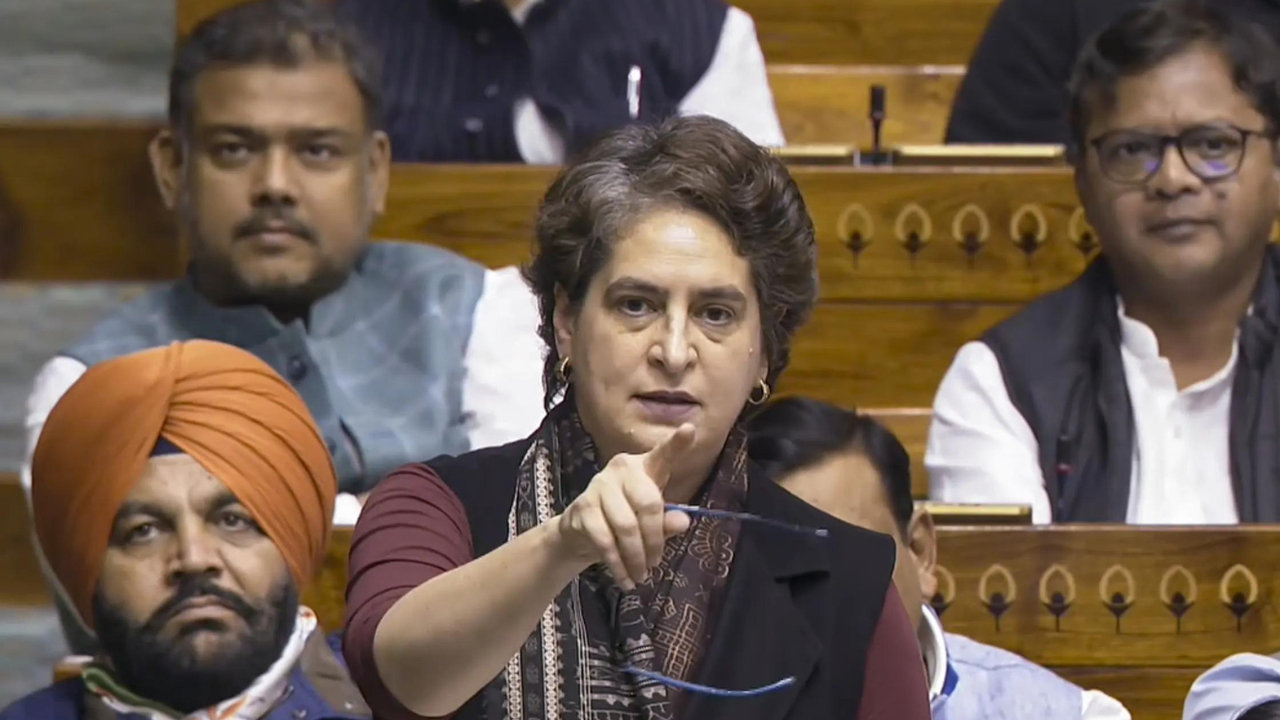
Priyanka Gandhi Challenges PM Modi in Lok Sabha, Defends Nehru’s Legacy During Vande Mataram Debate

Congress MP Priyanka Gandhi Vadra delivered a sharp rebuttal to Prime Minister Narendra Modi in the Lok Sabha during a debate marking 150 years of the national song, Vande Mataram. She accused the Prime Minister of presenting “selective history” and overlooking critical facts related to India’s freedom movement and the national song’s evolution.
Speaking during the discussion, Priyanka Gandhi said the period Jawaharlal Nehru spent in prison during the independence struggle is nearly equal to the number of years PM Modi has served as Prime Minister. “Pandit Jawaharlal Nehru lived for this country and died serving the country,” she said, receiving strong support from Opposition benches.
Priyanka Gandhi Defends Nehru’s Contributions
The Congress leader highlighted that Nehru spent over 3,200 days (nearly nine years) in jail during the freedom movement and served as India’s Prime Minister for 17 years. She argued that many institutions vital to modern India—including ISRO, DRDO, IITs, IIMs and AIIMS—were established during Nehru’s leadership.
“You criticise Nehru repeatedly,” she said, addressing PM Modi. “But without ISRO, there would be no Mangalyaan; without DRDO, there would be no Tejas; without IITs and IIMs, India would not be leading in technology today.”
Calls to ‘Close the Chapter’ on Nehru Attacks
Priyanka Gandhi urged the Prime Minister to stop repeatedly invoking Nehru to criticise past governments. She suggested preparing a complete list of accusations so the matter can be debated “once and for all,” allowing Parliament to focus on issues such as unemployment and price rise.
Questions on PM Modi’s ‘Selective’ History of Vande Mataram
She challenged the Prime Minister’s recent remarks on Vande Mataram, accusing him of omitting historical facts. Priyanka Gandhi pointed out that Rabindranath Tagore first sang Vande Mataram in 1896 at a Congress session—not at an event of the Hindu Mahasabha or RSS.
Recounting the song’s origins, she said:
1875: Bankim Chandra Chattopadhyay wrote the first two stanzas.
1882: Anandamath was published with additional verses.
1905: The song became a symbol of unity during the anti-partition movement in Bengal.
Priyanka Gandhi emphasised that British officials “dreaded” the song because of its strong revolutionary energy.
On Bose–Nehru Letters and Tagore’s Intervention
She said the Prime Minister selectively quoted correspondence between Subhas Chandra Bose and Jawaharlal Nehru. She read Nehru’s full response, stating that the new objections to the song were “manufactured by communalists” and should not influence national decisions.
She added that after Rabindranath Tagore’s discussions with Nehru, Tagore supported using only the first two stanzas of the song because the later verses could be “misconstrued as communal.”
On October 28, 1937, the Congress Working Committee, which included Mahatma Gandhi, Nehru, Sardar Patel and Tagore, declared the first two stanzas as the national song.
Priyanka Gandhi also noted that during the 1950 Constituent Assembly, leaders such as Dr B.R. Ambedkar and Shyama Prasad Mukherjee raised no objections to the chosen form of Vande Mataram.
“Anti-Constitutional Mindset” Allegation
She criticised the government for questioning the decision taken by the freedom struggle’s most respected leaders. “By alleging that Vande Mataram was fragmented by an anti-national ideology, you are insulting the entire Constituent Assembly,” she said.
PM Modi’s Counterpoint
Earlier in the day, PM Modi had accused the Congress of “fragmenting” Vande Mataram under pressure from the Muslim League. He cited a 1937 exchange between Nehru and Bose, arguing that Congress had compromised on the song’s legacy.
Modi described the Congress’ decision on October 26 that year as “a betrayal,” saying the party “bowed to communal forces.”

Comments are closed.