
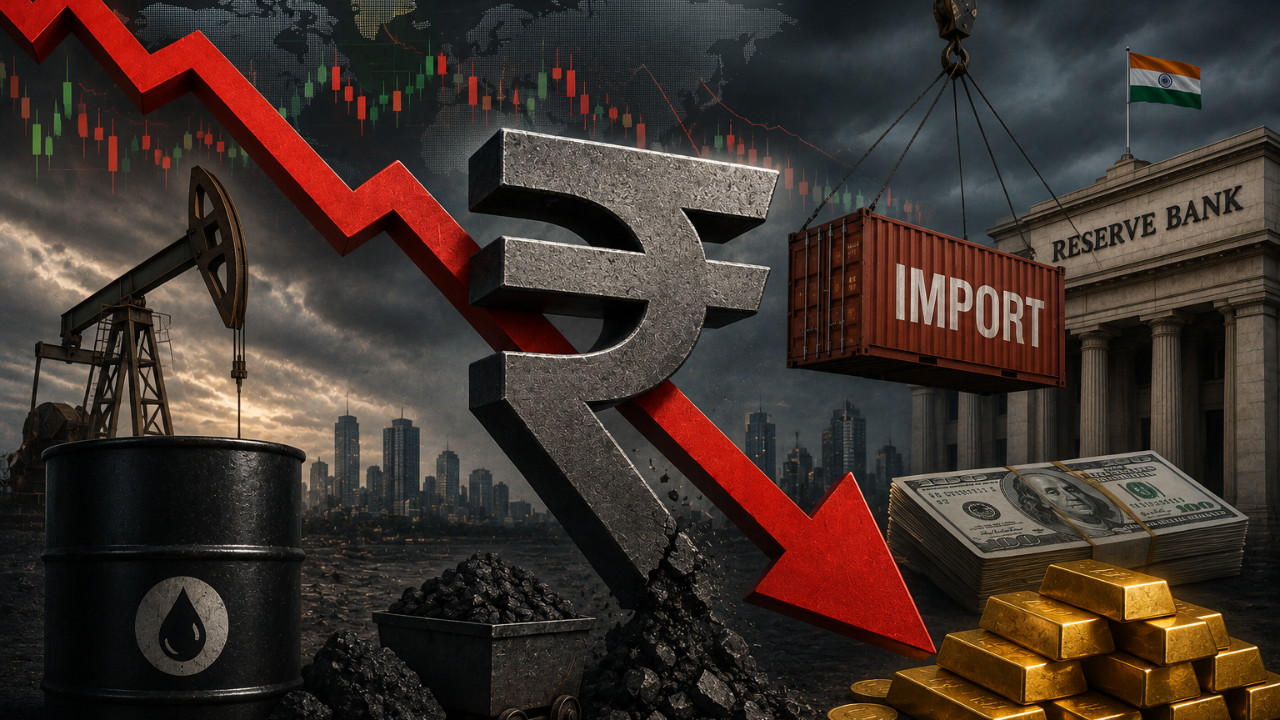
Rupee Falling : Saving Petro or buying less Gold will not stop Rupee Falling; So where exactly is it playing?

Rupee Falling : To prevent rupee depreciation and market volatility, import restrictions, saving petrol, reducing gold purchases and traveling domestically rather than abroad are frequently heard. On the surface, this advice sounds right to you. But the bottom line is that these problems completely ignore the root cause. So what is the real reason?
Rupee vs US Dollar : RBI’s luck shines in trying to save the rupee, Rs 50000 crore has come into the treasury after selling 53 billion dollars
The important point is that the rupee is not weakening just because Indians are spending excessively. In fact, we are wrongly looking at a problem related to capital markets as a ‘trade-related problem’; In reality, however, the real problem lies in the dynamics of capital flows and inherent weaknesses in our economic structure, and these factors are affecting the economy as a whole.
Indices and current status of rupee
This year, the Nifty 50 index has fallen by around 11% making it the weakest performer among the world’s major indices. In contrast, South Korea’s ‘KOSPI’ index rose by nearly 50%, Taiwan’s ‘TAIEX’ by 48% and Japan’s ‘Nikkei’ by 18%. A dollar was valued at ₹89.86 at the beginning of the year, which has now hovered around ₹96. This means that the rupee has depreciated by 6.5% in the last five months. Despite the RBI’s intervention, the rupee’s decline has not stopped; Moreover, withdrawal of funds from the market by foreign portfolio investors continues. Hence the rupee is depreciating.
Where exactly is the real problem?
India’s problem is not lack of demand or savings, but misallocation of capital. Opportunities exist in areas such as artificial intelligence (AI), manufacturing, defense and renewable energy; Yet, there is a lack of investment in these sectors. Foreign investors do not find India as a market where they can easily invest, expand their business. Although they seem willing to take business risks, they want to avoid the uncertainty of policy changes. Due to frequent changes in regulations and difficulties associated with repatriation of capital, they prefer markets like Singapore and Dubai.
Tiger Global case
Recently, US-based leading investment firm ‘Tiger Global’ sold its $1.6 billion stake in e-commerce company ‘Flipkart’. He had to pay a huge amount of tax i.e. ₹14,500 crore on this transaction. The Supreme Court ruled that the company is liable to pay tax on profits earned in India. Moreover, the court held that the ‘General Anti-Tax Evasion Rules’ (GAAR) are applicable to investments made before 2017.
A negative signal for investors
While the verdict is legally correct, it has sent a negative signal to the investor community. The Flipkart-Walmart transaction definitely proved the potential for return on investment in India; But this has also created a perception that the regulatory norms in the country are unstable and their interpretation is subject to frequent changes. A large portion of foreign investment is invested in ‘liquid’ and ‘index-linked’ funds, which can be traded very quickly.
Post Office’s ‘This’ scheme will provide maximum, risk-free guaranteed income of Rs 10000 per month

Comments are closed.