
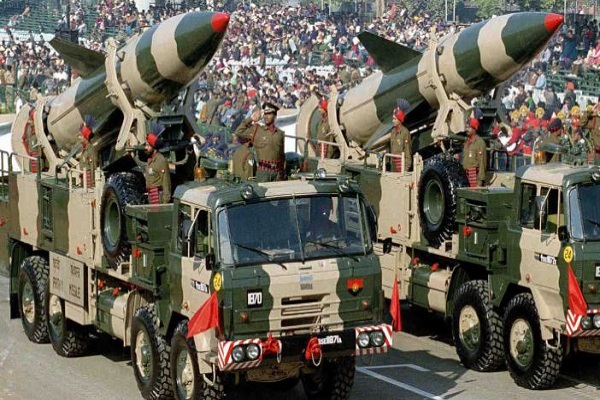
SIPRI report revealed: Important change in India’s policy on nuclear weapons, 12 nuclear warheads deployed for the first time

New Delhi, June 9. If we believe the recent report of Stockholm International Peace Research Institute (SIPRI), for the first time, India has placed 12 nuclear warheads in the category of ‘deployed’, which is an important change in its nuclear strategy. This report is a departure from New Delhi’s old tradition, under which nuclear warheads were kept separate from their delivery systems.
Earlier nuclear warheads were kept separate from their delivery system.
SIPRI says that India’s nuclear weapons stockpile is now considered to be operationally deployed rather than merely stored. The move means launch-ready weapons have been deployed in underground missile silos and new nuclear-powered submarines, indicating a higher level of operational readiness. The report also said that this is the first known case of India integrating nuclear warheads with delivery systems or deploying them at a base with active operational forces.
2025 India was the fifth largest military spender in the world in
According to this SIPRI report, India will be the fifth largest military spender in the world in 2025, allocating US $ 92.1 billion for defence. The report also mentions an ‘unusually serious military crisis’ between India and Pakistan in May 2025.
As of January 26, India had 190 nuclear weapons compared to Pakistan’s 170.
The institute estimates that by January 2026, India had about 190 nuclear weapons while Pakistan had 170. The organization said that last year India slightly increased its nuclear weapons stockpile and continued to develop advanced delivery systems. At the same time, India also emphasized long-range capabilities capable of hitting targets as far away as China while maintaining a focus on Pakistan.
Major countries are becoming more dependent on nuclear weapons as a means of national power.
SIPRI said, ‘The main point of SIPRI Yearbook 2026 is that countries are becoming more dependent on nuclear weapons as a means of national power. “This is reversing decades of efforts to reduce the number and role of nuclear weapons, while also increasing the risk of miscalculation and escalating tensions.”
Pakistan is busy improving its delivery system
The report said that Pakistan is continuing to improve its delivery system and accumulate stockpile of fissile material, which may expand its nuclear weapons stockpile in the future. It also noted that during the brief conflict in May 2025, India attacked Pakistan’s air and missile bases that were believed to be linked to nuclear activities. However, both countries took steps to prevent further escalation of tension.
9 nuclear-capable countries had approximately 12,187 had nuclear weapons
Nine nuclear-capable countries had a combined total of about 12,187 nuclear weapons at the beginning of 2026. SIPRI also reported that worldwide military spending increased for the 11th consecutive year and will reach a record US$2.9 trillion in 2025. At the same time, India and Pakistan were among the world’s top arms importers and also included cyber operations in the conflict for the first time.

Comments are closed.