
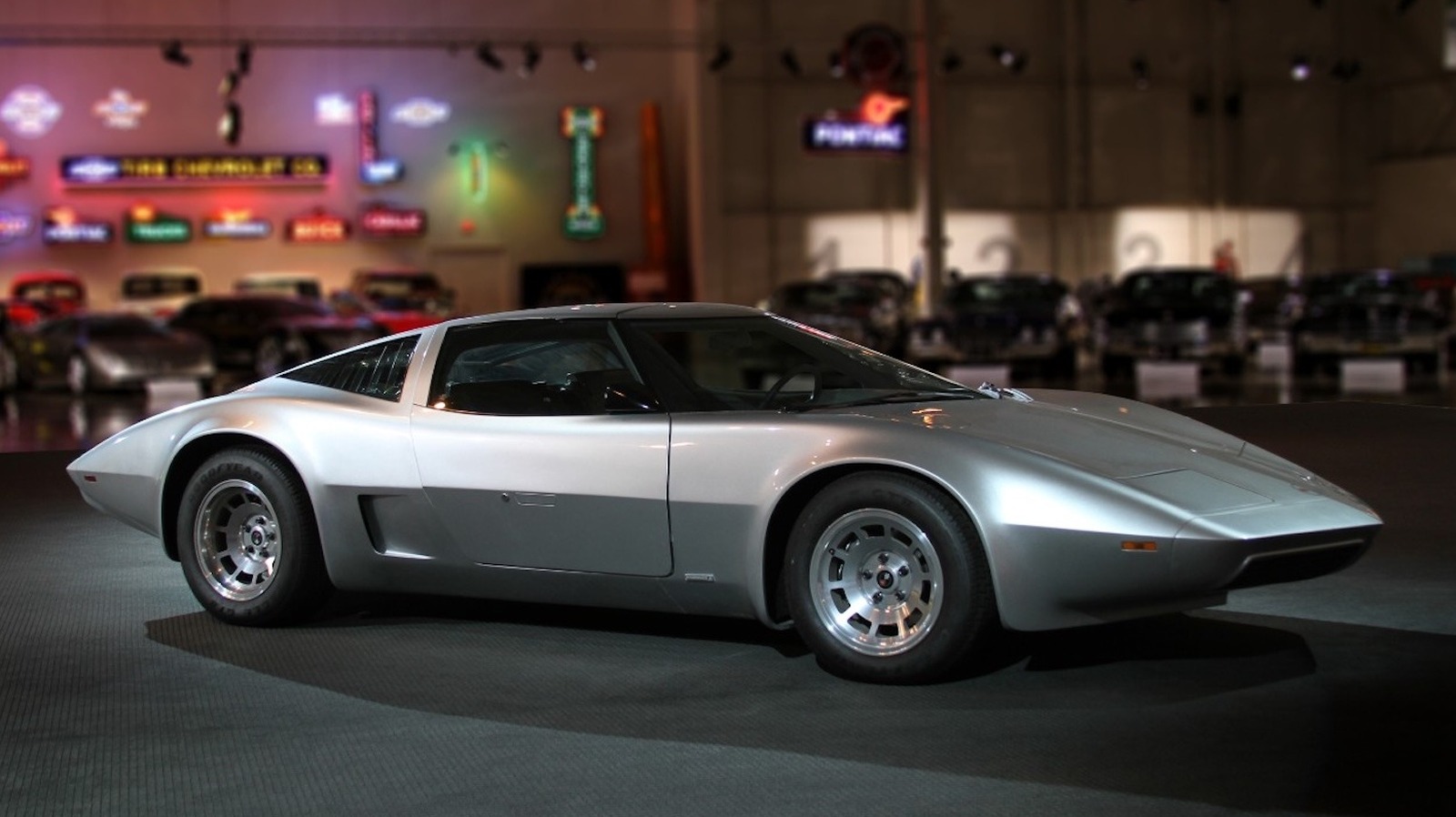

The reason why Corvettes, which have had some very powerful engines, switched from front-engined to mid-engined behind the driver dates back to the distant past. It was less than 10 years since the original 1953 Corvette had debuted. Zora Arkus-Duntov, the Corvette’s creator, had been advocating for a mid-engine Corvette since the 1950s, producing the CERV I, or Chevrolet Engineering Research Vehicle #1, in 1962, followed by the CERV II in 1964. These were fully functional vehicles with advanced technology built in, and they looked amazing. These early vehicles, and those that followed, showed how the mid-engined layout provided better traction, improved acceleration, and more balanced handling.
It took until 1970 for the first mid-engined Corvette concept car to be revealed to the public at that year’s New York Auto Show. Unfortunately, the incoming tsunami of fuel crises and emissions regulations was about to swamp the performance bandwagon in general, and the mid-engined Corvette in particular. Duntov left GM in 1975, frustrated with the lack of progress on a mid-engine Corvette.
During this period, the Aerovette concept debuted in 1973 as a showcase for GM’s four-rotor Wankel engine and later received small-block Chevy V8 power. The mid-engined Corvette was approved for production as the C4 Corvette, but Duntov’s replacement decided to remain with the front-engined layout. A major concern was the risk of putting off traditional Corvette buyers with a radical layout change. The switch would have to wait.
When did Corvettes switch from front-engine to mid-engine?
That wait lasted all the way until model year 2020 and seven generations of front-engined Corvettes. The Corvette C8 was designed for a new cohort of younger Corvette buyers who were very familiar with European mid-engined supercars and would embrace such an approach in a new Corvette. There were also performance benefits to be harvested from the switch to a mid-mounted engine, which the Corvette development team has achieved with the C8.
That first 2020 Corvette C8 model was the Stingray, powered by a 6.2-liter LT2 V-8 that produced 495 horsepower with the performance exhaust option. Corvette then upped the ante in 2023 with the Corvette Z06, which our review stated had one of the best-sounding engines, a naturally aspirated 5.5-liter V8 with a flat-plane crank and an 8600 RPM redline. The next C8 model came along in 2024: the Corvette E-Ray, which combined the Stingray’s engine with an electric motor powering the front wheels, making it the first all-wheel-drive Corvette. It produced a combined 655 horsepower and could do the 0-60 mph run in a Chevy-estimated 2.5 seconds flat.
For 2025, Chevrolet rolled out the Corvette ZR1, which took the Z06’s flat-plane crank V8 and added two turbochargers to make a spectacular 1,064 horsepower monster. The Corvette ZR1 can claim to be the highest-powered Corvette ever made for the street (so far), with a Car and Driver-tested 0-60 time of 2.2 seconds, their fastest-ever time for a rear-drive vehicle.
What is the future outlook for the mid-engine Corvette?
Chevrolet has teased some intriguing upcoming and future mid-engine Corvettes. Starting with what is definitely coming along on the current C8 platform, the 2026 Corvette ZR1X has been announced by Chevrolet and was revealed during Monterey Car Week in August 2025. The Corvette ZR1X combines the ZR1’s twin-turbo V8 with an upgraded, more powerful version of the E-Ray’s electric-powered front motor. Total horsepower amounts to 1,250, with all four wheels driving it forward. Chevrolet estimates the ZR1X will do 0-60 mph in under 2 seconds, with a quarter-mile time under 9 seconds and a trap speed of 150 mph. Top speed will be 233 mph in standard trim, the same as that of the ‘plain’ ZR1. The ZR1X has a starting MSRP of $207,395 compared to the lower-performing Ferrari F80 at $3.7 million and McLaren W1 at $2.1 million.
From the realm of the real to that of the conceptual, there is the Corvette CX, which, in Chevrolet’s words, provides “a glimpse of the high-performance future” and will serve as inspiration to inform Corvette design language for years to come.” The Corvette CX concept, with its rear wing raised, features many imaginative design details like its jet cockpit-inspired, forward-opening canopy. It is powered by four electric motors, one at each wheel, that produce over 2,000 horsepower in total, with a 90 kWh lithium-ion battery providing the energy. Both the CX and its racing version, the Corvette CX.R Vision Gran Turismo, will appear in the Gran Turismo 7 video game.

Comments are closed.