

Their wedding took place in 1996 at a modest home in Ngoc Ly Commune in Bac Giang Province’s Tan Yen District.
Though her younger brother, who owned a bridal shop, had made a wedding dress for her, she chose not to wear it and opted instead for simple clothes with light makeup. “The children’s mother had passed away not long before, and I didn’t want their relatives to feel hurt,” Hang, now 60, says.
After lighting incense at her husband’s family altar and before the portrait of his late wife, she had prayed silently: “Please watch over me and give me the strength to raise your children. And please don’t scare me. I’d be so frightened I might run back home.”
That half-joking prayer marked the beginning of a 30-year journey as a stepmother, filled with challenges, sacrifices and love.
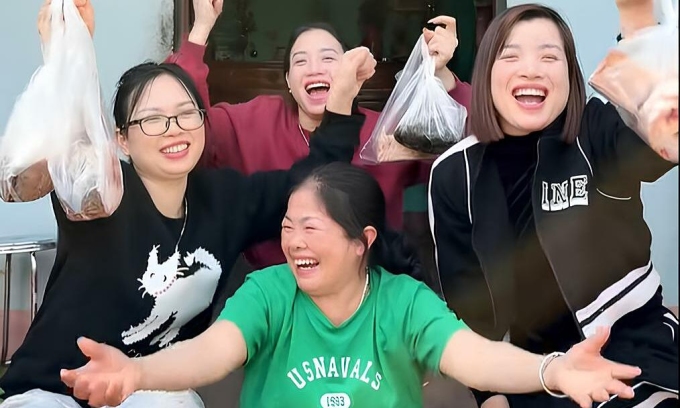
Hang (in blue) with three of her husband’s four daughters in early 2026. Photo taken from a video |
Earlier, the kindergarten teacher had rejected the marriage proposal by a matchmaker, considering herself past marriage age but also intimidated by the prospect of helping raise four young daughters. “When I heard he had several young children, I was frightened and immediately refused,” she recalls.
But Bieu remained determined and would frequently cycle 15 kilometers to visit her family. Eventually, when Bieu’s mother-in-law and brother-in-law personally approached her, Hang agreed to visit their home.
She was greeted by four girls, the three being 12, seven, and five. Duong Bac Giang was the infant and still in her sister’s arms. Hearing that a “new mother” might soon join their family, the children gathered around Hang with curious eyes and a longing for affection. “When I saw the children and their gentle father, I agreed,” she says.
After marrying Bieu, Hang began working at 4 a.m. in the fields before heading to her job as a kindergarten teacher.
At lunchtime, she would rush home to cook and care for the family. At the time, rural preschool teachers were paid partly in rice, and her annual salary amounted to about 400 kilograms of the grain. The family survived on a small plot of farmland and her modest income.
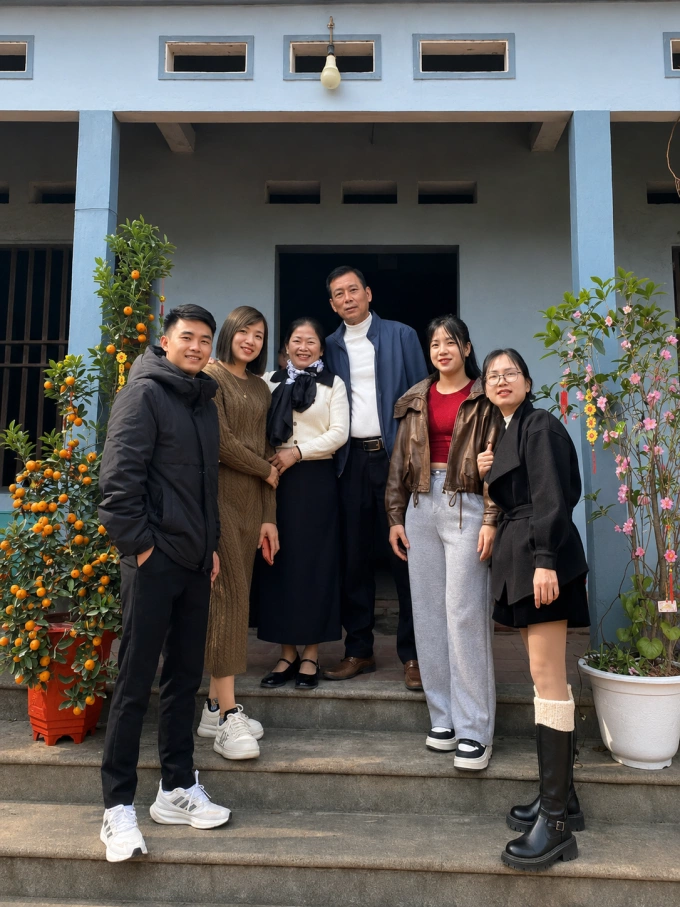 |
Hang (in white) and her husband with their children during Tet 2026. Photo courtesy of the family |
Three years later, she and Bieu welcomed a child of their own, adding further financial strain. But economic hardship was not her greatest challenge; more difficult were the emotional wounds carried by the children and the belief that a stepmother could never love another woman’s children as her own.
From the beginning, Hang told the girls: “People will always have something to say. But if you have accepted me as your mother, then we must trust and listen to one another.”
As the girls entered adolescence, disagreements were inevitable. On one occasion, the eldest daughter was scolded for a mistake and, upset, ran to her late mother’s altar to cry. Deeply hurt, Hang mounted her bicycle and headed back to her parents’ house. But when she looked back and saw her husband chasing after her with their young child, she turned around and returned home.
Instead of asserting authority, she chose to become a friend to the girls. She even encouraged them to seek advice from their grandmother and aunts if they felt her guidance was unfair.
At home, she made sure gifts and new clothes were distributed equally among all five daughters. Her fairness gradually erased any sense of division. The girls slowly came to regard her as their own mother.
“Sometimes I would cycle to my parents’ house after an argument, and when I came back, the children would already be waiting for me at the gate,” she says.
As they grew older, the daughters began confiding in her about their relationships and personal lives. The youngest daughter, Giang, told her she did not learn that Hang was not her biological mother until she was seven years old.
She recalls now: “When I was little, I was stubborn. Whenever I got upset, I would say I wanted a different mother. She [Hang] would just smile and comfort me.”
For each of their four daughters’ weddings, Hang and Bieu carefully prepared the dowry and wedding gifts. Everytime, the stepmother would be the first to cry out of sheer love for the daughters she had raised.
Today, Hang is a grandmother nine times over. Whenever one of her daughters gives birth, she brings her home and cares for both mother and baby for the first month.
For Hang, the greatest joy of her later years is seeing all four daughters build stable careers and happy families.
Bieu often tells his children to cherish the woman who stood by him through the most difficult years of his life. In fact, his daughters are now even closer to their mother than to him. Before visiting their parents, they often call first to ask: “Mom, are you home today? Can I come by?”
Ten years ago, the youngest daughter, Giang, married a man who had previously been married and was raising a child from that relationship. When entering family life as a stepmother, she had said she drew inspiration from the way Hang had raised her and her sisters. “She gave me a mother, and she gave me the strength to become one.”
Comments are closed.