
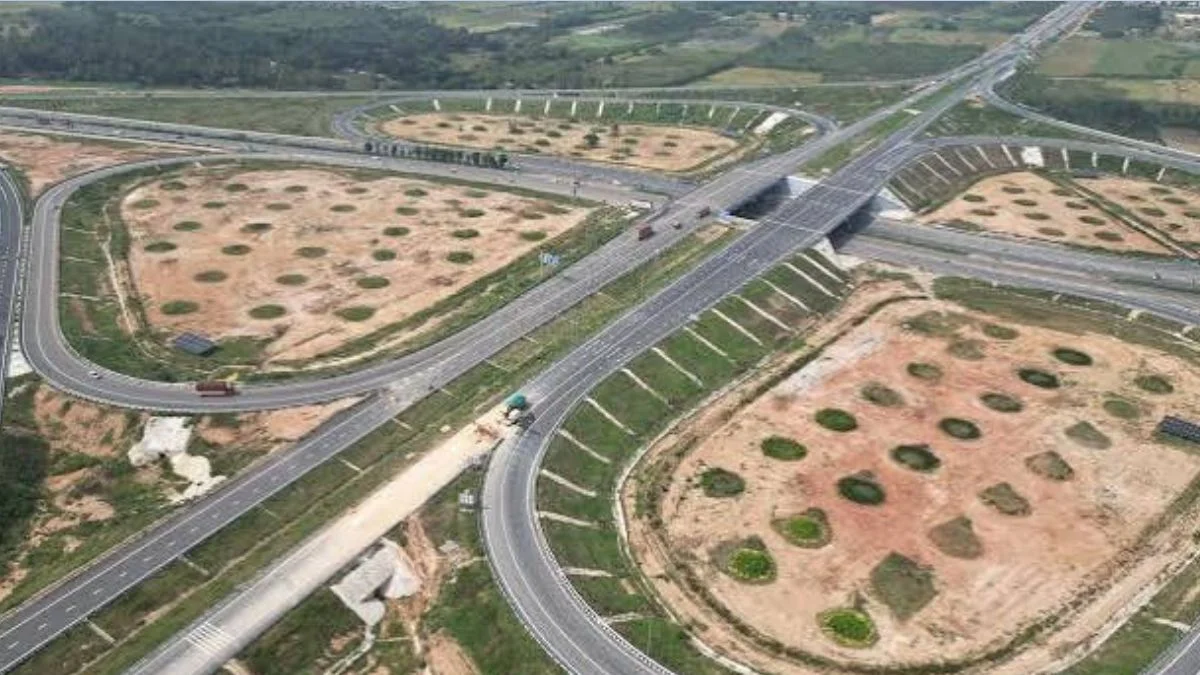
₹18,000 crore Chennai-Bengaluru expressway nears completion, promises faster travel and economic boost

The 258-km Chennai-Bengaluru Expressway (NE-7)one of India’s largest greenfield highway projects under the Bharatmala Pariyojanais nearing completion and is expected to become fully operational by July 2026significantly reducing travel time between the two metropolitan cities.
Constructed by the National Highways Authority of India (NHAI) at an estimated cost of ₹18,000 crorethe four-lane, access-controlled expressway connects Hoskote in Karnataka with Sriperumbudur in Tamil Nadupassing through Andhra Pradesh. Designed for speeds of up to 120 km/hthe corridor is expected to reduce the journey between Chennai and Bengaluru from the current 5–6 hours to approximately 2 hours and 15 minuteswhile shortening the travel distance by nearly 80 kilometres.
The expressway passes through Hoskote, Malur, Bangarapet, Kolar Gold Fields, V Kota, Palamaner, Chittoor, Gudiyatham, Arakkonamand Sriperumbudurimproving road connectivity across the three southern states.
The project is being developed in three phases across 10 construction packages. The 71-km Karnataka section has already been opened to traffic, while construction in Andhra Pradesh and Tamil Nadu is in its final stages, with several stretches reporting over 90 per cent progress. However, one construction package in Tamil Nadu remains delayed due to financial issues faced by the contractor.
The expressway will feature modern infrastructure, including grade-separated interchanges, flyovers, underpasses, rail overbridges, truck lay-bys, parking baysand advanced traffic management systems aimed at improving road safety and traffic efficiency.
According to project details, four toll plazas have been planned in Karnataka at Hedigenabele, Agrahara, Krishnarajapuraand Sundarapalya. Toll charges for cars and jeeps are expected to range between ₹185 and ₹190 for a one-way journey and ₹275 to ₹280 for same-day return travel. Heavy commercial vehicles will pay tolls of up to ₹635 for a one-way trip.
The project experienced delays due to land acquisition challenges, environmental clearances, railway approvals, utility relocation, rock-cutting workand unseasonal rainfall. Despite these hurdles, officials expect the expressway to strengthen the Chennai-Bengaluru Industrial Corridorimprove freight transportation, accelerate manufacturing activities and generate employment across Karnataka, Andhra Pradesh and Tamil Nadu.
Improved connectivity is also expected to drive residential and commercial development in key locations such as Hoskote, Devanahalli and Sriperumbudurwhile enhancing logistics efficiency and regional economic growth. The government also plans to eventually extend the corridor towards Mangalurufurther expanding southern India’s transport network.

Comments are closed.