
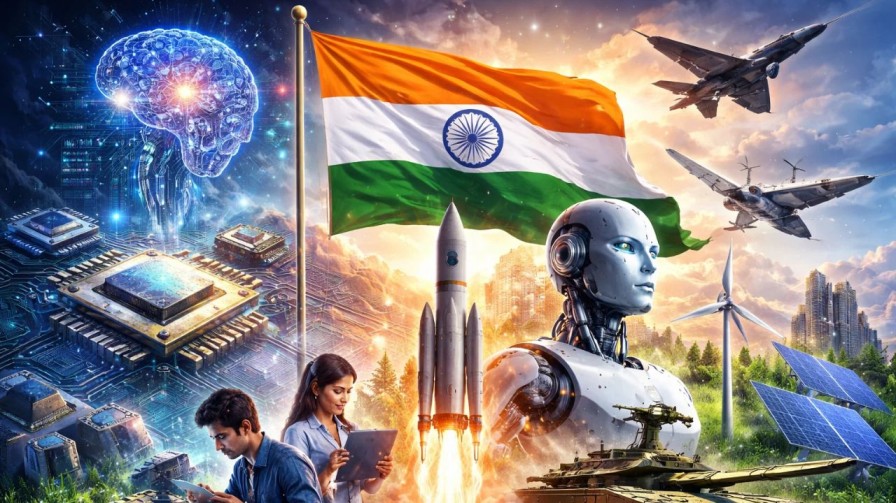

It has been a decade i.e. 10 years since Startup India Mission was started in the country. The Central Government has now responded in Parliament regarding this mission, which was started with the aim of developing business mentality among the youth of the country, making new products in the country, making people self-reliant and strengthening the economy. In this reply, the Central Government has given details as to how effective this Startup India Mission was in 10 years. On a question by Samajwadi Party MP Mohibullah Nadvi, the Central Government has told in the Parliament that more than 21.9 lakh people have got work in 10 years.
In this scheme, which was started in the year 2016, small startups get money in the form of seed fund or loan, get tax exemption, ease in patent registration and also get subsidy on electricity, land etc. Overall, an effort is being made to create such an environment that if any businessman wants to start a new business, he can get money and government work can also be done easily.
What question was asked?
Mohibullah Nadvi had asked in Parliament on February 10 whether the government had reviewed the results of the Startup India program in the last decade? He had also asked what work was done by this scheme in the fields of semiconductor, AI, battery, defence, space and quantum computing?
Also read: Need or compulsion, why is India putting so much emphasis on manufacturing?
A written reply to this has been given by Jitin Prasad, Minister of State, Commerce and Industry Ministry. The reply reads, ‘This mission was started on January 16, 2016 with the objective of creating a startup ecosystem in the country and promoting investment as well as innovation.’
What happened in 10 years?
According to the data till December 31, 2025, there were a total of 2,07,135 units which were recognized as startups. These units directly created 21.9 lakh jobs. Of these, 14,400 startups are related to AI, defence, technology hardware (semiconductor is included in this) etc. and 1.25 lakh jobs were created in them.
These startups were given funding through three major schemes. These schemes are – Fund of Funds for Startups (FFS), Startup India Seed Fund Scheme (SISFS) and Credit Guarantee Scheme for Startups (CGSS).
Also read: No change in repo rate, relief on loan, EMI, what relief will you get from RBI’s announcement?
SEBI registered Alternative Investment Funds (AIFs) are funded by Small Industries Development Bank of India (SIDBI). These AIFs give money to these startups. According to the reply given in Parliament, these AIFs in the tech, AI and robotics sectors have funded a total of Rs 916.49 crore in 48 startups.
Under the SISFS scheme, funding is given to those startups which are in the initial stage. Under this scheme, which started from April 1, 2021, a total of 406 startups have been selected till December 31, 2025 and they have been given seed money of Rs 73.4 crore.
CGSS scheme has been started from April 1, 2023 and under this, loans are given to companies. A total of 14 companies in the aerospace and defense sector have been given loans of Rs 68.30 crore under this scheme till December 31.
Apart from these, startups are also being helped through National Quantum Mission, India AI Mission and Design Linked Incentive (DLI). To advance the companies in the semiconductor sector, up to 50 percent of the cost is being reimbursed. For this, a maximum of Rs 15 crore is given per application. A total of 24 projects have been provided assistance under DLI.

Comments are closed.