
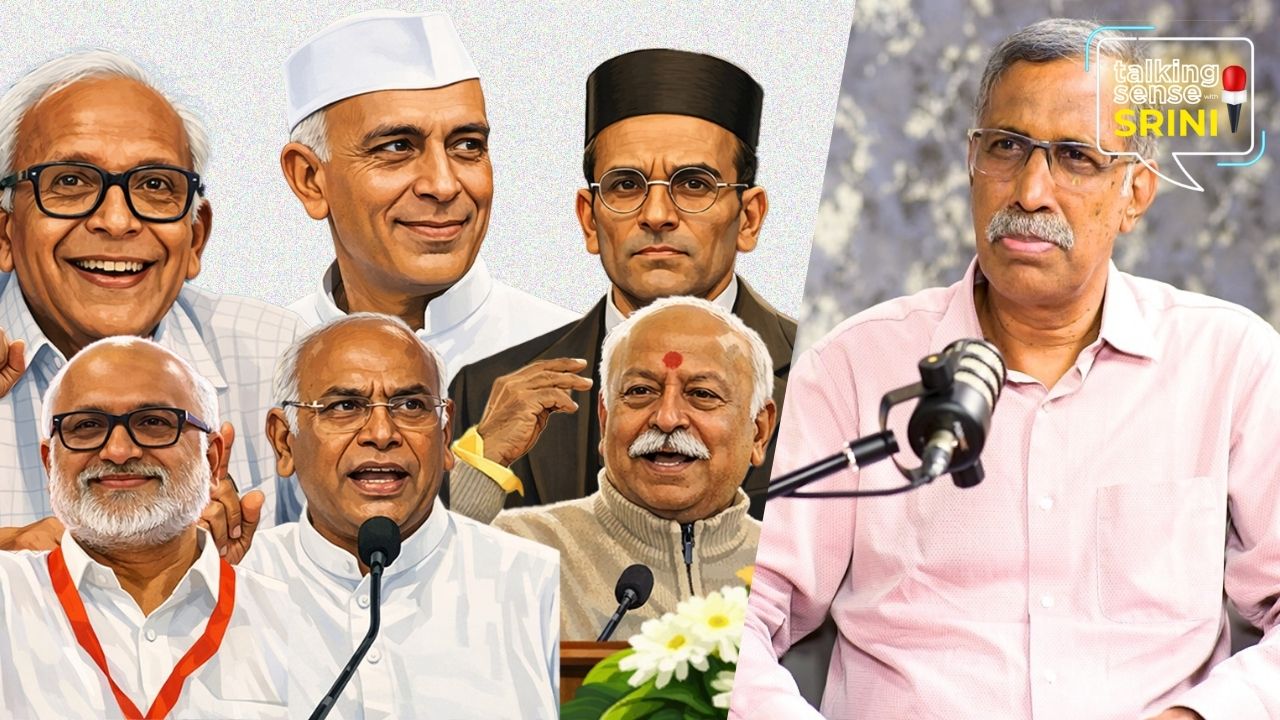

As India approaches its 77th Republic Day this month, an unusual historical convergence is taking shape. Three ideological currents that have defined the country’s political journey, the communist Left, the Hindu nationalist Right and the centrist Congress tradition are all marking roughly a century of existence.
Also read: Amit Shah’s ‘Chanakya Neeti’ struggling in Tamil Nadu? | Talking Sense With Srini
The moment offers a rare opportunity to assess how these competing worldviews shaped the Republic, why some waned while others surged, and what the balance of power suggests for India’s political future.
That was the thrust of a discussion led by S Srinivasan, Editor-in-Chief of The Federalon Talking Sense with Srinirecorded at Madras Christian College to mark the show’s 50th episode. Srinivasan traced the ideological arc of Indian politics from Independence to the present moment, when the Right appears firmly ascendant under Prime Minister Narendra Modi.
Why India chose the Centre
India’s early post-Independence choice of a centrist path was neither accidental nor inevitable, Srinivasan argued. It was the outcome of Mahatma Gandhi’s political dominance and the Congress party’s unmatched ability to mobilise mass support across regions, castes and religions.
“The Left and the Right were both active before 1947,” Srinivasan noted, “but it was Gandhi who emerged as a towering figure over all of them.”
Also read: Why unrest in Bangladesh matters to India | Talking Sense With Srini
While communist groups focused largely on class-based struggles such as land reforms and peasant mobilisation, and Hindu nationalist forces articulated a civilisational vision of India, the Congress, under Gandhi’s leadership, occupied a broad middle ground.
Gandhi’s politics, Srinivasan said, were neither doctrinaire nor exclusionary. His idea of secularism was not the Western separation of church and state, but a more inclusive framework aimed at managing India’s deep social complexity. “India is a very complex nation — religion, region, caste, language,” he said. “Gandhi understood this and worked as a binding force.”
That approach translated into electoral dominance after Independence. Jawaharlal Nehru, whom Gandhi chose as India’s first prime minister, carried forward this centrist vision, blending political democracy with state-led economic planning and social reform.
The rise and fall of the Left
Contrary to its present marginal status, the Indian Left once posed a serious challenge to the Congress. In the first general elections of 1951–52, communist parties emerged as the second-largest bloc in Parliament. Their strength lay in grassroots movements around land redistribution, labour rights and social justice.
Also read: Why 2026 could be a testing year for India | Talking Sense With Srini
Yet the Left’s decline, Srinivasan argued, stemmed from its inability to adapt to Indian realities. “Their approach was very doctrinaire,” he said. “They stuck doggedly to Marxist philosophy and did not reinvent themselves for Indian conditions.”
One critical failure was the Left’s reluctance to engage with caste, focusing almost exclusively on class. “In India, caste is a political reality,” Srinivasan said. “You cannot wish it away in electoral politics.”
Organisational rigidity compounded the problem. Decision-making remained centralised within powerful politburos, limiting regional flexibility. Prolonged rule in states such as West Bengal also bred stagnation, marked by grassroots violence and a failure to renew leadership or policy.
Also read: Why Centre’s G RAM G spells trouble for states | Talking Sense With Srini
Factionalism further weakened the movement. Splits between the CPI, CPI(M), and later factions eroded coherence. “Even at 100 years, they have not come together,” Srinivasan observed, contrasting the Left’s fragmentation with the organisational unity of the Right.
How the Right found its moment
The ideological Right, anchored by the Rashtriya Swayamsevak Sangh (RSS), took a different route to power. For decades after Independence, the RSS focused on social organisation and character-building rather than electoral politics. The assassination of Gandhi and the subsequent ban on the organisation forced it into political dormancy.
The turning point, Srinivasan argued, came much later — beginning in the late 1970s and early 1980s. Events such as the Emergency, mass religious conversions at Meenakshipuram in Tamil Nadu, political turmoil in Jammu and Kashmir, and later the Shah Bano case created a sense among Hindu nationalist groups that secular politics had failed to address majority’s concerns.
Also read: Why IndiGo is just the tip of India’s monopoly iceberg | Talking Sense With Srini
The Ram Janmabhoomi movement of the late 1980s and early 1990s provided a mass mobilisation platform. But Srinivasan cautioned against reducing the Right’s rise to a single event. “It was an accumulation of moments,” he said, “combined with the failures of the Congress and the vacuum left by the Left.”
Since 2014, the BJP under Modi has consolidated this ideological momentum into what Srinivasan described as a “regime change.” Nationalism, cultural identity and strong leadership have become the defining features of governance.
The hollowing of the Centre
If the Right’s rise reflects organisational strength, Srinivasan said, it also exposes the Congress party’s long-term decline. Once a mass movement rooted in grassroots networks such as the Seva Dal, the party gradually became leader-centric and disconnected from everyday political mobilisation.
“The Congress has become a party of leaders, not workers,” Srinivasan said. Corruption scandals during the United Progressive Alliance years, dynastic politics, and an inability to adapt to post-liberalisation aspirations further eroded its credibility.
Also read: Nitish 10.0: Chief minister or compromise minister? | Talking Sense With Srini
Yet Srinivasan rejected the idea that centrism itself is obsolete. Despite the BJP’s dominance, he noted that roughly 40–45 per cent of voters still back it, leaving significant space for alternatives. “The problem is not the absence of issues,” he said. “It is the inability to mobilise.”
In a polarised environment, centrism struggles because nuance is harder to communicate. “A centrist position is layered,” Srinivasan said. “It requires patience and understanding, while extreme positions offer quick, decisive answers.”
What lies ahead
Looking forward, Srinivasan argued that ideological boundaries are getting increasingly blurred. Globalisation has forced governments, even right-wing ones, to adopt welfare policies once associated with socialism. At the same time, post-ideological formations such as the Aam Aadmi Party complicate traditional classifications.
Also read: Will Rahul Gandhi ditch DMK for Vijay? | Talking Sense With Srini
Still, the Right remains dominant for now, aided by organisational discipline and the opposition’s disarray. “The strength of the Right also starkly represents the failure of the opposition to get its act together,” Srinivasan said.
As India marks a century of ideological contestation, the more pressing question, Srinivasan suggested, is whether India’s political class can adapt those traditions to a rapidly changing society without hollowing out democratic debate itself.

Comments are closed.