
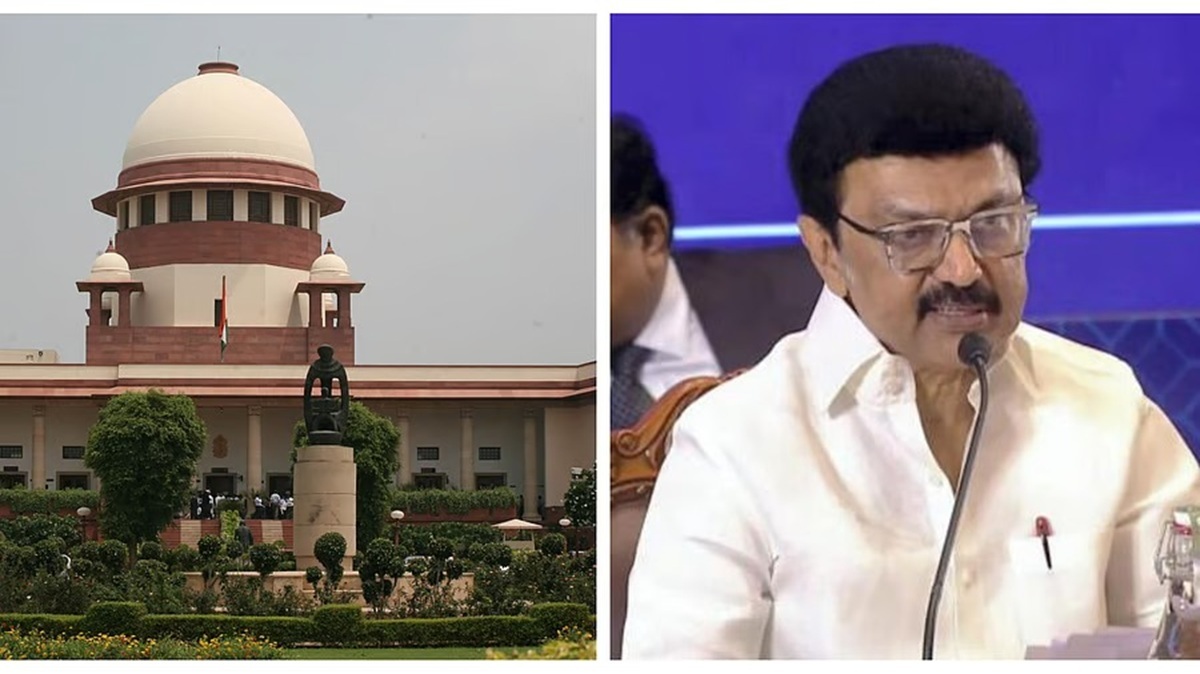

The Supreme Court has taken a tough stand on the long-running controversy over Jawahar Navodaya Vidyalaya (JNV) in Tamil Nadu and reprimanded the DMK government of the state. On Monday, the apex court modified its eight-year-old interim order directing the Tamil Nadu government to identify the land required to set up Navodaya Vidyalayas in each district. This order was given by the bench of Justice BV Nagarathna and Justice R Mahadevan.
During the hearing, Justice Nagarathna made strong remarks on the Tamil Nadu government’s argument that the Centre’s schemes were ‘imposed’. Reminding the state of its constitutional status, he asked, “Are you not a part of this republic?” The judge asked the government to “not make it a language issue and give up the ‘my-state, my-state’ attitude.” The bench stressed, “This is a federal country. Don’t waste this opportunity. This is an opportunity for your students.”
Emphasizing on Centre-State dialogue, Justice Nagarathna said, “There should be a federal discussion. You take one step, they will also take one step. They can even take two steps. Tamil Nadu has got all the prestige after the bifurcation of Andhra Pradesh. It is the largest industrial state in South India. Ahead in everything. Grab this opportunity. Don’t consider it an imposition, this is an opportunity for your students. You can say this is our language policy. They will consider it. They will consider your policy. Please bring your steps and your process to the notice of the Central Government secretaries.”
Senior advocate P. Wilson, appearing for Tamil Nadu, argued that the plan was a “backdoor attempt” by the Center to impose Hindi on Tamil Nadu. On this the court clarified that this process is only preliminary and exploratory. The bench said, “We are only doing an exercise. We are not asking you to lay the foundation stone today itself.”
Justice Nagarathna also indicated that the state can set conditions if it wishes, such as implementing a two-language policy instead of the three-language formula. He said, “If you have any language policy, then let us know and we will amend the scheme accordingly. But do not suppress the opportunity for rural students.”
The bench made it clear in its directions that its approach is in the best interest of the children. Justice Nagarathna said the court’s concern was more about the education of children from poor and rural backgrounds than about Hindi. He asked, “Why this mental barrier? If economically backward students are being given opportunities, then why are you stopping them?”
Wilson argued that under the Navodaya model, the state has to maintain schools for three years and provide 30 acres of land to each district. To this the court retorted, “What is wrong if the Central Government wants to invest in education? Only meritorious students are admitted there. Why do you oppose schools? Education is in the concurrent list. It is raising the standards.”
Wilson said, “I (the state) can build my own schools. Our gross enrollment ratio is the highest. No state will ever be able to match us. They want 30 acres of land in every district. I have to spend money. I have spent Rs 3,548 crore on the Samagra Shiksha Yojana. They still owe us money. This is not the way to behave with the state.”
Despite this, Justice Nagarathna made a strong comment, saying, “If they want to study under the central curriculum, you cannot come in the way. How can you deprive them?” He then asked, “Are you not a part of this republic?” And stressed that “we live in a federal society”, where dialogue between the Center and the state is essential. The bench said, “We have not said anything on the language. There cannot be such a confrontational attitude. It is in the interest of the students.”
The court also noted that 650 Navodaya Vidyalayas have already been approved across the country and only Tamil Nadu opposed it. “We modify the interim stay order passed by this Court on December 11, 2017 and direct the petitioner State to identify the land required for setting up Navodaya Vidyalayas in each district. This exercise be completed within a period of six weeks and the status report thereof be placed before this Court,” the bench said in the order.
With the latest order, the apex court has given a clear indication that the interests of the students should be given priority, rising above political or linguistic conflicts on the question of education. Seeking consultation with representatives of the Union education ministry and the Tamil Nadu government, the court fixed the next hearing of the case after six weeks. The bench also said, “Please do not talk through press or media. Talk face to face. Everyone is giving statements, but there is no conversation between real people.”
Let us tell you that the dispute has been going on since 2017, when the Madurai bench of Madras High Court had directed the state to provide temporary arrangements and land for Navodaya Vidyalayas. The High Court had then held that Navodaya Vidyalayas do not violate the Tamil Nadu Tamil Learning Act, 2006. The Supreme Court also made it clear that Navodaya schools in Tamil-speaking areas adopt Tamil as the primary and instructional language.
Also read:
Bengal SIR draft voter list released, more than 58 lakh names marked for deletion
PM Modi’s visit to Jordan: Many important agreements on energy, water, culture and digital cooperation
Bondi Beach attack: Terrorists who attacked Jews went to Philippines on Indian passport

Comments are closed.