
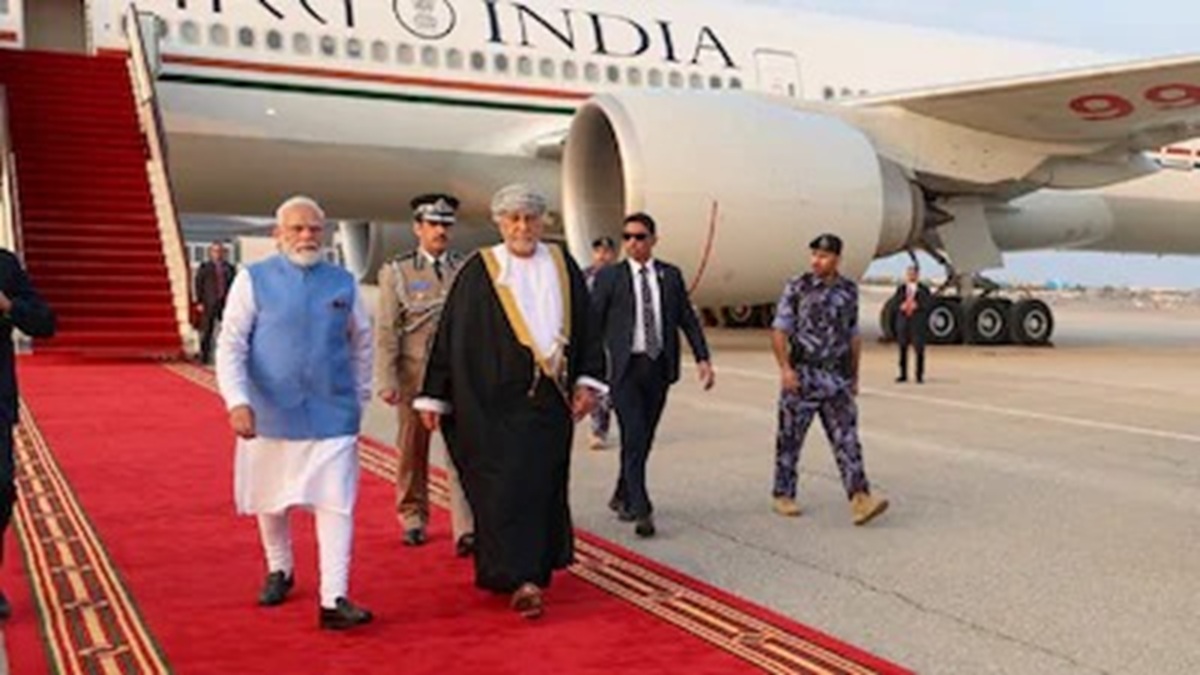
India-Oman CEPA: A sign of strategic strength to India’s economic presence in the Gulf countries

The proposed Comprehensive Economic Partnership Agreement (CEPA) between India and Oman outlines New Delhi’s strategy for a deep and sustainable economic partnership in the Gulf region. This agreement is not just a trade agreement, but is considered an important step towards increasing India’s share in the regional value chain, ensuring the strength of supply chains and forging long-term economic partnerships in the era of global realignment.
This agreement is equally important for Oman. This would be Muscat’s second free trade agreement with a single country and the first such agreement in nearly two decades. This reflects Oman’s strategy to diversify its economy, expand non-oil trade and attract long-term investment, where India emerges as a natural and reliable partner.
The India-Oman CEPA is part of a broader series of trade agreements signed by India in recent years that are delivering tangible benefits to farmers, exporters and manufacturers. CETA with the United Kingdom cuts tariffs on more than 90 percent of goods in 2025, paving the way for expanded bilateral trade.
The agreement with the EFTA bloc (Switzerland, Norway, Iceland and Liechtenstein) in 2024 strengthened market access as well as investment commitments in India. The agreements with Australia and UAE in 2022, and Mauritius in 2021 open up new markets for India and provide access to Africa. All these initiatives show a clear policy direction—diversification rather than dependency, resilience rather than weakness, and shared development rather than transaction.
The same trend is visible in the economic relations between India and Oman. In the last eight years, bilateral trade has increased from $6.70 billion in 2017–18 to $10.61 billion in 2024–25. The momentum continued in the current financial year as well and trade reached $5.45 billion between April and September 2025–26.
Diversity in business structure is also evident. Oman is India’s 28th largest trading partner, while India has become Oman’s fourth largest destination for non-oil imports and third largest destination for non-oil exports. This shift signals a maturing economic relationship beyond hydrocarbons.
India’s exports to Oman include refined petroleum products, aluminum oxide, rice, machinery, boilers, electrical equipment, plastics, iron and steel, ceramics, cosmetics and aircraft components. At the same time, Oman plays an important role in India’s energy and industrial supply chain. Crude oil and LNG are prominent among India’s imports, but also fertilizers, organic chemicals, sulphur, ammonia, iron ore, plastics and aviation components.
Along with trade, investment relations are also strong. More than 6,000 India-Oman joint ventures are active in Oman, through which about $7.5 billion has been invested in the Omani economy. In contrast, FDI equity inflows from Oman to India were recorded at over $605 million between April 2000 and March 2025, reflecting long-term strategic confidence.
The institutional framework has given further depth to this partnership. Oman–India Joint Investment Fund (OIJIF), formed in 2010 with a 50:50 partnership between SBI and Oman Investment Authority, has so far invested $320 million in India. The third tranche of $300 million announced during the visit of Sultan Haitham bin Tariq to India in December 2023 is now being implemented. Similarly, Oman India Fertilizer Company (OMIFCO)—a $969 million joint venture operating since 2006—remains an important pillar of India’s fertilizer security and Oman’s industrial development.
Indian companies are increasing their presence in Oman’s special economic zones through joint ventures and investments. There is expansion in oil-gas, construction, logistics and manufacturing as well as emerging sectors like green hydrogen, green ammonia, renewable energy, green steel, waste management and software. This aligns with Oman’s Vision 2040 and India’s Sustainable Development Strategy.
Overall, the proposed India-Oman CEPA goes beyond tariff reduction and seeks to strengthen long-term strategic alignment. With growing trade, deepening investments and cooperation in forward-looking sectors, this partnership is poised to become a strong model of India-Gulf economic cooperation in the years to come.
Also read:
Central government’s clarification on Nehru documents controversy: Papers kept with Sonia Gandhi are not ‘missing’
Encroachment removed in Chhatarpur: 22 illegal houses demolished by using bulldozer
Belgium’s Supreme Court rejects Mehul Choksi’s extradition petition, paving the way for him to be brought to India

Comments are closed.