
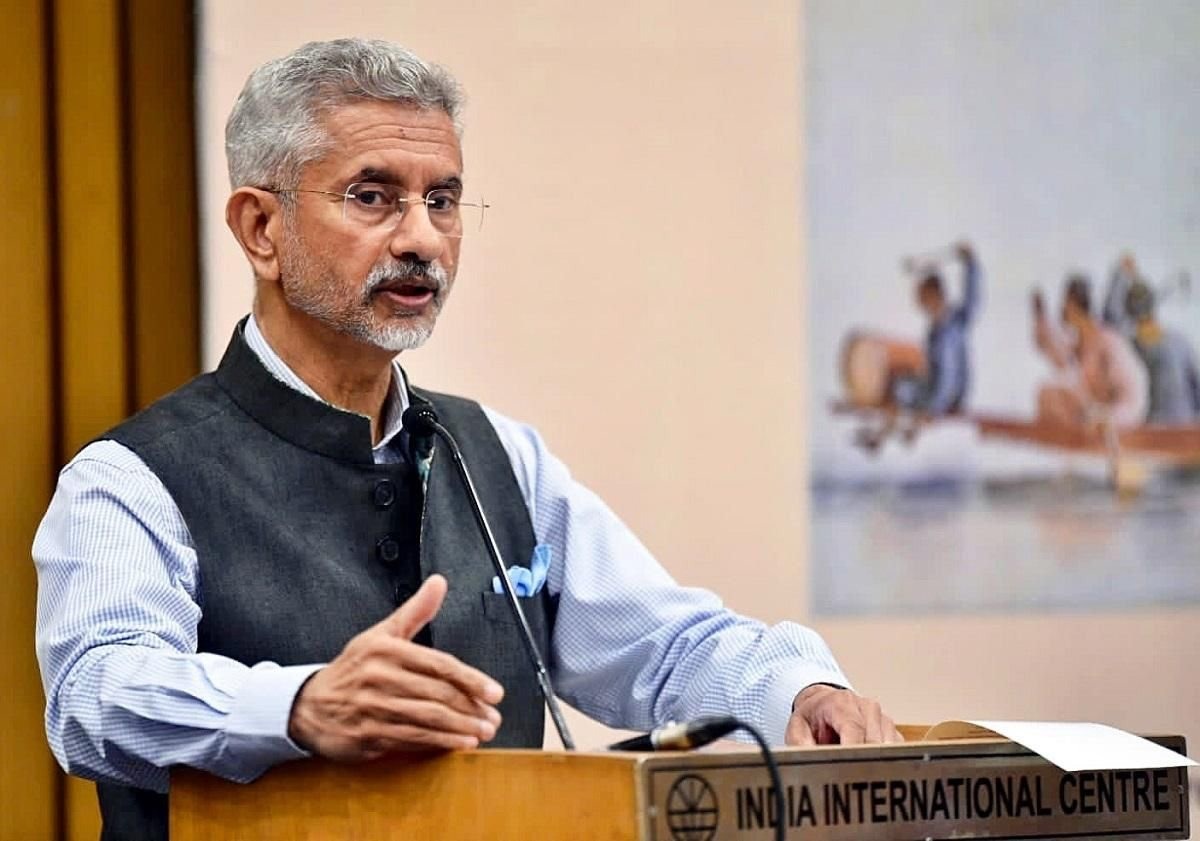

Foreign Minister S. Jaishankar has made India’s stand clear and tough on the issue of terrorism, saying that India has every right to protect its citizens against the neighboring countries which continuously promote terrorism. He underlined that the expectation of cooperation and neighborly spirit cannot co-exist with terrorism. These statements of his are being seen in the context of Pakistan.
Addressing an event at IIT Madras, Jaishankar said, “But when it comes to bad neighbors who insist on terrorism, India has every right to protect its people and will do whatever is necessary. You even request us to share water and also spread terrorism in our country—this is not acceptable.”
Elaborating on India’s neighborhood policy, the External Affairs Minister said New Delhi’s approach is driven by “common sense”, with a clear distinction being made between friendly and hostile neighbours. He said, “You can have good neighbors as well as bad. Unfortunately, we have bad neighbors. Look to the West if a country decides to continue terrorism deliberately, persistently and without remorse, we have the right to protect our people. We will exercise that right. How we do it is our decision. No one can tell us what we should or should not do. We will do whatever is necessary to protect ourselves.”
#WATCH Tamil Nadu: On being asked about India’s neighborhood policy, EAM Dr S Jaishankar says, “… You can also have bad neighbors. Unfortunately, we do. When you have bad neighbors, if you look to the one to the west. If a country decides that it will deliberately,… pic.twitter.com/8w6dgDHLtc
— ANI (@ANI) January 2, 2026
Jaishankar also linked the erosion of trust between terrorism and regional cooperation to issues like water-sharing. He said, “Many years ago we had a water-sharing agreement, but if terrorism continues for decades, there is no scope for good neighborliness. And when there is a lack of good neighborliness, its benefits also do not accrue. You cannot say, ‘Please share water with us, but we will continue terrorism with you.’ It doesn’t match.”
On the contrary, referring to India’s policy towards friendly neighbours, he said that India has continuously helped in times of crisis. Jaishankar said, “India invests, helps and shares with good neighbors whether it is vaccines during Covid, fuel and food aid during the Ukraine conflict, or $4 billion in aid during Sri Lanka’s financial crisis. India’s growth is a rising tide for the entire region, and most of our neighbors believe that if India grows, they too grow with us.”
He also informed that he had recently visited Bangladesh, where he represented India at the funeral of former Prime Minister Khaleda Zia.
Jaishankar, while speaking on India’s broader worldview, mentioned ‘Vasudhaiva Kutumbakam’. He said, “When we use the term ‘Vasudhaiva Kutumbakam’ so casually, what is its message? What it means is that we have never seen the world as a hostile or enemy environment from which we have to be defensive and protect ourselves.” He added that today’s Indian diplomacy focuses on problem-solving, competitiveness and partnerships.
Highlighting India’s global role during the COVID-19 pandemic, the External Affairs Minister said that vaccine diplomacy had an unprecedented emotional impact on the world. “In my entire career, I have never seen anything that had as big an emotional impact on the world as delivering a vaccine,” he said, recalling that many developing and small island countries were dependent on India when rich countries stockpiled vaccines.
Concluding his address, Jaishankar reflected on India’s civilizational identity and its role in the changing global landscape, saying, “India is one of the few ancient civilizations that exists today as a modern nation-state. We have a deep understanding of our past, which is inherited through our beliefs, language and culture. It is about rediscovering and expressing our inner capabilities and creativity—not in an anti-Western, but in a non-Western way.”
Also read:
Pakistani economy dependent on IMF bailout is seriously insecure: Report
Pahalgam attack kingpin Saifullah Kasuri again threatens India; ‘India made a big mistake’
8 American lawmakers wrote a letter to the Indian Ambassador demanding bail for Omar Khalid.

Comments are closed.