
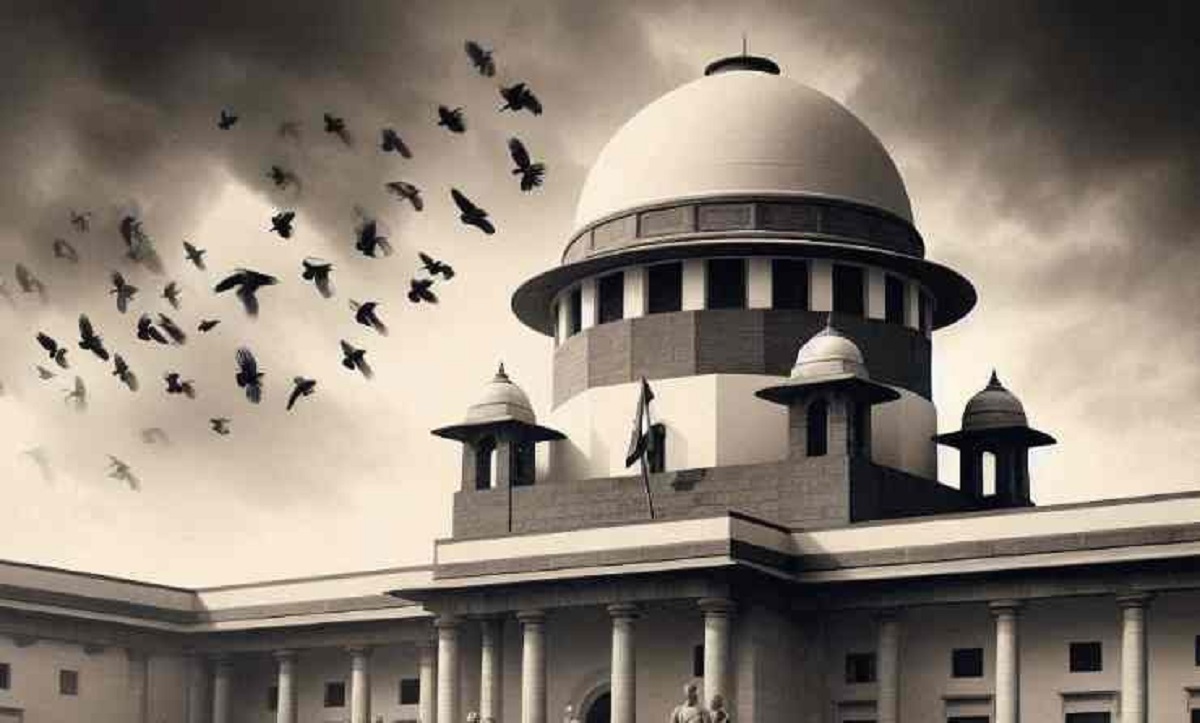

A new dispute seems to be emerging between the judiciary and the government regarding the reference to judicial corruption in the Class 8 NCERT book. Chief Justice of India (CJI) Surya Kant has taken a strong stance on this, calling it a well-planned and deep-seated attack on the judiciary. The Supreme Court says that the Supreme Court will not tolerate any attack on the dignity of the institution.
Taking suo motu cognizance of the matter, the CJI said he has been continuously receiving calls and messages on the issue, including from judges of high courts. Senior advocate Kapil Sibal drew the court’s attention to this, saying, “We as senior members of this institution are extremely concerned about the inclusion of ‘judicial corruption’ in the Class 8 textbooks.”
Responding to this, the CJI said, “I have been receiving a lot of calls and messages about this, including from judges of high courts. I will not allow anyone to malign the reputation of the judiciary or question its integrity.”
In this context, senior advocate Abhishek Singhvi argued that it appears as if only one institution is being targeted. “It seems as if corruption exists only in the judiciary. There is not a word about politicians, ministers, bureaucrats or anyone else,” he said. “Selectivity, My Lord. This selectivity… it is there in other areas also, but here only judicial corruption has been talked about,” Singhvi said. Justice Joymalya Bagchi commented, “The structure of the book lacks the integrity of the basic structure of the Constitution.”
Describing it as a potential new flashpoint between the government and the judiciary, Supreme Justice Surya Kant said action would be taken in the case, no matter how high it reaches. “This appears to be a well-planned and deeply orchestrated attack on the judiciary. We will not allow anyone to target the judicial institution,” he said.
After this strong comment of the Supreme Court, now it has to be seen what clarification NCERT gives on this controversy and what further steps are taken. At present, the judiciary has given a clear message about protecting its institutional honor.
Let us tell you that the previous textbook of NCERT did not have the topic of corruption, and it only described the responsibilities of the judiciary, the meaning of independent judiciary, the structure of the courts and ways to deal with them. However, it did mention that the time taken by courts to hear a case affects the common man’s access to justice. It also stated that the saying, “Justice delayed is justice denied” is often used by courts to describe the time taken to hear a case.
According to the book’s chapter “Corruption in the Judiciary,” judges are governed by a code of conduct that sets guidelines for their actions inside and outside the court. It points to the internal accountability-maintenance process of the judiciary and “a well-established process for receiving complaints through the Centralized Public Grievance Redress and Monitoring System (CPGRAMS)”. It said that between 2017 and 2021, more than 1,600 such complaints were received.
The text reads, “In cases where the allegations are serious, Parliament can remove a judge by passing an impeachment motion. Such a motion is considered only after a proper investigation, during which the judge is given full opportunity to present his side of the case.”
It further states, “Nevertheless, people face corruption at different levels of the judiciary. For the poor and needy, this can worsen the problem of access to justice. Therefore, there are continuous efforts at the state and central levels to build trust and transparency in the judicial system, by using technology, and to take swift and strong action against cases of corruption wherever they arise.”
Also read:
This plant that came from heaven has countless properties along with its fragrance, it will help in increasing sleep and digestion power.
16 year old Indian restaurant ‘Rangrez’ closed in London due to threats from Pakistani groups
‘Modi Magic’ in Israel: Knesset decorated with tricolor lights, Prime Minister Modi welcomed with ‘Namaste’ in Hindi and Hebrew in newspapers


Comments are closed.