

Public discussion in the country regarding India-US Bilateral Trade Agreement (BTA) has intensified. Concerns have come to light regarding this agreement, especially from some sections of the farming community. Many questions are being raised like the possibility of a fall in the prices of maize and soybean, the fear of increased competition from the import of foreign fruits and the possible impact on the edible oils market. These concerns are natural, because farming in India is not just an economic activity but an important basis for livelihood, food security and rural stability.
However, if we carefully look at the structure of this agreement and the safeguards included in it, it becomes clear that this agreement is not a completely open trade, but a balanced and protected framework. The central government has tried to strike a balance between increasing business opportunities and protecting farmers from sudden market shocks.
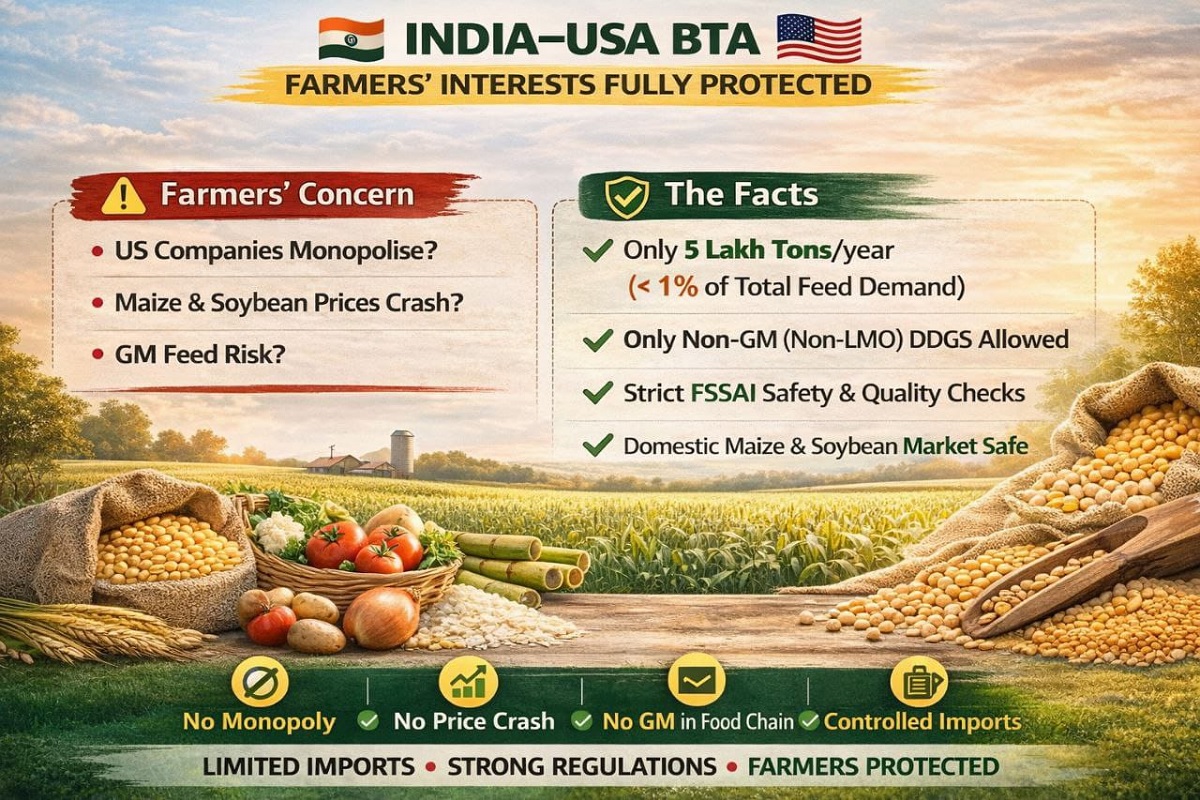
In this context, first of all the issue of import of DDGS (Distillers Dried Grains with Solubles) used in animal feed comes to the fore. Some critics say that its import may reduce the demand for corn and soybean in the country. But the reality is different from this.
The total demand for animal feed in India is around 600 lakh tonnes, while the DDGS import limit has been fixed at only 5 lakh tonnes. That means less than one percent of the total demand. Apart from this, it has also been made mandatory that the DDGS being imported should be non-LMO (non-GM) and it can be used only for animal feed.
Imports in such limited and controlled quantities are not likely to have any major impact on the domestic grain market. Conversely, sectors like poultry, dairy, fisheries and animal husbandry could reduce the cost of animal feed, benefiting millions of rural families.
Similarly, a balanced policy has been adopted regarding the import of Red Sorghum. The agreement provides only a partial duty concession of 30 per cent and that too only for non-GM red sorghum, which can only be used as animal feed.
The duty has not been reduced so much that it would harm domestic production. Besides, the quantity of imports is also controlled. This provides security to sorghum farmers in Rajasthan, Maharashtra, Karnataka and Madhya Pradesh, while the poultry industry benefits from stable prices.
The most politically sensitive issue is the import of fruits, especially apples. Apple growers of Jammu and Kashmir, Himachal Pradesh and North-East India fear that import of foreign apples may increase the pressure on their market.
But in this case also many security measures have been implemented. Apples will be imported under the quota system. The limit has been fixed at 1,00,000 metric tonnes in the first year and 1,50,000 metric tonnes from the third year onwards.
Apart from this, the minimum import price has been fixed at ₹80 per kg. Even after 35 percent duty concession, the price of imported apples remains around ₹106 per kg. If imports exceed the quota limit, the full 50 percent duty rate is applicable.
The objective of this arrangement is clear – to prevent dumping, maintain the competitiveness of Indian apples and avoid falling prices during the harvest season.
Similarly, import of tree nuts like almonds, pistachios, hazelnuts and walnuts has also been allowed within limited quota. With this, local producers of Jammu-Kashmir, Himachal Pradesh and Uttarakhand will not have to face uncontrolled foreign competition.
The most sensitive sector is edible oil. India already imports about 40 lakh tonnes of soybean oil every year. The concession given under this agreement is less than 10 percent of India’s total consumption and that too is limited in the quota system.
At present, 35.75 percent import duty is applicable on edible oils, which provides adequate protection to the domestic market. The quantity of imports has also been kept so limited that there is no sudden pressure on the domestic market.
In the case of soybean, total imports are limited to about 6 lakh tonnes, of which only 1 lakh tonnes is under the non-GM quota. This reduces the possibility of negative impact on prices of farmers growing mustard, sunflower, sesame and groundnut.
Looking at all these areas a similar policy is visible – Limited quota, phased implementation, minimum import price and Non-GM bet Higher duty on imports exceeding quota| This means that this agreement is not a model of completely open trade but of “managed integration”, i.e. controlled global integration.
If the cost of animal feed and edible oils comes down then it can help in keeping food inflation under control. Its benefit is not only available to urban consumers but also to rural families.
Stable consumer prices and stable farmer income are not contradictory goals but two important pillars of a balanced economy.
India’s agricultural economy is so important that its interests cannot be ignored in any trade agreement. Available indications show that the Central Government has prepared this agreement only after understanding this reality.
Controlling market access with limited quotas and safeguards seeks to ensure that international trade serves as a complement to domestic agriculture, not as a competitive threat.
It is not possible to remain completely isolated in a world moving towards rapid globalization. But open trade without security is also not the right path.
The real test of any policy is balance. And in the case of India-US trade agreement, this balance appears as the most important guiding principle.
Rijiju said in Lok Sabha, Rahul Gandhi deviated from the topic in LPG debate!

Comments are closed.