
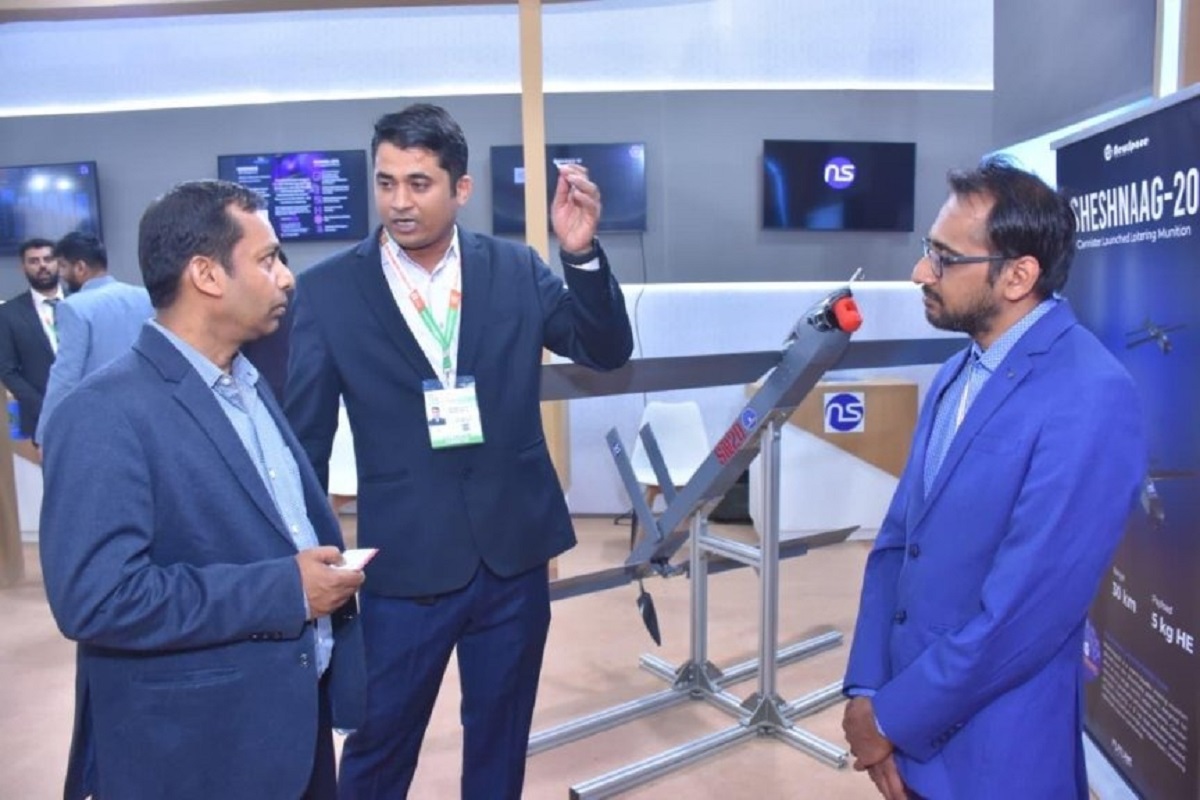

Another important achievement has been registered in India’s defense innovation sector. Bengaluru-based defense technology company NewSpace Research and Technologies has successfully flight tested its indigenous loitering munition system ‘Sheshnag-20’. This system was first displayed at the international platform World Defense Show 2026 in Riyadh, the capital of Saudi Arabia.
According to defense experts, Sheshnag-20 is a new generation precision strike system that will strengthen India’s strategic capabilities. It is a canister-launched electric fixed-wing platform that can be easily deployed from ground or military vehicles. With a wingspan of approximately two meters and a maximum take-off weight of 20 kilograms, the drone has the capability to carry a payload of up to five kilograms, allowing it to be used in a range of missions from surveillance to targeted strikes.
Key features of this loitering munition include a flight capability of approximately one hour and an operational range of approximately 30 kilometers. It can reach a maximum speed of 150 kilometers per hour and operate at an altitude of approximately 6,000 metres. Its biggest feature is that it is capable of attacking after accurate target identification by hovering over the target area for a long time.
Due to its canister based design, its logistics system also becomes simple. Being battery operated and equipped with a brushless DC motor, its noise is also low, due to which its use in covert operations is considered effective.
The company has worked on advanced systems before also. The Sheshnag‑150, the long-range version of the Sheshnag series, has already shown its capability in trials. In initial trials conducted in Karnataka, the system demonstrated accurate target engagement with a circular error probable of approximately five metres.
Loitering munitions are becoming increasingly important in modern warfare as they combine intelligence surveillance, target identification and precision strike in a single platform. Due to their smaller size and less detectability, they are considered more effective in contested battlefields than conventional larger UAVs.
Under the policy of Make in India and defense self-reliance of the Government of India, private sector companies are also being promoted in the development of military technology. In this context, Bengaluru’s aerospace ecosystem is emerging rapidly and many start-ups are working on advanced drones and autonomous systems.
Defense analysts believe that systems like Sheshnag-20 could play an important role in future operations against infantry, armored units and high-value targets. Its successful test also indicates that India is rapidly moving forward in the field of indigenous drone and loitering munition technology, which may prove important for both military modernization and export prospects in the coming years.
Also read:
Iran’s warning: US allies will turn oil infrastructure into ashes
Bill to amend transgender law introduced in Lok Sabha, ‘self-declared gender identity’ excluded from definition
Decision to release Sonam Wangchuk from custody
North Korea fired about 10 ballistic missiles towards the Sea of Japan

Comments are closed.