
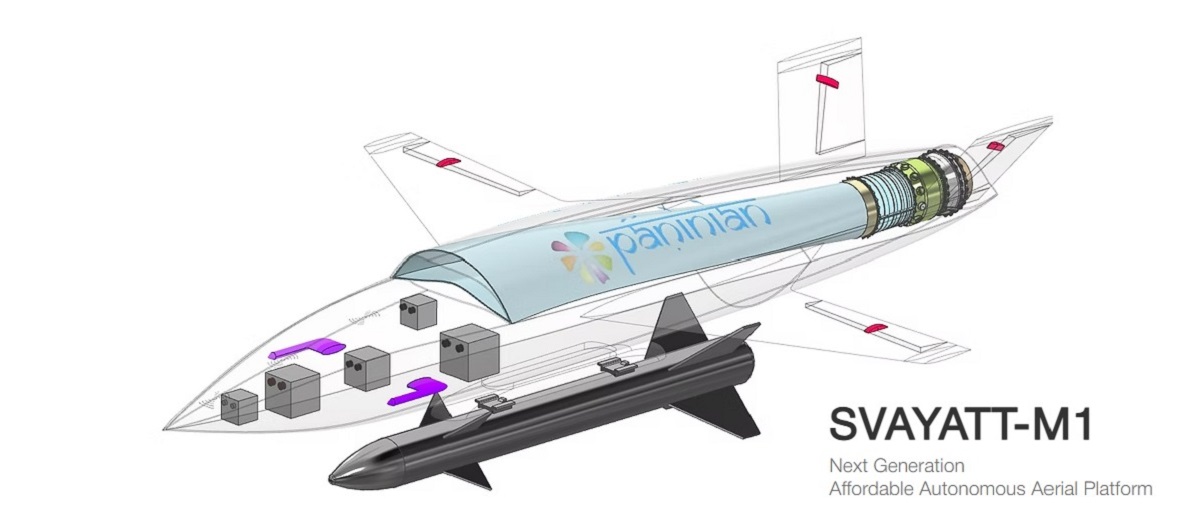

In a significant advancement in India’s defense technology sector, startup Paniniyan India has developed AI-based ‘Loyal Wingman’ drone SVAYATT-M1. It is an Advanced Collaborative Combat Aerial Vehicle (CCAV), designed to operate in high-risk combat areas in conjunction with manned combat aircraft. The objective of this project is to enhance the capabilities of the Indian Air Force and promote indigenous technology in the modern battlefield.
Established in the year 2020, Paniniyan India was founded by former experts from DRDO and HAL. The company is currently operating from a 50,000 sq. ft. state-of-the-art campus, which includes simulation lab, wind tunnel and composite manufacturing facilities. The company has also received a grant under the MEITY TIDE 2.0 program of the Ministry of Electronics and Information Technology to promote indigenous innovation. More than 200 engineers are working with the company on various defense projects.
The SVAYATT-M1 has been developed as a low-cost ‘loyal wingman’ that can perform missions in conjunction with manned combat aircraft. This platform has been specially designed for those areas where the enemy air defense system is extremely strong. Its low-observable airframe reduces radar and infrared signatures, enabling it to enter enemy territory stealthily.
This drone has been fitted with an in-house turbofan engine developed by Paniniyan. It also supports STOBAR carrier operations, which increases its usefulness for the Navy. However, at present detailed technical information like its size, weight, speed or range has not been made public as it is still being developed as a conceptual prototype.
The biggest feature of SVAYATT-M1 is its advanced artificial intelligence based mission system. Through ‘Kalman Intel’ technology it is capable of mission planning, target selection, swarm coordination and navigation even without GPS. Through this, it can work with manned aircraft like Su-30MKI, Rafale and future AMCA in ‘Manned-Unmanned Teaming’ (MUM-T).
The modular ‘plug-and-play’ architecture of this platform makes it suited for a wide variety of missions. It can carry different payloads for surveillance and reconnaissance (ISR), electronic warfare, anti-ship strikes, air-to-ground attacks and special missions of limited duration. The drone also has the capability of ‘terrain-hugging flight’, adaptive threat response and network-based operations in difficult terrain, further enhancing its usefulness in actual combat situations.
According to experts, such platforms will help the Indian Air Force to overcome the challenge of shortage of pilots, increase the range of attacks and ensure the safety of human life in risky missions. Apart from this, this system can also prove to be important for India’s defense export strategy, especially in cooperation with friendly countries like Vietnam.
Along with SVAYATT-M1, the company is also working on other platforms like Svayatt TD-1 target decoy system and PA-LW50 Wingman drone. Modern processes such as digital twin technology, software-in-the-loop (SIL) and hardware-in-the-loop (HIL) testing are being used in the development of these systems, thereby rapidly strengthening India’s capabilities in the field of autonomous warfare systems.
Also read:
Infiltration attempt failed in Uri sector, Pakistani terrorist killed
India preparing to make a big bet of Rs 1 lakh crore in semiconductor sector
Retired RBI employee became victim of cyber fraud several times

Comments are closed.