
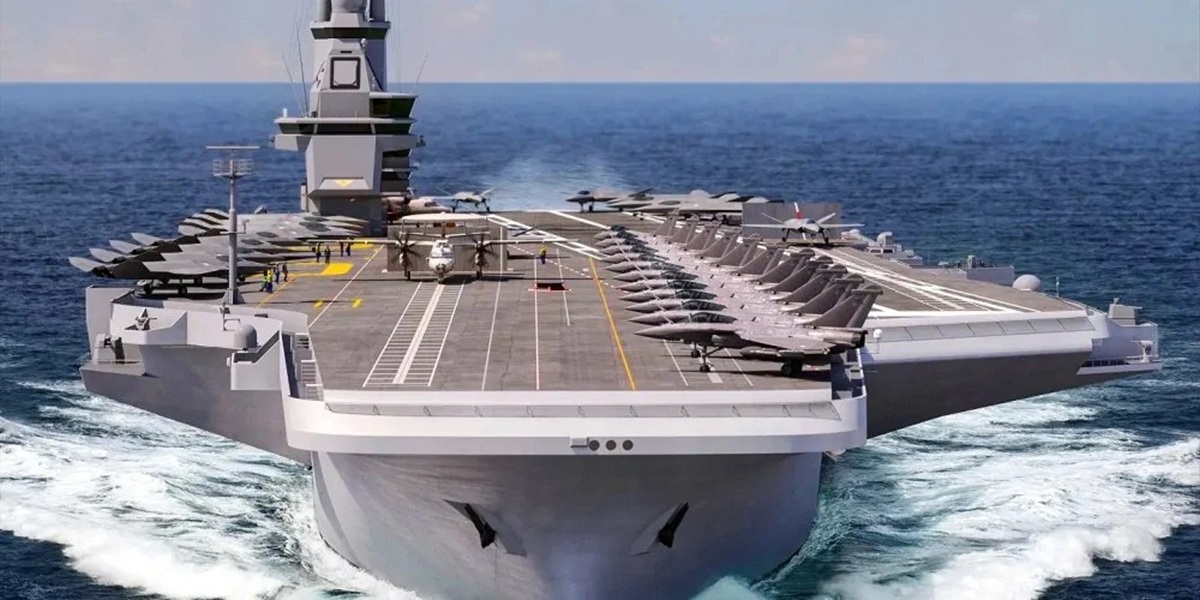

India is moving rapidly towards strengthening its naval capability, and the proposed third aircraft carrier INS Vishal (IAC-III) is emerging as an important part of this strategy. The Indian Navy and Defense Research and Development Organization (DRDO) have made significant progress in the design phase of this 65,000 to 70,000 tonne ship, due by April 2026.
Although construction has not yet received formal approval, the project is central to India’s strategy to maintain a fleet of three aircraft carriers by the 2030s. Its purpose is to maintain regional balance, especially in the face of China’s rapidly growing naval capability.
Emphasis on new technology and capabilities
INS Vishal will be technologically very different from the existing INS Vikramaditya and INS Vikrant. While both INS Vikramaditya and INS Vikrant are based on the STOBAR (Short Take-Off But Arrested Recovery) system, INS Vishal is being designed with the CATOBAR (Catapult Assisted Take-Off But Arrested Recovery) system. With this, heavy aircraft, airborne early warning systems, refueling aircraft and long-duration drones can be deployed.
Small scale trials of Electromagnetic Launch System (EMALS) by DRDO have been successful, however full scale implementation is yet to take place due to technical and cost challenges.
Propulsion and design changes
Integrated Full Electric Propulsion (IFEP) has been chosen for this vessel, which will be powered by gas turbine. The nuclear propulsion option previously considered was abandoned in 2017, as developing a marine reactor could take 15–20 years, according to the Bhabha Atomic Research Center (BARC). However, India’s long-term defense roadmap leaves open the possibility of nuclear-powered aircraft carriers after 2035.
The air wing of INS Vishal is likely to include 30–35 fixed-wing aircraft, about 20 helicopters and UAVs capable of flying for up to 36 hours. This platform will promote manned-unmanned teaming (MUM-T) and network-based warfare capabilities.
The biggest challenges facing the project are budget and technical dependencies. Collaboration with the US for EMALS technology remains uncertain, while the cost is also quite high. A duplication (IAC-II) of the Vikrant-class in 2025 was considered, but the INS Vishal project has regained momentum in 2026.
India’s Defense Ministry is pushing for a balanced navy comprising aircraft carriers, submarines and other warships, which will set the pace for the project. Strategically, INS Vishal will strengthen India’s power projection capability in the Indian Ocean and beyond. If it is commissioned in the 2030s, India will be able to further establish itself among the major naval powers globally.
Also read:
America demands ban on uranium production for 20 years, Iran strict on nuclear enrichment
Dr. Babasaheb Ambedkar is not just a person, but a resolution!
Chinese tanker banned by US passes through Hormuz Strait despite US blockade

Comments are closed.