
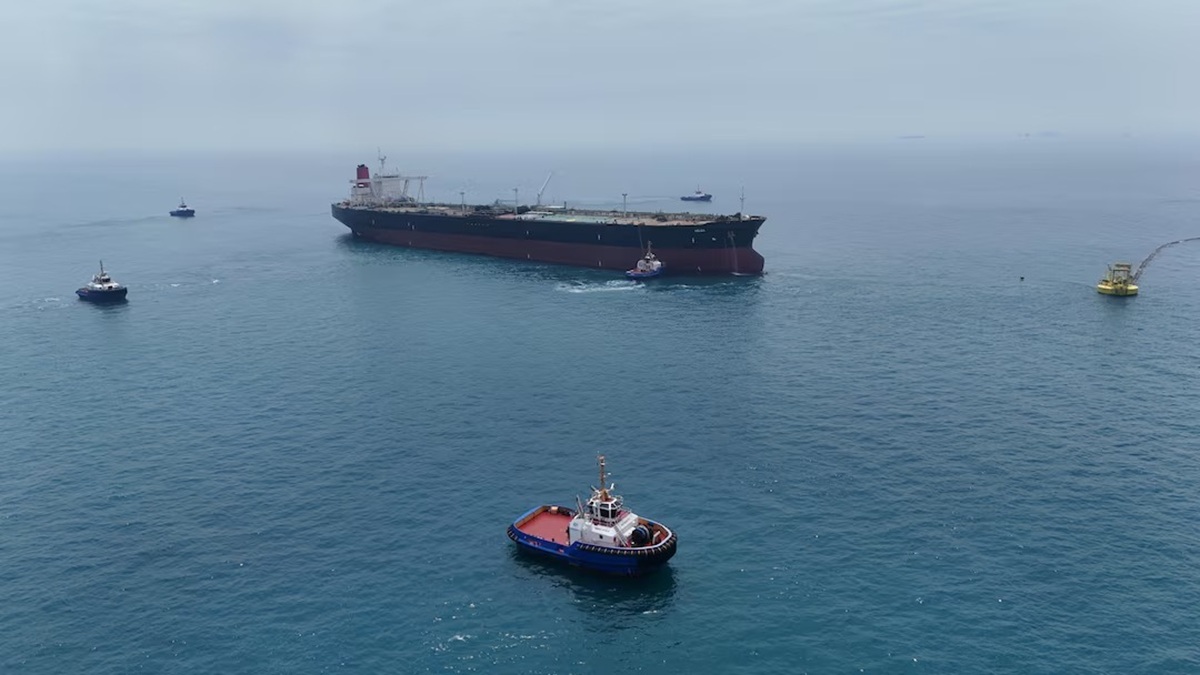

The conflict between Iran and America is at its peak and tension over the Strait of Hormuz still continues. America has deployed its naval forces here and imposed a blockade on one of the world’s busiest sea routes. However, according to the information received, many tankers are crossing this blockade and passing through this sea route. Many analysts have also pointed to a route through which ships could travel directly from Iran’s Kharg Island to Mumbai.
The latest example of an Indian ship passing through this route is ‘Desh Garima’. The ship reached Mumbai last Wednesday despite facing Iranian firing on the tense route. This tanker had brought 97,000 metric tons of crude oil from Ras Laffan, Qatar. Not only ‘Desh Garima’, but more than 30 other tankers have also transited the Strait of Hormuz since the US blockade began on April 13. The Financial Times reports that at least 34 tankers belonging to Iran have bypassed the US blockade.
According to Ministry of External Affairs (MEA) spokesperson Randhir Jaiswal, 14 Indian ships are currently present in the Hormuz area. Jim Bianco, president and macro strategist at Bianco Research, a financial research and market analysis company, outlined one possible path forward. He explained with a map the routes through which Indian ships could pass. A few days later, business analyst and podcast host Mario Knopf pointed the same path. According to him, the ships could proceed along Iran’s territorial waters and enter Pakistani waters before crossing the blockade.
What routes can ships take to India?
If a tanker loads at Kharg Island, it can proceed via two possible routes: the Persian Gulf and the Gulf of Oman. The first route goes along the Makran coast of Pakistan. Following this route, ships can directly reach Pakistani waters from Iranian waters without entering international waters. Although this is technically possible, it becomes a bit complicated for India as it passes through Pakistan’s territorial waters. The special thing is that under normal circumstances the US Navy cannot easily stop ships in the territorial waters of another country.
Another possible route is for the ship to sail along the coast of Iran, reach Chabahar port and from there turn south and enter international waters. After this it can directly reach any western coast of Maharashtra, Gujarat, Goa, Karnataka or Kerala.
At the moment, the jurisdiction of the US blockade is limited only to international maritime boundaries, which applies in the context of the conflict with Iran. Unless there is illegal activity involved, the Navy cannot stop legitimate merchant traffic taking place in international straits.
According to the United Nations Convention on the Law of the Sea (UNCLOS), every coastal state has control over its territorial waters up to 12 nautical miles (about 22 km). Foreign merchant ships have the right of ‘innocent passage’ through these waters. This means that they can pass peacefully without stopping, without carrying on any trading or fishing activity and without any danger. As long as the ship is only passing through, the coastal country should not normally stop it.
Also read:
Like Pahalgam, terrorist attack on two security guards in Mira Road; Stabbed after asking about religion
Andhra Pradesh: Attempt to rape a 6-year-old innocent child, 60-year-old Maulana beaten by the mob
“If someone misbehaves, they will be dealt with appropriately.”

Comments are closed.