
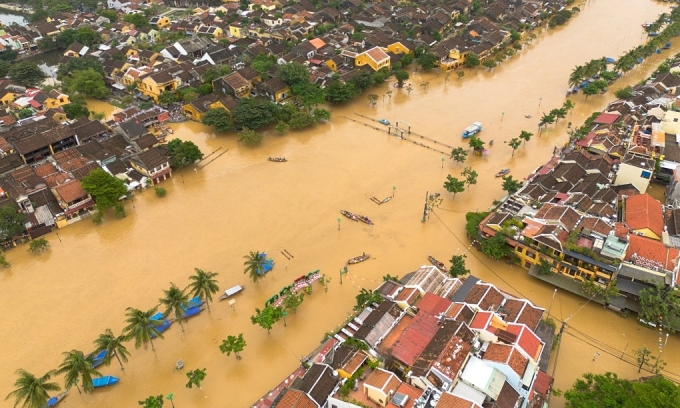

The National Center for Hydro-Meteorological Forecasting reported that the month was defined by three widespread heavy rain events triggered by storms and cold air masses. The first event, driven by Storm Fengshen, lasted from Oct. 23 to Nov. 3 and dumped massive amounts of water on the region.
Hoi An ancient town in Da Nang City is flooded on Nov. 17, 2025. Photo by Read/Nguyen Dong |
Rainfall totals from Ha Tinh to Quang Ngai and parts of the Central Highlands ranged from 500 to 800 mm, with specific locations recording staggering figures.
Nam Dong in Hue recorded 2,452 mm, while Tra My in Da Nang received 2,061 mm.
This prolonged deluge pushed river systems to unprecedented levels. On Oct. 27, the Bo River in Hue crested at 5.31 meters, surpassing the record flood of 2020. Three days later, the Thu Bon River rose to 5.62 meters, exceeding the historic flood level of 1964 by 0.14 meters.
Storm Kalmaegi brought the second wave of extreme weather from Nov. 6 to 7, affecting areas from Hue to Dak Lak with widespread rainfall of up to 280 mm. This system caused rivers in Gia Lai and Dak Lak provinces to breach the highest warning levels.
The situation worsened significantly during the third event between Nov. 16 and 21, caused by a combination of cold air and easterly disturbances. During this period, the Son Hoa Station in Dak Lak recorded 1,069 mm of rain, while mountainous regions from Hue to Khanh Hoa saw totals reaching 700 mm.
The cumulative effect of this third wave led to the highest flooding on the Ba River in 50 years. On Nov. 20, the river peaked at 40.99 meters in Dak Lak, standing 1.09 meters above the historic 1993 level. Downstream at the Phu Lam Station, the water also exceeded the 1993 record, while the Dinh River in Khanh Hoa surpassed its 1986 flood peak.
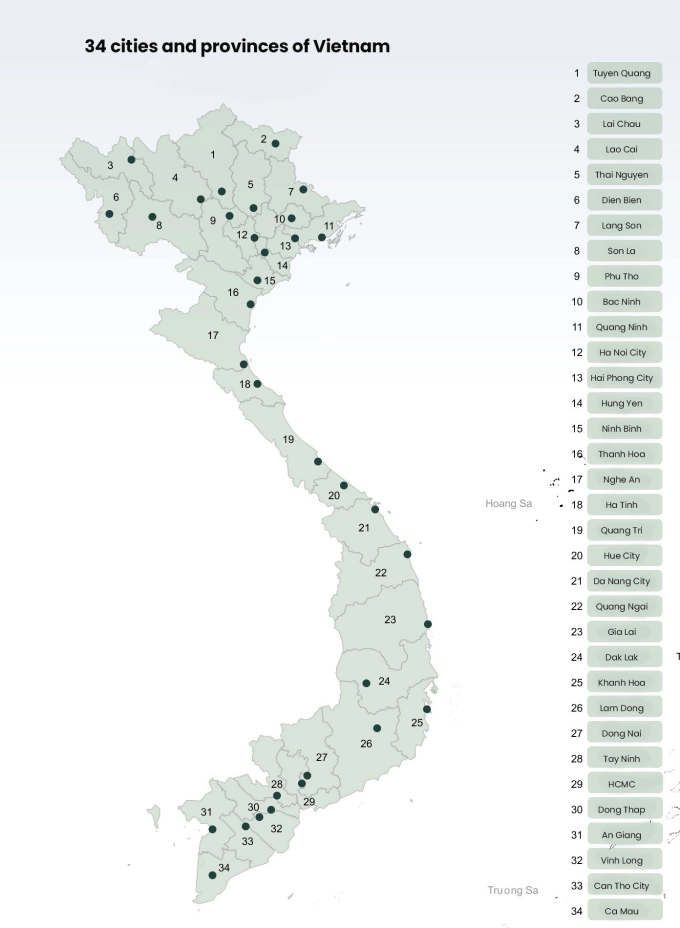 |
A map of 34 cities and provinces of Vietnam. Graphics by Khanh Hoang, Dang Le |
The intensity of the storms resulted in areas from Dak Lak to Lam Dong receiving up to 300% more rainfall than the long-term average, breaking six daily rainfall records.
In Quy Nhon Ward of Gia Lai Province, rainfall reached 380 mm on Nov. 19, nearly 90 mm higher than the 1981 record. That same day, Son Hoa Station in Dak Lak recorded 601 mm, about 140 mm more than the 2008 record.
Additionally, eight monthly rainfall records were broken in November. Son Hoa Station in Dak Lak saw a total monthly rainfall of 1,312 mm, which was 325 mm above the 2010 record. Ayunpa in Gia Lai received 469 mm, surpassing the 2007 record by 100 mm, while Cam Ranh in Khanh Hoa reached 886 mm, exceeding 2018 levels by 135 mm.
The human and economic toll of these disasters has been catastrophic. Authorities reported 163 people dead or missing and more than 170 injured.
The floods devastated housing, causing nearly 1,400 homes to collapse, damaging over 67,800 others, and submerging approximately 381,600 residences. The agricultural sector suffered immense losses, with floodwaters damaging over 114,840 hectares of rice and crops, affecting another 174,000 hectares of farmland, and sweeping away hundreds of thousands of livestock and poultry. Infrastructure was also heavily impacted, with landslides blocking hundreds of national and provincial road sections.
Looking ahead, the National Center for Hydro-Meteorological Forecasting predicts that one to two more storms or tropical depressions could enter the East Sea in December. Early in the month, coastal regions from Quang Ngai to northern Khanh Hoa are expected to see significant rainfall, further threatening areas already struggling to recover.

Comments are closed.