
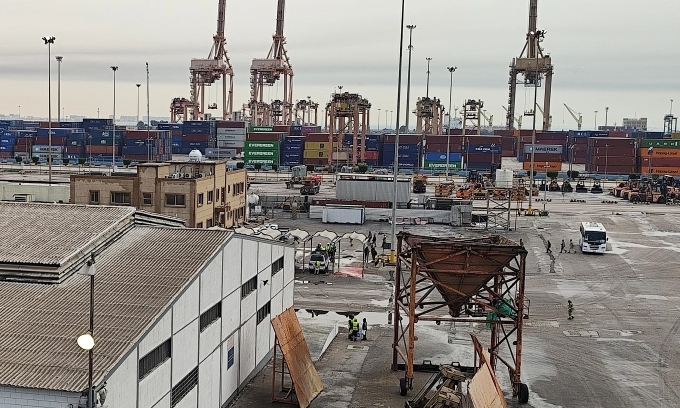

Their 160 Vietnamese crew members are stockpiling food and medicine while drone strikes and electronic warfare close in around them.
Nguyen Tri Khieu, 44, captain of the cargo ship Hai Duong 09, has been docked at Dammam, Saudi Arabia, since March 1. His phone has not stopped ringing. Every call from Vietnam carries the same question: “Are you safe?”
For now, the answer is yes. Dammam port is operating normally, no alerts have been issued, and Khieu has not seen any missiles or aircraft. The weather has been cool and clear. But the war is close. Reading the news, he learned that the Ras Tanura oil refinery, just 30 km from his berth, was hit by Iranian drones on March 2, causing a fire and temporarily halting operations at one of the largest refineries in the Middle East.
And the way home is shut. On March 2, an IRGC commander declared the Strait of Hormuz “closed” on Iranian state TV, warning that any ship attempting to cross would be attacked, Al Jazeera reported.
The threat has not been formalized as a legal blockade, but it has effectively halted commercial shipping through the strait, the only exit from the Persian Gulf. GPS and navigation systems across the region have been severely disrupted by electronic warfare, with maritime intelligence firm Windward reporting more than 1,100 vessels affected within 24 hours. Ships cannot determine their positions accurately and risk being mistakenly targeted.
“In 20 years in this profession, 10 of them as captain, I’ve never faced anything like this,” Khieu said. “Staying put and waiting for the situation to normalize is the safest option.”
The Hai Duong 09 left Phu My Port in Ho Chi Minh City on Feb. 12 and reached Dammam after passing through the Strait of Hormuz. The original plan was to finish unloading by March 4, pick up cargo in the UAE and return to Dammam before heading home. The conflict killed that plan. Now the ship will move to an anchorage about two hours from port and wait.
There is enough food and water aboard for another month. Viettel’s roaming internet works at the dock, and the crew will switch to Starlink once they move to the anchorage. The 18 crew members, all Vietnamese, are maintaining their normal routines. But the situation could change rapidly if the conflict widens.
At Hamriyah port in the UAE, Nguyen Huu Tho, 37, a crew member of the cargo ship Franbo Progress, said his ship has 17 Vietnamese aboard and is working a coastal route along the UAE. No attacks have hit the area, but the ship has decided not to attempt the strait, instead planning to anchor and wait once it finishes unloading.
Pham Tien Long, owner of the oil tanker Van Phong 1, said his ship and its 22 crew members are currently in Iraqi waters and safe. He has helped the crew stockpile food, water and medicine for at least one to two months while commercial activity nearby still functions. The crew is calm and has accepted they will be in the Gulf for an extended period. Ship owners, manning agencies and cargo owners are in talks to ensure proper compensation for crews stranded in the conflict zone.
“We’ve considered evacuating the crew to shore, but it depends on the situation and which option is safer,” Long said. “Hopefully the parties agree to a ceasefire soon.”
The conflict erupted on Feb. 28 when the U.S. and Israel launched a massive coordinated military operation against Iran, targeting its leadership, military facilities, nuclear sites and missile programs.
The strikes killed Supreme Leader Ayatollah Ali Khamenei and several other senior officials. Tehran retaliated with waves of missiles and drones targeting Israel, U.S. military bases and several Gulf states. By March 3, at least 787 people had been killed in Iran, according to the Iranian Red Crescent, along with at least 11 in Israel, six U.S. soldiers and eight people in Gulf states.
The Strait of Hormuz, between Oman and Iran, carries roughly 20 million barrels of petroleum liquids per day, accounting for about 20% of global seaborne oil trade, according to the U.S. Energy Information Administration. Its effective closure has sent oil prices surging and stranded ships from dozens of countries on both sides of the chokepoint.
The Vietnam Maritime Administration has published two hotline numbers for ships and crew: 0904.678.978 and 0945.296.595. The agency has instructed ship owners to closely monitor conditions and seek alternative routes to ensure the safety of all personnel and vessels.

Comments are closed.