
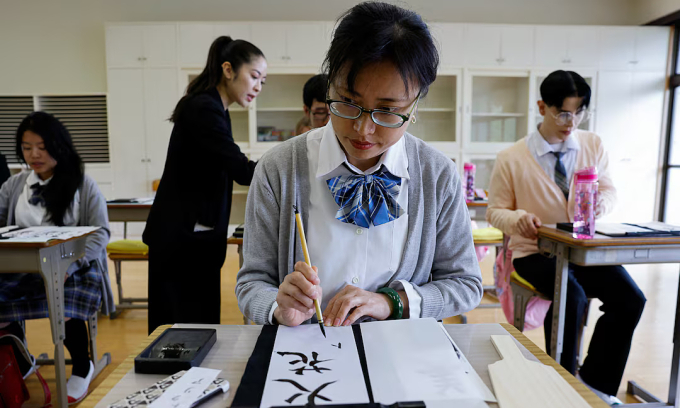

But in more than a third of Japan’s municipalities, a school like hers does not exist at all, leaving roughly 170,000 foreign residents with no access to language classes of any kind.
On a February morning at New World International Academy in Nagoya, Diyali stood before her classmates, including 17 other international students, and delivered a speech about the ancient temples of Nara.
“Todaiji temple is a famous temple in Nara. I want to look at the cute deer there,” she said in Japanese, as cited by The Yomiuri Shimbun.
When she arrived in Japan in the autumn of 2024, she could manage little more than a greeting. Now she is preparing to graduate in March, with plans to attend a junior college and work in caregiving.
Diyali’s trajectory is what Japan’s language education system is supposed to produce. The problem is that the system cannot scale fast enough to match the country’s surging foreign population.
The number of foreign nationals living in Japan hit a record 3.95 million at the end of June 2025, according to the Immigration Services Agency.
The Japan Times reported the figure represented 3.21% of the country’s total population. Japanese learners at schools and other institutions totaled about 290,000 in fiscal 2024, according to the education ministry. Yet in 38.2% of all municipalities, there is no Japanese learning facility at all, an education ministry survey found.
Approximately 170,000 foreign residents live in these “blank areas,” with no access to classes on daily conversation or basic life in Japan, as Nikkei Asia also reported.
The gaps are starkest in rural prefectures: Okinawa had the highest ratio of municipalities with no classes at 85.4%, followed by Aomori at 75% and Hokkaido at 69.7%, according to Nippon.com.
The number of Japanese language schools more than doubled over 10 years to 873 nationwide by the end of 2024, according to the Immigration Services Agency. But rapid growth brought uneven quality, with some schools flagged for inadequate enrollment management and weak instruction.
In response, the government enacted a law in 2023, which took effect in April 2024, transferring oversight to the education ministry from the Justice Ministry, according to the Library of Congress. The law requires schools to design curricula matched to students’ actual goals and mandates nationally registered instructors. Any school that fails to earn accreditation by March 2029 will lose the ability to sponsor international student visas.
But only 64 of Japan’s 873 schools have cleared the bar so far, according to the education ministry. For many smaller operators, the requirements are overwhelming. A language school in the Hokuriku region applied twice and was rejected both times.
At Sendagaya Japanese College in Tokyo, which enrolls about 1,700 foreign students, eight teachers spent nearly a year developing the curriculum to win accreditation in October 2024. But most schools lack the resources for that kind of effort.
“Japanese language schools have traditionally had a prominent aspect as ‘preparatory schools’ for university admission. But the new system emphasizes communication skills, leaving some schools unable to adapt,” Musashino University Professor Uichi Kamiyoshi, who specializes in Japanese language education, told The Yomiuri Shimbun.
Even where schools exist and meet standards, the people teaching in them are often working for free. Of approximately 50,000 Japanese language teachers in fiscal 2024, about 27,000 were volunteers, the education ministry survey found.
Back in Nagoya, New World International Academy’s principal, Tadaharu Miki, said his school aims to go beyond exam preparation.
“We want to foster not just students aiming for higher education but also those who are needed by local communities,” Miki told The Yomiuri Shimbun.
For Diyali, that model worked. She arrived unable to hold a conversation and will leave ready to build a career. The question is whether Japan can make that path available to the millions who will follow her.

Comments are closed.