

Dong Nai’s investment and construction project management board signed off in late May on the construction design for Road 770B, a route to be built from scratch at a cost of about VND4.6 trillion (US$175 million).
The road is one piece of a far larger effort to make sure travelers and freight can quickly reach Long Thanh International Airport, which is due to open to commercial traffic this year after a technical opening in December 2025. Built on a greenfield site about 40 km east of Ho Chi Minh City, the airport is designed to handle 25 million passengers a year in its first phase and is intended to relieve the chronically overcrowded Tan Son Nhat airport in the city center.
Vietnam’s state-owned airports operator Airports Corporation of Vietnam, the airport’s investor, plans to route the bulk of the country’s international flights through Long Thanh once it is running. For travelers bound for southern Vietnam, that eventually means a longer drive from a new airport rather than the short hop into central Ho Chi Minh City that Tan Son Nhat offers today.
Ground access has been the open question hanging over that timeline. Beyond expressways funded by the central government, Dong Nai is building a web of its own connector roads, including routes 25B and 25C and expansions of roads 769 and 773, at a combined cost running into the tens of trillions of dong. Road 770B is the latest to clear the design stage.
When finished, the road will run nearly 43 km through nine communes and wards: Xuan Bac, Gia Kiem, Xuan Que, Xuan Duong, Long Phuoc, Phuoc Thai, Dau Giay, Binh Loc and Xuan Lap. That figure excludes about 9.7 km that overlaps with Ho Chi Minh City’s Ring Road 4 and 2.2 km shared with the Xuan Duong-Thua Duc road. At full build-out it will be 60 m wide with six to eight lanes.
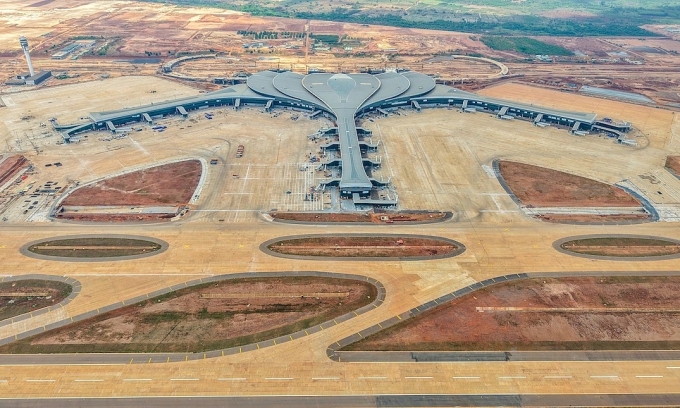
Long Thanh Airport in Dong Nai City is set to begin commercial operations in 2026. Photo by Read/Phuoc Tuan |
According to Dong Nai authorities, 770B is meant to tie the eastern and northeastern parts of HCMC to Long Thanh Airport and to two industrial parks, Xuan Que-Song Nhan and Bau Can-Tan Hiep, while feeding into the Bien Hoa-Vung Tau Expressway, National Highway 51 and the Cai Mep-Thi Vai deep-water port cluster, one of the country’s main gateways for ocean freight.
The first phase will lay a 45.5-m roadbed carrying six lanes, with a 27-m carriageway. The route calls for 13 bridges, including an overpass crossing the Bien Hoa-Vung Tau Expressway, along with six interchanges.
Land for the project has been in the works for more than a year. In early 2025, Dong Nai approved the road’s compensation, resettlement and site-clearance component at more than VND3.3 trillion ($125 million) from the local budget.
On April 30, 2026, Dong Nai became Vietnam’s seventh centrally-run city, formed from the former province, which had merged with neighboring Binh Phuoc Province in July 2025. The resulting city spans more than 12,700 sq.km and is home to about 4.5 million people, making it one of the country’s largest urban units by area and the administrative anchor for Long Thanh airport and the factory belt around it.
Comments are closed.