


The native of Minh Tien, Dai Tu, in the northern Thai Nguyen Province had always been healthy and with lots of aspirations in life.
But after that fateful night on 19, 2019, his youthful years turned into six years of being bed-ridden. That evening he had returned to his rented apartment after working overtime, and as always had a shower at 11 pm.
But when he lay down on his bed he suddenly felt a headache, nausea, loss of control, and weakness on the left side of his body before losing consciousness.
Au Van Hieu before the stroke. Photo courtesy of Hieu |
His friends found out only the next morning, and rushed him to the ER at the Bac Giang Province General Hospital. Doctors made a gloomy prognostication, estimating his likelihood of survival at just 1-2%.
But refusing to give up, Hieu’s family immediately took him to Hanoi’s Bach Mai Hospital, where doctors diagnosed him with a hemorrhagic stroke.
It is an often fatal condition caused by a broken cerebral blood vessel, but one rarely seen in young people without medical conditions though there is a recent surge with the advent of modern lifestyles. To dissolve the blood clots and reduce intracranial pressure, doctors had to perform a craniectomy on Hieu.
Though he had no medical history, he did not lead a particularly healthy lifestyle, frequently staying up late, suffering from work-related stress, eating at irregular hours, and showering late at night.
Hieu regained consciousness after being in a coma for 20 days, but had lost most of his cognitive and motor functions. Four months after his first surgery he came back to Bach Mai hospital for the cranial graft.
In recent weeks the Central Military Hospital 108 has reported getting many similar cases, including young patients with no prior medical issues.
According to the Ministry of Health, showering with cold water at night may trigger vasospasms and spikes in blood pressure, which can culminate in vessel rupture and a hemorrhagic stroke.
Cold temperatures can also thicken the blood and increase the production of red and white blood cells, promoting clot formation that could block blood vessels and cause cerebral infarction.
The Ministry of Health advises against showering after 10 p.m., particularly with warm water during the colder months.
Dr Nguyen Thi Dung, director of the physical and occupational therapy department at Hanoi French Hospital, says the price to pay for strokes is often permanent sequelae.
Statistics show only 25-30% of patients who suffered strokes recover and become independent; the rest have to live a life of dependence, with 15-20% needing others’ assistance even for daily tasks.
Hieu had to relearn basic skills such as eating, talking and walking from scratch. But the stroke took toll not just on his body. For a young man at the peak of his youth, losing control over his body and social status was a devastating shock.
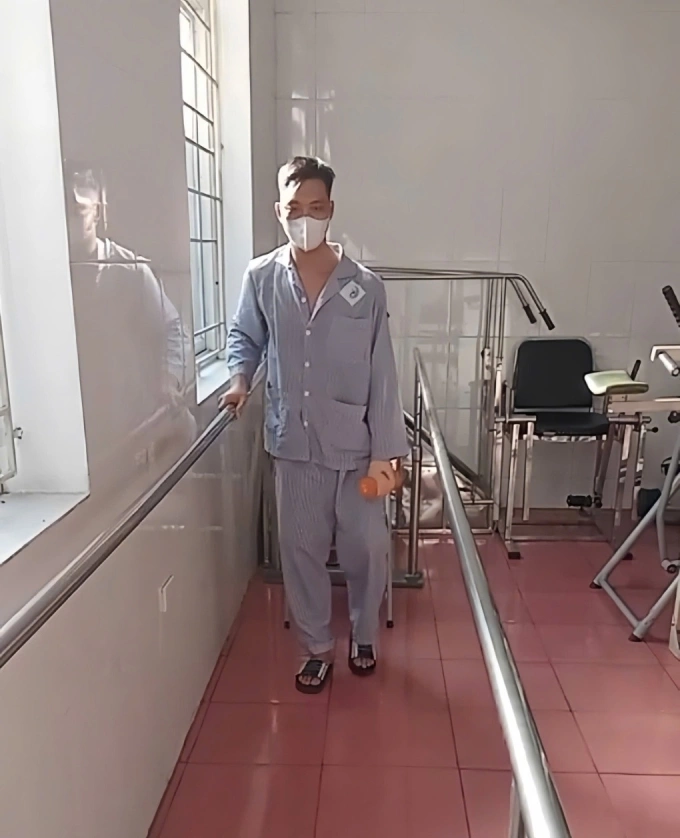 |
Au Van Hieu in recovery. Photo courtesy of Hieu |
Hieu admits to falling into depression and even thinking of ending his life to give his family relief. “I feel like I am an enormous burden”.
A meta-analysis published in The Lancet pointed out that almost a third of the stroke survivors have to deal with depression in the first five years.
Post-stroke depression is not only a psychological response to the predicament, but also comes from actual physical damage in parts of the brain that regulate emotions, creating a vicious cycle that hinders the recovery process and increases the risk of death.
Six years of treatment later Hieu is still not able to reintegrate into social life. He says his arm still has limited functioning and it is expected to take many years for it to go back to even 70-80%.
Reflecting on his situation, Hieu hopes it will be a warning for young people, especially those not having healthy lifestyles.

Comments are closed.