

As organizations rely more heavily on digital infrastructure, maintaining consistent system performance has become a priority. From e-commerce platforms to manufacturing systems and financial services, many businesses operate environments that require near-continuous availability.
To support this need, companies are adopting 24/7 monitoring practices to help keep systems stable, secure, and responsive. Continuous monitoring enables earlier detection of potential issues, which can help reduce the likelihood of service interruptions and maintain performance levels.
Modern enterprise systems often run across complex environments that combine cloud infrastructure, databases, applications, and integrated services. In such settings, unresolved minor issues can develop into larger operational problems if not addressed in time.
A 24/7 monitoring setup provides real-time visibility into system health and performance, allowing for faster detection and response when issues arise.
Commonly cited benefits include earlier issue detection, reduced downtime, and more consistent system performance. These factors can contribute to smoother operations as businesses expand digital services.
As digital transformation progresses, Japanese enterprises are becoming more dependent on reliable IT systems. According to IDC, Japan’s spending on digital transformation is projected to exceed US$73 billion by 2027, reflecting growing demand for stable and well-managed infrastructure.
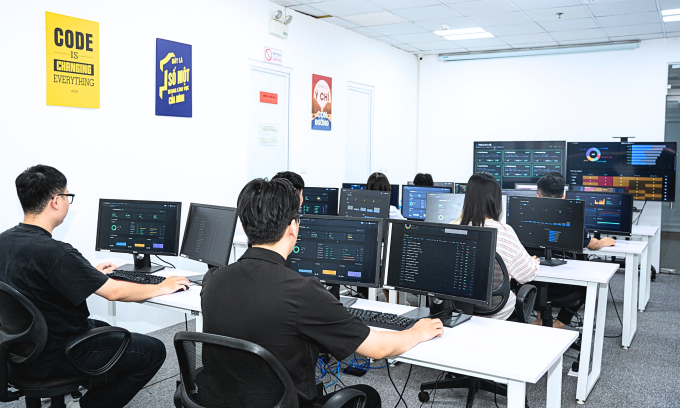
Kaopiz engineers conduct round-the-clock system monitoring in a dedicated, security-controlled environment. Photo courtesy of Kaopiz |
With the increasing use of real-time platforms and hybrid cloud environments, monitoring solutions are more frequently integrated into core IT operations.
System downtime can have operational and financial implications. In sectors such as finance, e-commerce, and manufacturing, even brief disruptions may affect transactions, delay processes, and impact user experience.
Industry estimates suggest that downtime costs can reach significant levels for large organizations, depending on system scale and business model.
In addition to direct financial impact, downtime may lead to interrupted revenue streams, reduced productivity, reputational considerations, customer dissatisfaction, and additional recovery efforts.
For enterprises managing environments that combine legacy systems with modern cloud platforms, reducing disruption risks has become an ongoing focus.
Continuous monitoring is one approach used to manage these risks. Monitoring systems typically provide real-time data and generate alerts when irregular activity is detected, enabling technical teams to respond more quickly.
Core practices often include performance tracking, automated alerts, predictive analysis, and incident response processes. Together, these functions support system reliability and help manage operational risks.
A comprehensive monitoring approach may cover infrastructure, applications, security, and incident management. These components are often combined to support overall system availability.
Some enterprises work with external service providers to manage monitoring and related operations.
Kaopiza Vietnam-based IT service provider working with Japanese clients, provides infrastructure monitoring, system maintenance, and offshore engineering services. The company focuses on supporting early issue detection and maintaining system performance through structured monitoring processes.
According to a company representative, maintaining stable system performance is an important consideration for digital operations. Continuous monitoring can support earlier issue detection and help reduce downtime. As IT environments become more complex, 24/7 monitoring is increasingly adopted as part of broader efforts to support system reliability and long-term operations.
Email: marketing.jp@kaopiz.com
Japan Office: 3F, 3-8-8 Minami Ikebukuro, Toshima-ku, Tokyo
Tel: 03-5809-2633
Singapore Office: 1 Raffles Place #19-61, One Raffles Place Tower 2, Singapore 048616
Vietnam Office – Hanoi: 1-2-4-5F, CT1-C14 Bac Ha Building, To Huu Street, Dai Mo Ward, Hanoi
Tel: 024-6652-2105
Vietnam Office – Da Nang: 12F, SHB Da Nang Building, 06 Nguyen Van Linh Street, Hai Chau Ward, Da Nang
Tel: 024-6652-2105

Comments are closed.