

European countries dominated the absolute top of the annual list, with Iceland ranking first, followed by Norway, Denmark, and Switzerland.
However, the strong showing from East and Southeast Asia highlights the region’s advanced medical infrastructure and longevity.
Taking fifth place globally, Japan was the highest-ranked Asian nation.
The country benefited from one of the world’s highest life expectancies, universal healthcare coverage, and a robust preventive care system. Japan has also long been recognized for its extensive medical infrastructure and specialized aging-care services.
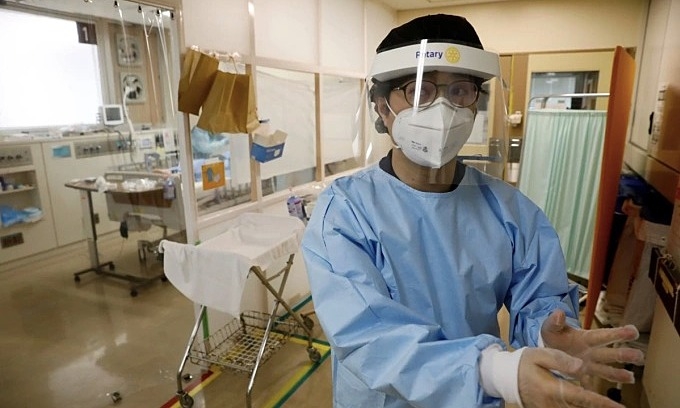
A medic at a hospital in Japan. Photo by Reuters |
Japan scored a perfect 100 for both hospital beds and immunization coverage metrics. It also achieved near-perfect marks for life expectancy (99.9), infant mortality (99.5), and healthy life expectancy (98.9).
South Korea secured the seventh spot globally, driven by its advanced hospital network, high physician accessibility, and significant investments in medical technology and digital healthcare services.
It earned a perfect 100 for hospital beds, alongside exceptionally high scores for epidemic mortality (99) and infant mortality (98.4).
Singapore followed closely in eighth place. The Southeast Asian city-state continues to earn global recognition for its highly efficient healthcare model, which seamlessly combines strong public healthcare programs with high-quality private medical services.
Singapore achieved perfect scores in both healthy life expectancy and epidemic mortality.
Evaluation methodology
The rankings evaluated countries based on 13 factors divided into three core categories: mortality and longevity, public health preparedness, and healthcare delivery.
The mortality and longevity group assessed overall population health. This included overall life expectancy from birth, healthy life expectancy (the average years lived in “full health”), infant mortality rates per 1,000 live births, and maternal mortality.
The public health preparedness category measured a nation’s readiness and research capacity. It evaluated immunization coverage among one-year-olds, the volume of medical research published in high-quality journals, and the proportion of deaths caused by epidemic events over a 10-year period.
The healthcare delivery group examined the system’s operational strength. Metrics here included disease detection rates, overall healthcare efficiency, hospital bed and physician density per 1,000 residents, out-of-pocket spending burdens, and the scope of universal health coverage.
Comments are closed.