
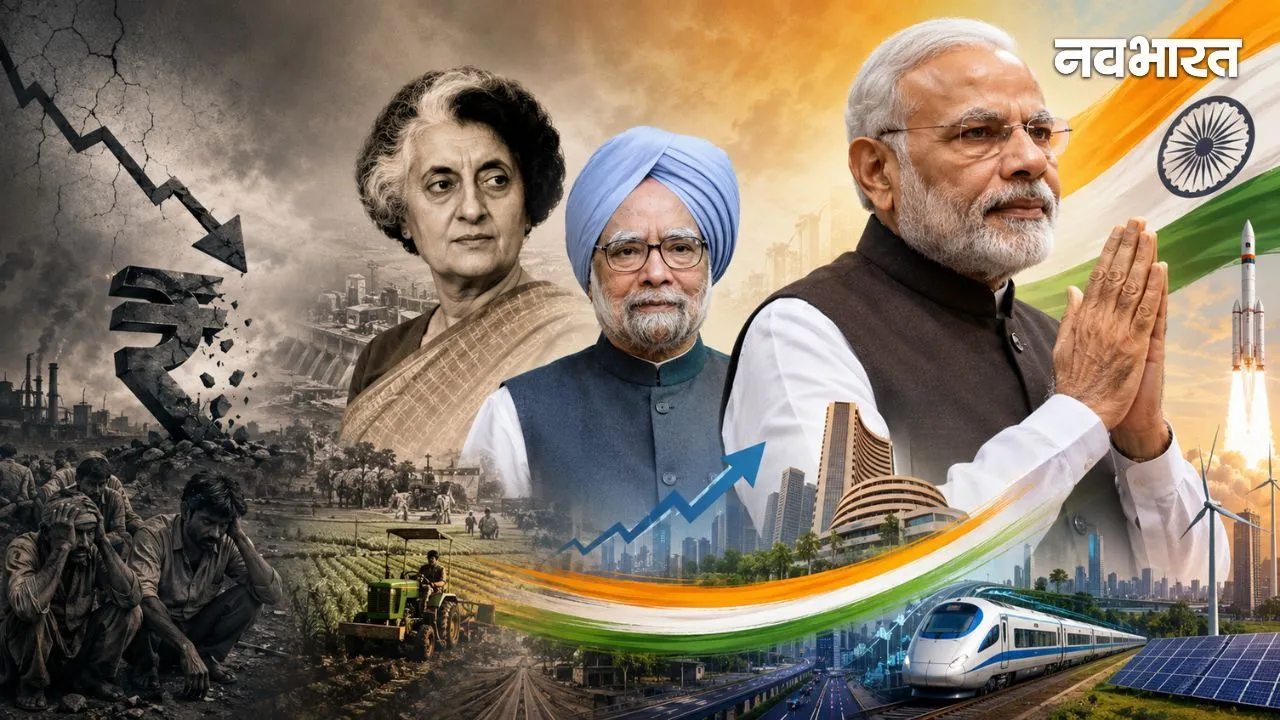
When did India get hit by economic crisis, how did Indira and Manmohan change the picture? Now what is the meaning of PM Modi’s appeal?

Economic Crisis in India After Independence: The effect of the ongoing tension in the Middle East for the last few months is now gradually being seen all over the world as well as in India. The country’s Prime Minister Narendra Modi has mentioned its impact twice in the last 24 hours. The PM has appealed to people to reduce the consumption of petrol and diesel, stop purchasing gold for a year and avoid foreign travel.
Since then, it is being speculated whether there is going to be another economic crisis in the country. At the same time, there are some people who have a question in their mind that after independence, when has India been in the grip of economic crisis, and then how has it become economically strong again? Let us know everything in detail.
3 major economic crises of independent India
Since independence, the Indian economy has seen many ups and downs. However, there have been three such major occasions, which are known as serious economic crises. For the first time in 1966, independent India was hit by a major economic crisis. After this, the balance of payment crisis also became very deep in 1991. Apart from this, the global economic crisis of 2008 had also engulfed India.

Three major economic crises of independent India
First: Economic crisis of 1966
In 1960, a decade after independence, India was fighting on many different fronts simultaneously. The country’s military expenditure had increased greatly due to the wars with China in 1962 and Pakistan in 1965. Along with this, the country faced a severe drought in 1965-66, due to which the production of crops decreased significantly. Due to which India had to import grains from abroad (from America under PL-480 scheme). The then Prime Minister Indira Gandhi had done a 57% devaluation of the Indian rupee in June 1966 to counter foreign pressure and save the economy.
Second: The 1991 ‘Balance of Payments’ crisis
After independence, in the year 1991, India faced the second and biggest economic crisis. It is considered to be the most discussed and serious economic crisis. India had only enough foreign exchange reserves left to import for just two weeks. The main reason for this economic crisis was that crude oil prices increased due to the Gulf War and India’s exports were affected by the fall of the Soviet Union. At this time the country’s fiscal deficit also remained at its highest level.
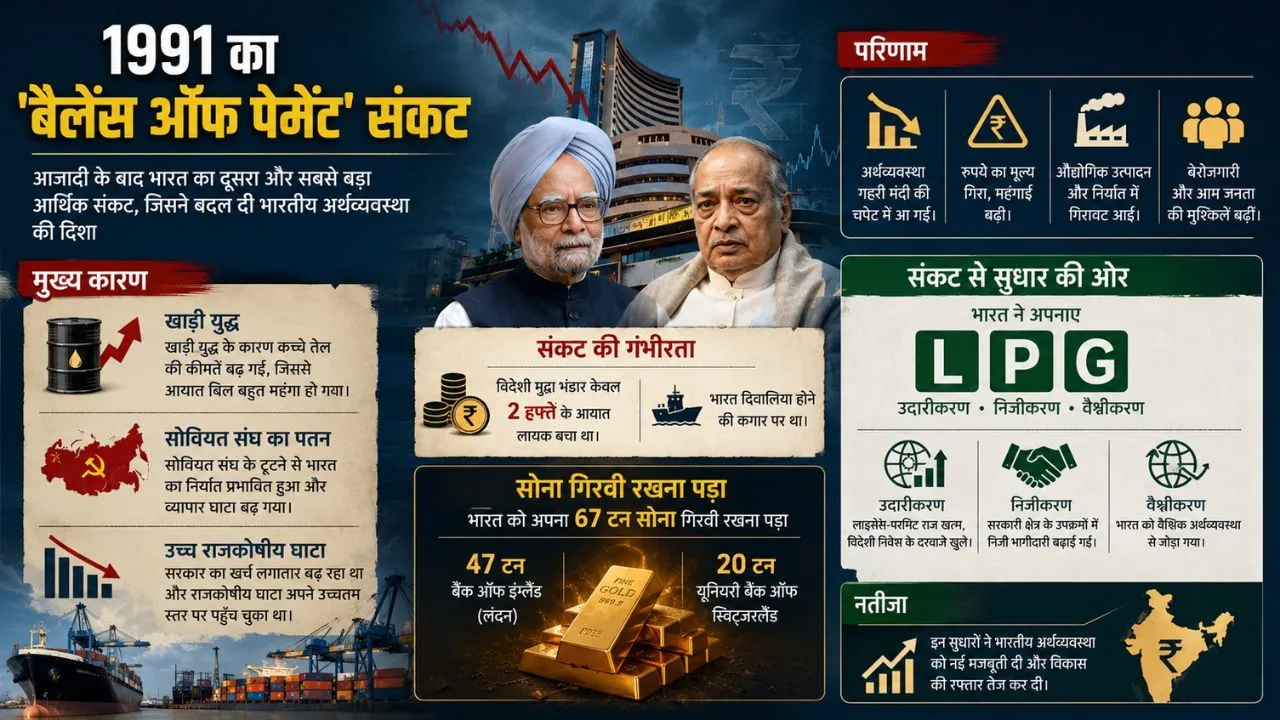
The result of this economic crisis was that India had to keep 67 tonnes of its gold (47 tonnes with the Bank of England and 20 tonnes with the Union Bank of Switzerland) to avoid bankruptcy. After this economic crisis, India implemented LPG (Liberalization, Privatization and Globalization) reforms, which changed the direction of the Indian economy.
Third: global economic recession of 2008
America was the epicenter of the global economic recession in 2008, but due to its global connectivity, India also did not remain untouched by it. The main reason for this economic crisis in America is ‘Subprime Mortgage’ Due to the crisis, stock markets and banking systems around the world had collapsed. Its impact on the Indian economy was that the country’s GDP growth rate, which was running around 9%, fell to 6.7%. There was a huge decline in exports and foreign investors started withdrawing money. However, to get out of this crisis, the Government of India and the Reserve Bank of India together increased liquidity in the market and gave several relief packages so that domestic demand remains intact.
The economy had collapsed in 2020 also
In the year 2020, the world economy completely collapsed due to the Covid pandemic. The impact of this crisis was also seen on the Indian economy. Where India’s GDP witnessed a historic decline of -23.9% in the first quarter of 2020-21 due to the lockdown imposed due to the pandemic.
What is the meaning of PM Modi’s appeal?
This appeal by Prime Minister Narendra Modi has come at a time when his party BJP has recently registered a big victory in Bengal and Assam. Due to US sanctions, India’s energy imports from Russia have continuously decreased. India is importing oil from other countries to meet its demand. India started buying oil from Russia in March after the US partially eased sanctions and domestic refineries were directed to prioritize LPG production for local consumption.

What is the meaning of PM Modi’s appeal?
Also read: explainer: Is economic crisis looming over India? Why did PM Modi have to appeal to the public, understand the complete mathematics
Pointing towards a big economic crisis
Economic experts say that Prime Minister Modi The clear message of the areas in which they are appealing for cuts is to reduce the pressure on foreign exchange reserves i.e. Forex. It is also being said that Modi’s appeal is pointing towards a major crisis in the Indian economy.

Comments are closed.