
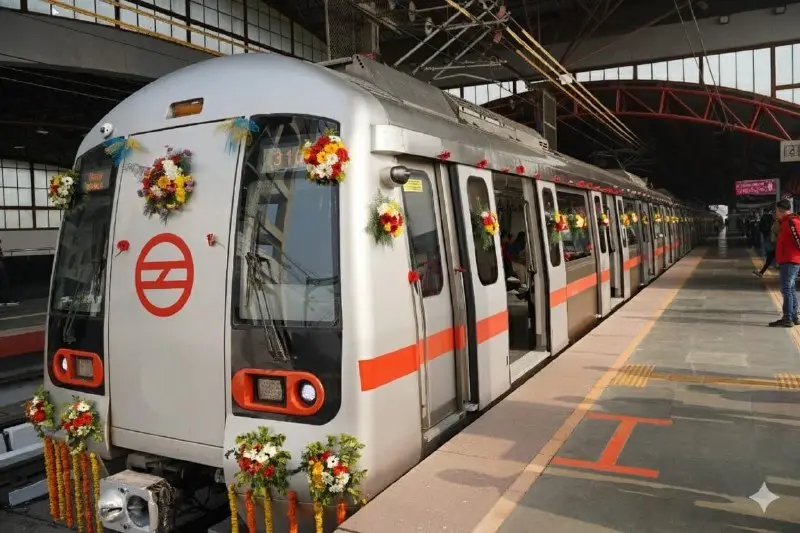
3 new routes of Delhi Metro approved, 13 stations will be built till India Gate and Airport, NCR will benefit.

A major step has been taken towards further strengthening public transport in Delhi-NCR. The Central Government has approved three new routes (corridors) for the expansion of Delhi Metro. This project will be developed under Phase-V(A) of Delhi Metro. With this approval, the metro network in the capital will be expanded by 16.076 kilometers, in which a total of 13 new stations will be built. The government has set a target to complete this ambitious project within the next three years, which will directly benefit millions of passengers.
The pace of Delhi will change with three new corridors, connectivity from Old Delhi to the airport will be strengthened.
The three new routes on which the metro will run under this project are very important strategically. The first and longest route will be ‘RK Ashram Marg to Indraprastha’, whose length is approximately 9.91 kilometers. This corridor will directly connect Old Delhi, North Delhi and West Delhi with important areas like Central Vista and India Gate. The second corridor will be built between ‘Aerocity to Indira Gandhi Domestic Airport Terminal-1’. This 2.26 km long link will provide metro facility directly from Aerocity to the domestic terminal. The third route will be between ‘Tughlakabad to Kalindi Kunj’, which is about 3.9 kilometers long and will pass via Sarita Vihar and Madanpur Khadar.
Out of total 13 new stations, 10 will be underground, reaching India Gate and War Memorial will now be very easy.
The most striking feature of the new extension is the structure of its stations. Out of the 13 new stations that will be built in the new line of total 16.076 km, 10 stations will be underground, while 3 stations will be elevated (on high bridges). Special attention has been given to the RK Ashram-Indraprastha route, where underground stations are proposed for very important places like India Gate, Dutta Path, War Memorial, High Court and Baroda House. With this, access of the general public to areas like Central Vista Zone and Supreme Court will become very easy.
Budget of more than Rs 12 thousand crore and time limit of three years, central and state governments will jointly bear the expenses
A financial blueprint has also been prepared to complete the project on time. The estimated cost of the entire Phase-V(A) project will be approximately Rs 12,014.91 crore. Under the funding model, the Central Government and the Delhi Government will contribute approximately equal shares, while the remaining amount will be raised through loans from international financial agencies and DMRC. According to officials, there is a plan to commission these corridors within 3 years after the construction work starts, so that the public can get its benefits as soon as possible.
Travelers of Noida, Faridabad and Gurugram will also get big benefits, will get freedom from traffic jams and pollution.
The impact of this expansion will not be limited to Delhi only, but other cities of NCR will also benefit from it. With the construction of Tughlakabad-Kalindi Kunj line, connectivity will be improved in the areas bordering Delhi. This will provide better interchange and alternative routes to passengers going towards Noida, Faridabad and Gurugram. Apart from this, this new network of 16 kilometers will reduce the pressure of vehicles on the roads, which will be of great help in reducing traffic jams and pollution in Delhi-NCR. Also, the Aerocity-T1 link will make it faster for people from South and Central Delhi to reach the airport.
Phase-IV work also on pace, preparation to complete existing projects by 2026
Along with the approval of the new phase, the work of Phase-IV of Delhi Metro is also going on war footing. Nearly 80% civil construction of the three priority corridors of Phase-IV, which has a total length of about 111 kilometers and includes 83 stations, has been completed. These lines are targeted to be completed in a phased manner by December 2026. Now the addition of three new corridors will further increase the total length and number of interchange stations of the Delhi Metro network, which will prove to be the backbone of urban traffic in the future.

Comments are closed.