
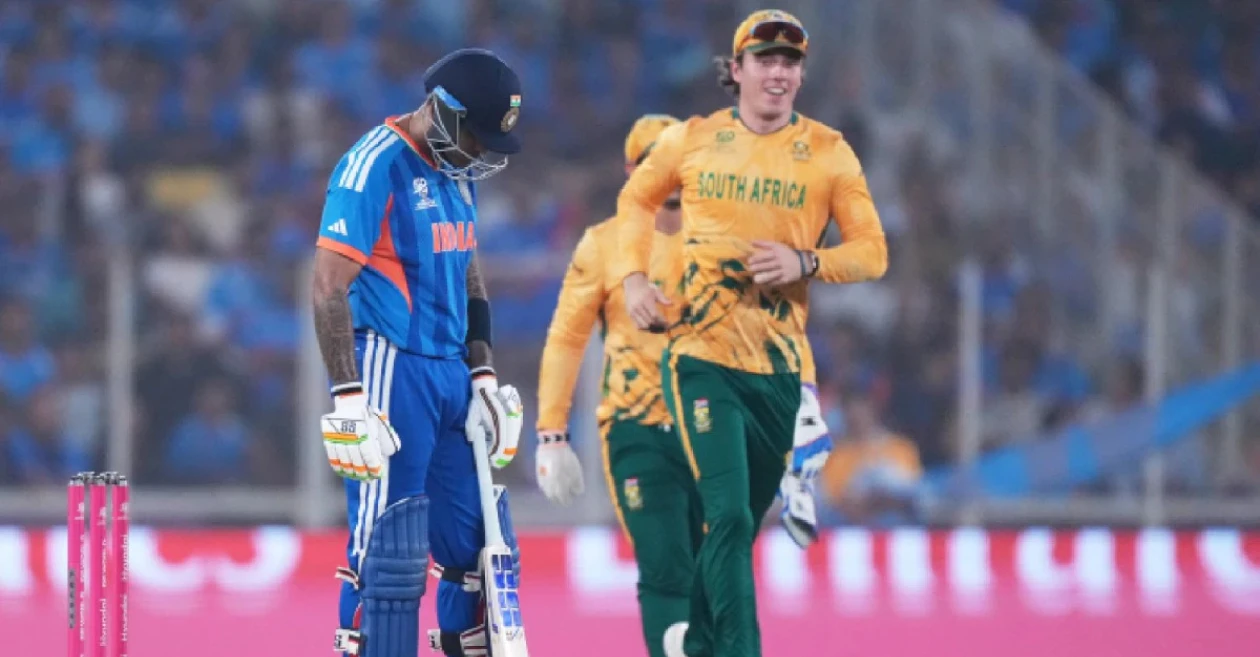
3 reasons behind India’s crushing defeat against South Africa in the T20 World Cup 2026 Super 8 match. Read

In what was being considered a blockbuster rematch of the final of the T20 World Cup 2024, breaking India’s image of invincibility, South Africa defeated India at the Narendra Modi Stadium on Sunday. The defending champions suffered a crushing defeat by 76 runs. Gave. The defeat ended India’s impressive 12-match winning streak in the T20 World Cup and was their biggest defeat in the history of the tournament, surpassing the 49-run loss against Australia in 2010. Chasing the target of 188 runs, the hosts were bundled out for only 111 runs in 18.5 overs, raising serious questions over the team’s preparation and approach.
Three main reasons behind India’s big defeat against South Africa
1. Devastating top-order failure exposes batting weaknesses
India’s much-vaunted batting line-up, which had barely made it through the group stage against weaker opponents, collapsed in spectacular fashion against quality bowling. The problems started in the first over itself when captain Aiden Markram dismissed in-form Ishan Kishan without scoring on four balls, on a ball that stopped at him, forcing him to hit a poorly cross-batted hit.
Tilak Verma’s poor form continued, being out in just two balls, charging at Marco Janssen and also wasting a DRS review. Abhishek Sharma eventually completed his hat-trick of ducks but he looked completely unwell and was out to Janssen for 15. At 26 for 3 inside the powerplay, the chase effectively ended.
Skipper Suryakumar Yadav’s struggles on difficult surfaces continued, scoring only 18 runs from 22 balls and then playing one ball straight to mid-wicket, could not get the ball out of square on a difficult track. The inability to build top-order partnerships reduced India to 51 for 5 in the 10th over, while the required run rate went out of reach. Suryakumar admitted after the match: “You can’t win the game in the powerplay, but you can lose the game in the powerplay. We lost too many wickets in the powerplay and then we couldn’t build small partnerships.”
2. Controversial selection decision: Axar Patel’s absence hurt
The most criticized aspect of India’s defeat was the vice-captain. Akshar Patel The decision was to keep him out in favor of Washington Sundar. The move, which was based on “match-ups” against left-handed batsmen, explained by assistant coach Ryan ten Doeschate, produced disastrous results as Sundar contributed neither with the bat nor the ball.
Ten Doeschate explained the strategic rationale: “We were focusing more on the match-ups in the middle. And then obviously, someone has to give way… We needed Rinku, as an eighth batsman, so to speak.” However, the decision looked even more like a conundrum when Sundar was sent down to No. 5 after an early collapse – a role Axar has played effectively for India.
The move received sharp criticism from experts and fans. Sundar’s lack of recent match practice and inability to make an impact has completely exposed the weaknesses in India’s middle order.
3. Lack of intensity after early successes allowed South Africa to recover
Despite excellent bowling from Jasprit Bumrah – his figures of 3 for 15 made him India’s highest wicket-taker in T20 World Cup history – the team failed to take advantage of a promising start, reducing South Africa to 20 for 3 in four overs.
Instead of building pressure, India’s bowling clearly lacked intensity, allowing David Miller and Dewald Brewis to build a match-turning partnership of 97 runs from just 51 balls. The pace was completely changed with Miller scoring 63 off 35 balls and Brewis scoring 45 off 29 balls, both adeptly assessing the conditions and rebuilding the innings.
South African captain Aiden Markram later described the partnership as decisive: “I think first and foremost was that partnership. The boys were brilliant, they held it together for us, steadied the ship and kept us in the game. I thought our middle-order batting was probably the difference.”
Mystery spinner Varun Chakravarthy, who was very effective in the group stage, conceded 47 runs in his four overs as the South African batsmen dealt with him effectively. What should have been a total of less than 160 became a daunting target of 188, and India’s confident approach after early successes proved costly.
With the net run rate falling to -3.800, India now face must-win fixtures against Zimbabwe in Chennai on February 26 and West Indies in Kolkata on March 1 to keep their semi-final hopes alive.

Comments are closed.