
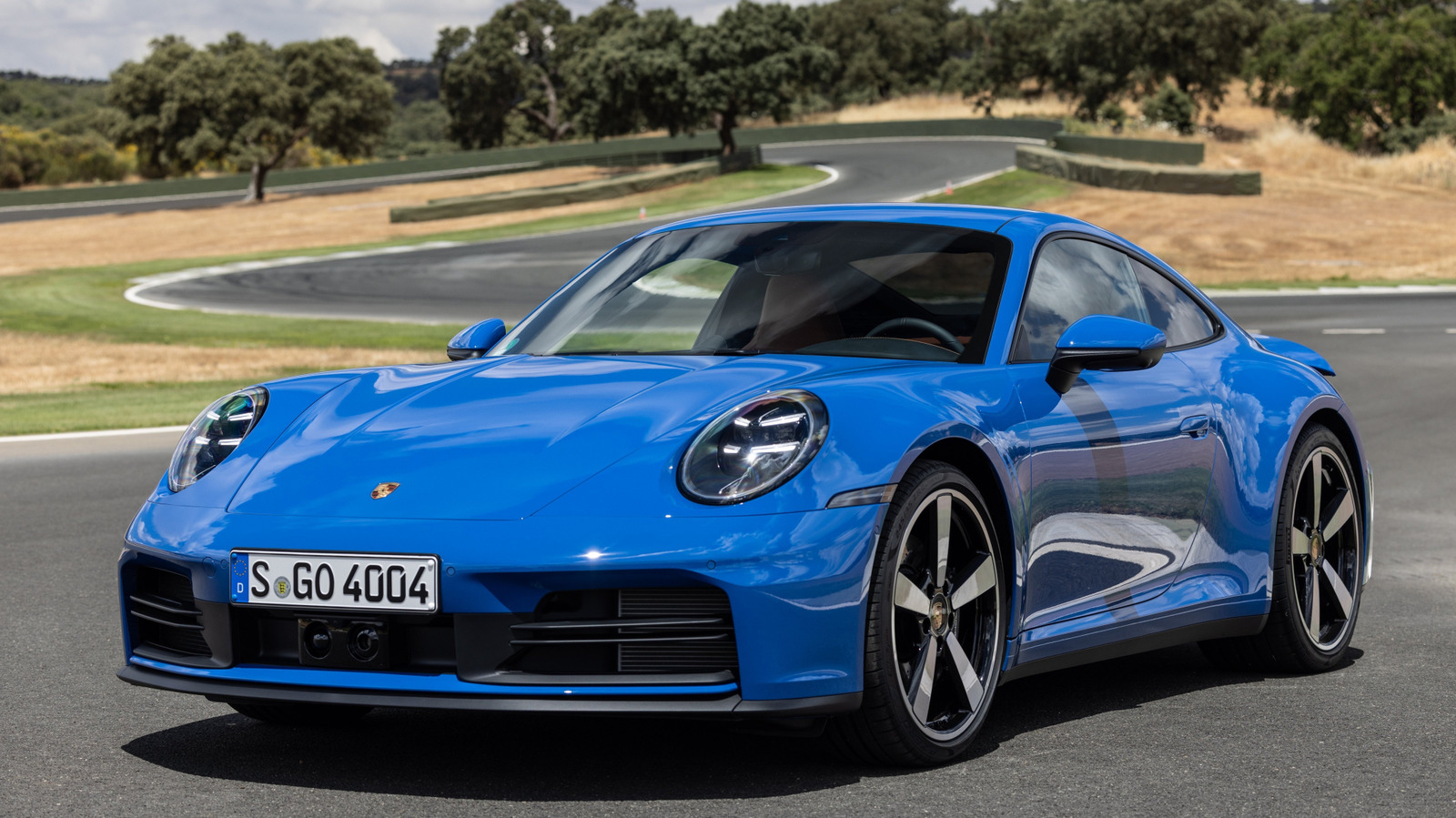

The Porsche 911 is a legendary sports car that has been around for over 60 years. During that time, it has grown in size significantly, become much more luxurious, and much more expensive to buy, especially if you fancy the higher-performance variants like the 911 Turbo and the GT3.
Our target Porsche 911 will be the standard, ‘entry-level’ version, the 2026 911 Carrera Coupe that lands at a price of $135,500, plus a $2,350 delivery, processing and handling fee for a total of $137,850. That gets you a bare-bones 911 in either black or white exterior paint with the basic black leather interior, automatic transmission, and no options. If you’d prefer a stick, the 911 Carrera T can be yours for $12,500 more. Our review of the Carrera T considered it maybe the best new Porsche, period. In Porsche World, this is the price of admission, with the sky being the limit. It is possible to add close to $100,000 of options to the basic car.
The competition will consist of comparable sports cars that have the performance to be considered as worthy of being included on the shopping list that also features the Porsche 911. Some may be less expensive, while others will be costlier. Since a car like the Porsche 911 is more of a want than a need, the typical buyer’s budget may be more flexible if their emotions are as moved as their bodies are by these vehicles.
2026 Porsche 911 Carrera Coupe – the yardstick
Let’s start by establishing the performance bona fides of our 2026 Porsche 911 Carrera Coupe, which holds its value better than any other, then measuring the other cars’ performance against it. But be aware that the Porsche 911 lost its propensity for wagging its tail and sending unsuspecting drivers backwards off the road a long, long time ago. Today’s Porsche 911s, even those with rear-wheel drive, are very well-behaved under all driving circumstances.
The 911 Carrera Coupe packs a 3.0-liter, twin-turbocharged flat-six in its traditional rear end location, mated to an eight-speed dual-clutch automatic transmission that drives the rear wheels on this particular model. It produces 388 horsepower, and in Car and Driver testing, it achieved a 0-60 time of 3.1 seconds, a 0-100 mph time of 7.8 seconds, and a quarter-mile time of 11.4 seconds at 121 mph. The 911 also notched a skidpad roadholding number of 1.09 g. Porsche claims that the 911 Carrera Coupe’s top speed is 183 mph.
The list of standard equipment on the 2026 Porsche 911 Carrera Coupe is fairly short. It includes 19-inch front and 20-inch rear silver-painted wheels, four-way sport seats, and HomeLink. Everything else is optional, but between paint-to-sample exterior colors ranging up to $32,940 extra, exclusive leather interior for $16,300, wheel upgrades for as much as $8,140, titanium sport exhaust for $4,270, and so much more, Porsche makes it very easy to customize your 911.
2026 Chevrolet Corvette C8 Z06
For those who don’t think a Corvette can take on a Porsche, we humbly submit the 2026 Chevrolet Corvette Z06, which in its basic form slightly undercuts the 911 Carrera Coupe on price. In coupe form, it has an MSRP of $120,195, totaling out at $136,345 after the destination fee and gas guzzler taxes are added in.
The Corvette Z06 comes with a hand-built, naturally aspirated, flat-plane crank, 5.5-liter V8 with an output of 670 horsepower, driving the rear wheels after it sends its power through an eight-speed dual-clutch automatic transmission, similar to the Porsche’s. Performance testing of the Corvette Z06 by Car and Driver achieved a 0-60 mph time of 2.7 seconds, 0-100 mph in 6.1 seconds, the quarter-mile in 10.7 sec at 129 mph, and a top speed of 189 mph. All are quicker/higher than those of the 911. The Corvette Z06’s roadholding was also higher at 1.12 g.
This is quite an achievement for the Chevrolet Corvette Z06, which is an expensive vehicle for many reasons. The Z06 not only outperforms the Porsche, but does it at a lower price. It is a testament to the team that created the Corvette Z06, which this past year won a prestigious award from a German publication — the Auto Bild Sportscar of the Year Award for cars priced up to 250,000 Euros, equal to $295,543. The Corvette Z06 has also won awards in its home country, including Road and Track’s 2023 Performance Car of the Year and Motor Trend’s 2023 Performance Vehicle of the Year.
2026 Mercedes-AMG GT 63 Coupe
The 2026 Mercedes-AMG GT 63 Coupe is the Mercedes-AMG coupe that outdoes the performance of the base-level 911. The GT 63 Coupe is powered by a twin-turbocharged 4.0-liter V8 engine that puts out 577 horsepower and is one of the greatest Mercedes AMG engines ever made. The power is fed through an AMG Speedshift MCT nine-speed automatic transmission, after which it is sent to all four wheels.
In testing performed by Car and Driverthe Mercedes-AMG GT 63 Coupe did the 0-60 mph run in just 2.7 seconds, beating the Porsche 911 Carrera Coupe by .4 seconds. It does 0-100 mph in 6.8 seconds, a 0.7-second improvement. Its quarter mile comes in at 10.9 seconds at 125 mph, 0.2 seconds quicker. Its top speed,, according to Mercedes-AMG, is 196 mph, 13 mph higher than the Porsche. Only its roadholding on the skidpad comes up a skosh short, with a number of 1.06 g against the Porsche’s 1.09 g. This is likely due to the Mercedes-AMG GT 63’s high 4245-pound curb weight, compared to the 911 Carrera Coupe’s more svelte 3472-pounds. Weight does have consequences when it comes to handling.
The Mercedes-AMG GT 63 Coupe costs $181,350 MSRP plus a $1,350 destination charge, totaling $182,700 before options. Mercedes-AMG GT models with even higher performance are available as your budget permits, with the electric motor-boosted GT63 S E Performance and its stunning 805 horsepower on offer for an approximately $21,000 upcharge.
McLaren 750S
The McLaren 750S Coupe, which our review demonstrated to be faster, but that’s not the point, is the McLaren supercar that eclipses the performance of the Porsche 911 Carrera Coupe. It is not only the most powerful McLaren to be series-produced, but it is also the lightest, with a curb weight of 3,206 pounds, making it 266 pounds lighter than the Porsche 911 Carrera Coupe.
The McLaren 750S Coupe uses carbon-fiber monocoque construction to keep its weight as low as possible. The McLaren 750S is a two-seater, mid-engine coupe, powered by a twin-turbo 4.0-liter V8 that produces 740 horsepower, channeled through a seven-speed dual-clutch automatic transmission that drives the rear wheels. The McLaren 750S Coupe also features an active rear wing that provides additional downforce during hard braking, then levels itself to reduce drag during acceleration.
Performance stats posted by Car and Driver show that the McLaren 750S can do 0-60 mph in 2.3 seconds, 0-100 mph in 4.8 seconds, a quarter-mile time of 9.8 seconds at 145 mph, and a top speed of 206 mph. The McLaren 750S also reached 1.19 g of roadholding on the skidpad. All of these are an order of magnitude beyond those of the Porsche, but this should not be a surprise, considering that its price is far beyond that of the Porsche. The McLaren 750S Coupe has a base price of $365,100, including destination fees, which is more than double that of the Porsche. As the old saying goes, “Speed costs money. How fast do you want to go?”
Methodology
We have sought out a group of three sports cars that outperform the Porsche 911 Carrera Coupe in its basic configuration, the 2026 911 Carrera Coupe that is priced at $137,850. Car and Driver testing is the benchmark that has been used to determine the performance of each vehicle, with primary emphasis on each car’s acceleration from 0-60 mph, 0-100 mph, its quarter-mile time, and its manufacturer-calculated top speed. We have also compared each of these sports car’s Car and Driver-recorded skidpad roadholding numbers, in which two out of the three cars exceeded the Porsche, with the Mercedes-AMG Coupe coming in slightly behind it, at 1.09g for the Porsche and 1.06g for the Mercedes-AMG. This could be attributed to the Mercedes-AMG GT 63 Coupe’s added weight, or it could be down to minute variations in the testing conditions on different days.

Comments are closed.