
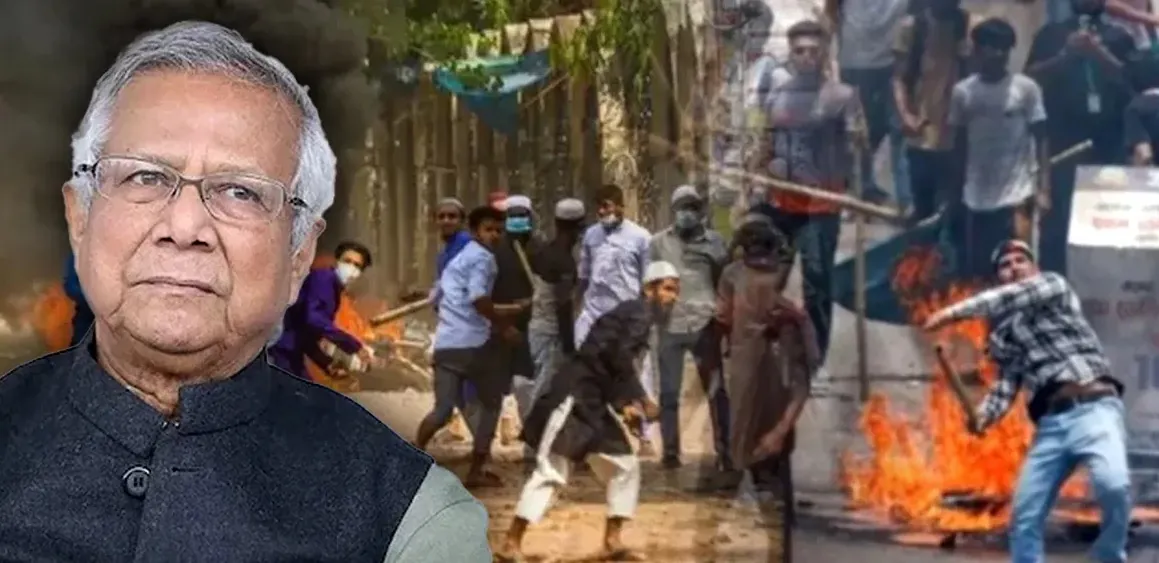

New Delhi: The Yunus government in Bangladesh has faced persistent allegations of violence against Hindus. Ten Hindus have been killed in the past two months. The Indian government has strongly condemned the violence against Hindus. On Monday, the Yunus government released a report on violence against minorities. This report reveals the horrific nature of violence in Bangladesh.
Although the report claims that most crimes committed in Bangladesh in 2025 were non-communal and common crimes, and that most crimes had no connection to religion or ethnicity, the report reveals that a one-year review of official police records from January to December 2025 revealed 645 incidents involving members of minorities, collected from verified FIR information reports, general diaries, charge sheets, and investigation updates across the country. The report also acknowledges that violence across the country claims an average of 3,000–3,500 lives each year.
645 incidents against minorities
A report released by the Yunus government’s press wing stated that Bangladesh is committed to combating crime with transparency, accuracy, and solutions. A one-year review of official police records from January to December 2025 documented 645 incidents involving members of minority communities.
The report stated that while every incident is concerning, the data paints a clear and evidence-based picture. Most incidents were criminal rather than communal in nature, highlighting both the complexity of law and order challenges and the importance of grounding public discourse in facts rather than fear or misinformation.
The report states that the results showed that communal elements were identified in 71 incidents, while 574 incidents were considered non-communal in nature. The communal incidents primarily involved the vandalism or desecration of religious sites and idols, along with some other crimes.
These are the stated reasons for violence.
In contrast, most incidents affecting minority individuals or property are caused by criminal activity other than religion, including neighborhood disputes, land disputes, political rivalries, theft, sexual violence, and cases related to past personal enmity. This distinction is important.
The report states that while all crimes are serious and should be held accountable, data shows that most incidents involving minority victims are not driven by community hostility, but rather by broader criminal and social factors that impact people of different religions and castes. Accurate classification helps prevent misinformation and allows law enforcement agencies to respond most effectively.
3,500 people killed in violence
The report stated that Bangladesh continues to face serious law-and-order challenges at the national level. Every year, an average of approximately 3,000-3,500 people across the country lose their lives to violent crime. This is not a number to be proud of. Every loss of life is a tragedy, and no society should be complacent in the face of such statistics. Furthermore, these figures must be understood in their proper context. Violent crime affects all communities, regardless of religion, caste, or geography.
The report asserted that existing indicators suggest that law and order in Bangladesh is steadily improving. Better policing, improved intelligence coordination, faster response times, and increased accountability have contributed to slow but meaningful progress. The government and law enforcement agencies are committed to further reducing crime and ensuring equal protection under the law.
The report denies allegations of communal violence.
Bangladesh is a country of Muslims, Hindus, Buddhists, Christians, and people of other religions; all are citizens with equal rights. Ensuring security and justice for every community is not only a constitutional responsibility but also a moral one. Protecting places of worship, preventing incitement, responding promptly to criminal acts, and distinguishing truth from rumors are essential to maintaining social harmony.
The report is presented in the spirit of transparency and accountability. It does not deny challenges, nor does it claim perfection. Rather, it attempts to provide a realistic, evidence-based picture of crime trends affecting minority communities within a broader national context. Constructive investigations, responsible reporting, and continuous institutional reform are all essential components of progress.

Comments are closed.