
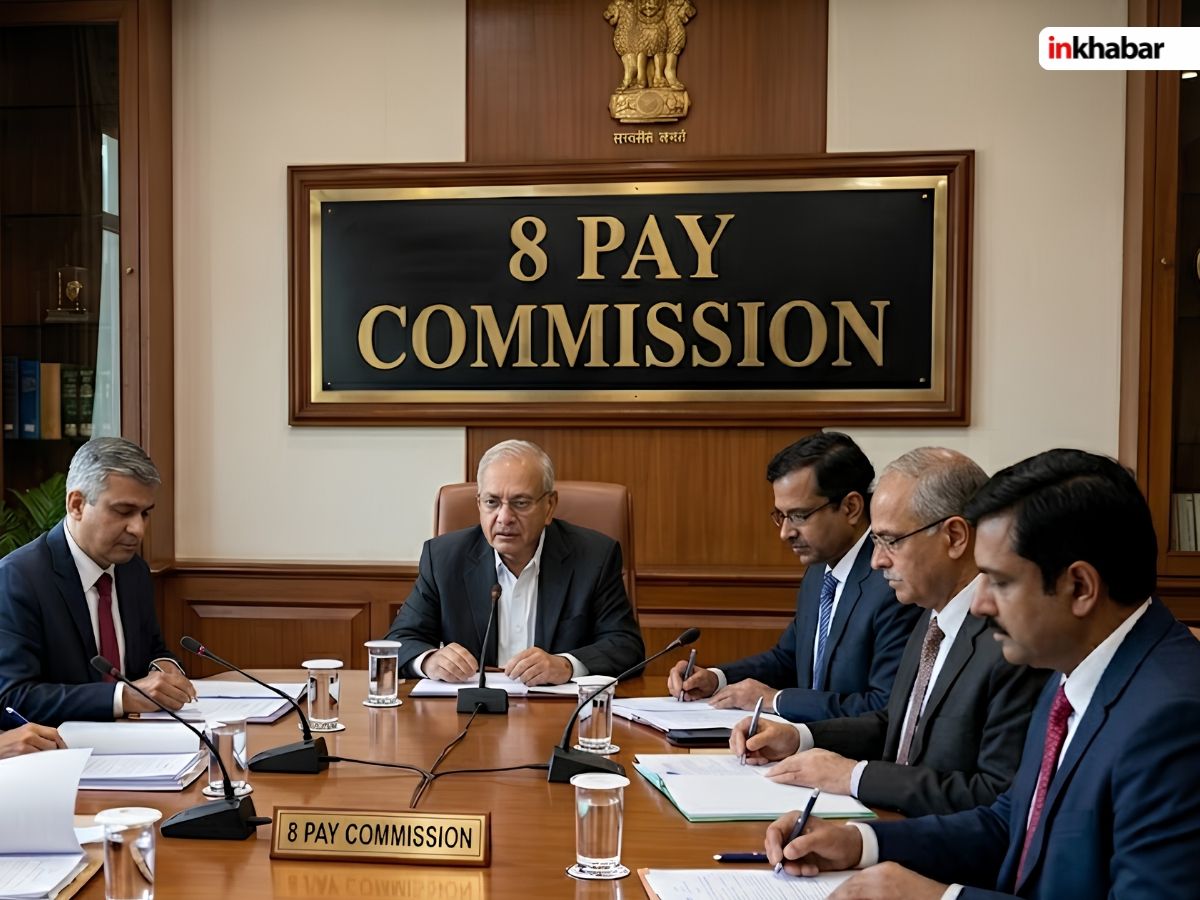

New Delhi: The possibility of substantial arrear payments under the 8th Pay Commission has become a key point of interest among central government employees, particularly those in higher pay levels. With consultations underway and the Commission progressing towards its recommendations, estimates suggest that some employees could receive arrears exceeding ₹20 lakh if implementation is delayed and a higher fitment factor is approved.
While the final recommendations are yet to be submitted, discussions surrounding salary revisions and arrear calculations have intensified, especially among employees in Pay Levels 6 to 10.
Why arrears may become significant
The tenure of the 7th Pay Commission concluded on December 31, 2025. As per established practice, revised salaries under the 8th Pay Commission are expected to take effect from January 1, 2026, regardless of when the government formally implements the recommendations.
If there is a gap between the effective date and the implementation date, employees become eligible for arrears covering the intervening period.
Historically, pay commission recommendations have often been implemented months after their effective date, resulting in sizeable arrear payments to employees.
If the 8th Pay Commission recommendations are implemented during the latter half of 2027, employees could potentially receive arrears for approximately 20 to 24 months.
How arrears are calculated
The calculation of arrears is generally based on the increase in an employee’s basic pay following the implementation of the new pay structure.
The formula involves determining the difference between the existing basic pay and the revised basic pay and multiplying that amount by the number of months for which the implementation is delayed.
For instance, if an employee receives an increase of ₹20,700 in basic pay and implementation is delayed by 20 months, the arrears would amount to ₹4.14 lakh.
Allowances such as House Rent Allowance (HRA), Child Education Allowance (CEA), and Transport Allowance (TPTA) are revised separately and generally do not form part of arrear calculations. Dearness Allowance (DA) is typically incorporated into the fitment factor used to determine revised salaries.
Employees likely to benefit
Pay Levels 6 to 10 cover a large section of central government employees across various departments and services.
These include Junior Engineers, Section Officers, Assistant Section Officers, Income Tax Inspectors, GST Inspectors, Assistant Audit Officers, Accounts Officers, Assistant Directors and several entry-level Group A officers.
Currently, the starting basic pay ranges from ₹35,400 for Level 6 employees to ₹56,100 for Level 10 employees.
The eventual increase in salary and corresponding arrears will depend largely on the fitment factor approved by the government.
Estimated arrears under different fitment factors
Based on projections for a 20-month delay period from January 2026 to August 2027, arrear payouts could vary considerably.
Under a fitment factor of 2.0, estimated arrears range from approximately ₹7.08 lakh for Level 6 employees to ₹11.22 lakh for Level 10 employees.
If the fitment factor is fixed at 2.15, estimated arrears could increase to between ₹8.14 lakh and ₹12.90 lakh.
At a fitment factor of 2.28, payouts may range from ₹9.06 lakh to ₹14.36 lakh.
A fitment factor of 2.57 could raise arrears to approximately ₹11.11 lakh for Level 6 employees and ₹17.61 lakh for Level 10 employees.
The highest projections emerge under a fitment factor of 2.86. In that scenario, Level 6 employees could receive arrears of around ₹13.16 lakh, while Level 10 employees may become eligible for nearly ₹20.87 lakh.
These estimates are based on calculations for a 20-month implementation delay and should be viewed as indicative rather than guaranteed amounts.
Key factors that will determine final payouts
Two major factors will ultimately determine the arrears employees receive.
The first is the fitment factor approved by the government. A higher fitment factor directly translates into larger salary increases and, consequently, higher arrears.
The second is the actual implementation date of the 8th Pay Commission recommendations. The longer the delay between the effective date and implementation, the larger the arrear payout.
Since the Commission is still in the consultation phase, neither of these factors has been finalised.
Conclusion
While projections indicate that some Level 10 central government employees could receive more than ₹20 lakh in arrears under the 8th Pay Commission, such payouts depend on a combination of a high fitment factor and a prolonged implementation delay. Until the Commission submits its recommendations and the government announces its final decision, these figures remain estimates. Nevertheless, the possibility of significant arrears continues to generate strong interest among lakhs of central government employees and pensioners across the country.

Comments are closed.