
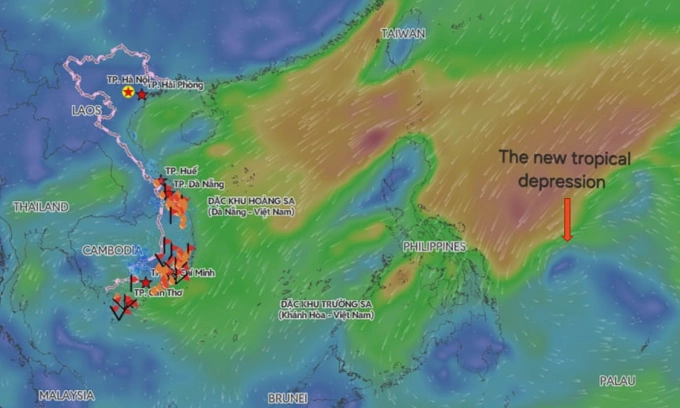

Hoang Duc Cuong, deputy director of the Vietnam Meteorological and Hydrological Administration under the Ministry of Agriculture and Rural Development, told a press briefing on Thursday that the depression is about 1,000 km east of central Philippines and is moving slowly toward the north–northwest.
According to forecasts, the system will cross the Philippines on Friday and Saturday before entering the East Sea, where it could intensify into the 16th storm this year in the East Sea, known internationally as the South China Sea.
Cuong said the system may interact with a cold spell and directly impact the central and south-central regions, bringing moderate to heavy rainfall from Thua Thien Hue to Khanh Hoa. The Hong Kong and U.S. meteorological agencies have begun monitoring the depression but have yet to issue detailed forecasts.
Weather experts warn that the central and south-central regions may see one to two episodes of widespread heavy rain in December. Rainfall from southern Quang Tri to the northern coast of the south-central region is forecast to exceed the multi-year average, raising the risk of flash floods and landslides.
The ENSO phenomenon is expected to remain in the La Niña phase, associated with increased rainfall and cold air intrusions, until February next year, before returning to neutral conditions from March to May 2026.
As of the end of November, the East Sea has recorded 15 storms and tropical depressions, making 2025 the most active cyclone year since monitoring began in 1961. Although Storm Koto weakened at sea last week, it still triggered heavy rain and landslides in the south-central region.
This year’s storm season has also seen several unprecedented events: Storm Wutip formed in June, the earliest occurrence in more than 40 years; Storm Ragasa reached 202–220 kph, making it the strongest ever recorded in the East Sea; and a late-November tropical depression traced back to Storm Senyar, which travelled from the Indian Ocean to the northwest Pacific, an unrecorded pattern.
Vietnam has also experienced widespread flooding in 2025, with peak water levels on many rivers surpassing historical records across the north, central, Central Highlands and Mekong Delta regions. Few previous years have seen major floods occur simultaneously on 20 rivers.
Cuong said the unusual storm and flood activity reflects an accelerating trend of extreme weather linked to climate change.
Since the beginning of the year, natural disasters have caused more than VND97 trillion (US$3.67 billion) in damage and left more than 400 people dead or missing.

Comments are closed.