
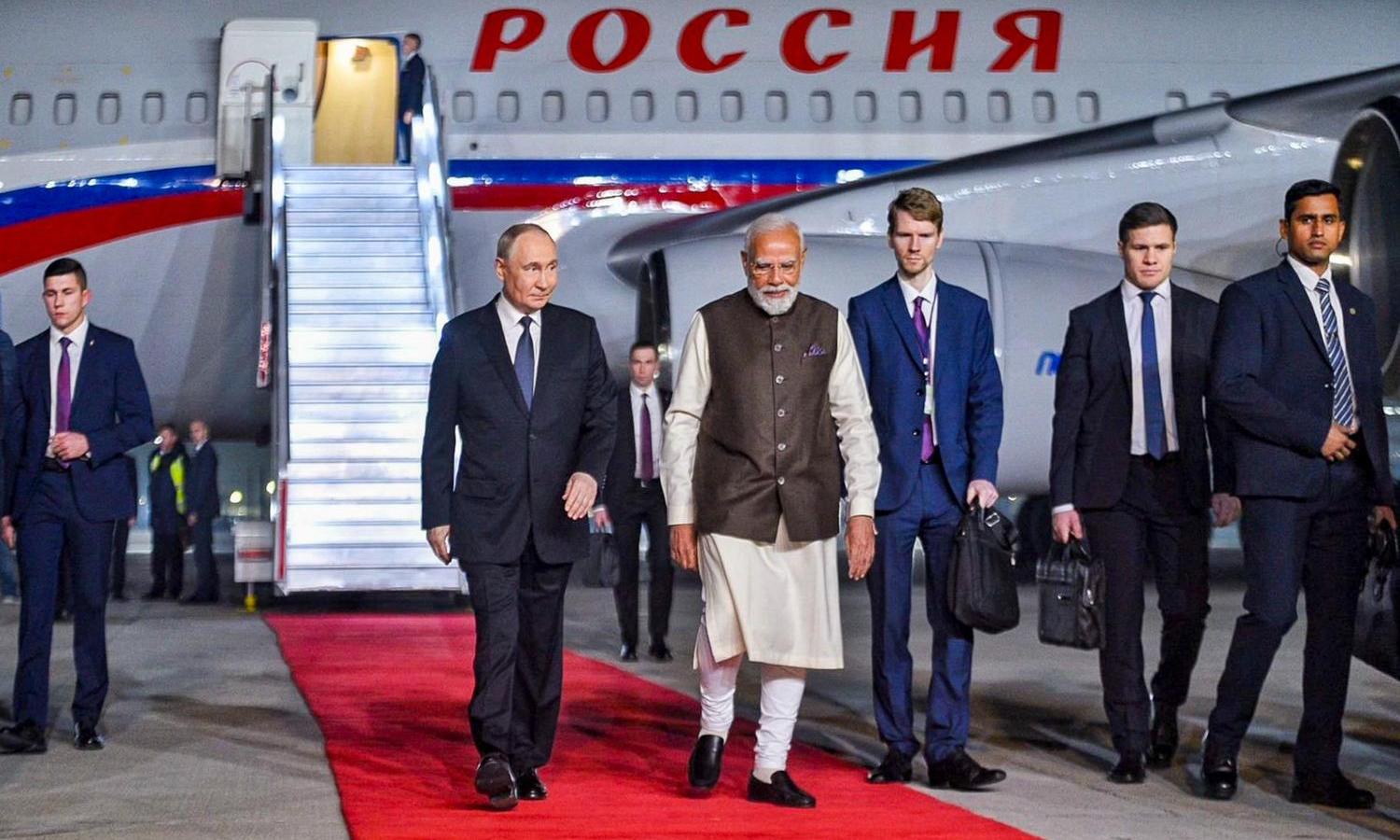

Prime Minister Narendra Modi and Russian President Vladimir Putin are set for the 23rd India-Russia Annual Summit meet in New Delhi on Friday (December 5). This will be their second meeting this year under the shadow of US President Donald Trump’s stiff tariffs on India and pressure on Russia to end its war on Ukraine.
The two had last met at the Shanghai Cooperation Organisation (SCO) summit at China’s Tianjin in September, after the US tariffs came into effect. Chinese President Xi Jinping, with whom Trump has a running trade war, hosted the event.
Their meeting at Tianjin arguably softened up Trump, who was criticised in his home turf for alienating and pushing India into the China-Russia club. This meeting was also seen as improving diplomatic and trade ties between India, Russia and China.
Also read: Putin visit shows Russia-India ties on even keel, despite oil import setback
By then, a month earlier in August, India had initiated a free trade talk with the Russia-led Eurasian Economic Union (EEU) – comprising Russia, Armenia, Belarus, Kazakhstan and Kyrgyzstan – to expand trade relations and diversify markets for Indian businesses, including MSMEs, farmers and fishermen.
Last month, an Indian delegation went to Moscow to take the trade talks with the EEU further. The FTA would be finalised in one and a half years. Ahead of the Modi-Putin summit on Friday, delegations of both sides held talks covering a wide range of bilateral engagements, including defence and space tie-up, trade and investment.
What to expect from summit
India can expect expansion in trade with Russia.
In October, Putin was reported to have instructed his officials, at a conclave of Sochi in South Russia, in which India participated, to formulate strategies to address the trade imbalance caused by heavy Russian crude import by India. He is supposed to have indicated an increase in imports of Indian agricultural goods and pharmaceuticals.
Also read: Putin’s India visit: ‘It’s a message to West and US’
Though there is no Indian official communication on the agenda, Commerce and Industry Minister Piyush Goyal said at a function on Thursday (December 4) that there was a vast untapped opportunity for India to export automobiles, heavy machinery, textiles and food products to Russia – acknowledging a heavily skewed trade balance.
Rising trade deficits
Trade data show India’s trade deficit with Russia has been on the rise. In the past eight fiscals, deficits in goods trade have risen sharply from -USD 6.5 billion in FY18 (of the total trade of USD 10.7 billion to -USD 59 billion in FY25 (of the total trade of USD 68.7 billion).
The following graph maps the rising goods trade and the rising deficit with Russia:
Quite clearly, as the goods trade expanded in the past few years, India ended up piling up huge deficits – accounting for 60.4 per cent of the total goods trade in FY18 to 85.5 per cent in FY25.
The key items of Indian imports are oil and petroleum products, fertilisers, bituminous substances, mineral fuels, mineral waxes, machinery, equipment, precious metals and stones, wood, pulp and paper products, metals and vegetable oils.
Also read: Russian President lands in Delhi; Modi and Putin travel in same car
Indian exports range from agri-products (fish, shrimp, rice, tobacco, tea, coffee, grapes) to chemical products, pharmaceuticals, iron and steel, ceramic products, aeroplane components, machinery, glass and glassware, clothing and knitwear, leather goods, rubber articles, electrical machinery, and surgical tools.
Even in services, the trade is skewed in favour of Russia.
Deals in the offing?
With the import of Russian crude expected to ease soon, although persisting – the US imposed sanctions on only two Russian oil majors Rosneft and Lukoil, who produce 49 per cent of Russian crude, not the rest – India’s trade deficit is unlikely to go down anytime soon.
Also read: S-400, Su-30 upgrades on agenda in India–Russia defence ministers’ talks
India is keen to buy more weapons and expand cooperation in the space and nuclear technology sectors. Russia has been a major weapon and nuclear plant supplier for India over several decades. Reports suggest India may sign a deal for a nuclear submarine.
On Wednesday (December 3), MoS Jitendra Singh, Department of Atomic Energy (DAE), told Parliament in a written reply that India was talking to Moscow about manufacturing Russia-designed nuclear small modular reactors (SMRs) in India. He said discussions had already taken place between the DAE and Russia’s Rosatom.
Rosatom claims to be the only one in the world to operate an SMR⁸ and that it has been operating a floating cogeneration nuclear power plant (FNPP) of 70 MW – supplying both energy and heat – in Pevek since 2019.

Comments are closed.