
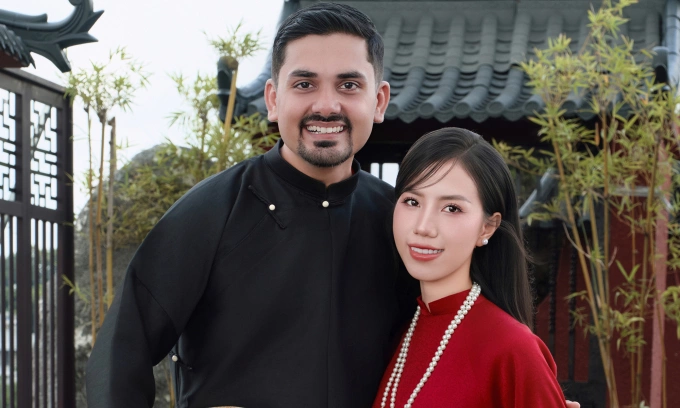

In March 2024, at the Vietshrimp Aquaculture International Conference in Ca Mau, her booth was next to Abhishek Khandelwal’s.
Seeing this foreign man so busy that he did not even have time to drink water, she kindly took him a glass of orange juice. The meeting was fleeting since both were caught up in work. But over the next three months regular text messages brought them closer together. “No one said ‘I love you,’ but we both felt like we were leaning toward each other,” Nhu Y, 31, of Hau Giang, explains.
Nhu Y and Abhishek Khandelwal. Photo courtesy of the couple |
But there seemed to be a cultural barrier. Khandelwal, 30, us from Patna in northern India, where the idea of arranged marriages remains entrenched. It was unprecedented for a boy to marry a foreign girl.
At first his parents objected strongly. They even traveled more than 2,000 km from their hometown to India’s global tech hub Bengaluru, where he worked, to dissuade him and match him up with a “suitable” girl from their own community.
To let the situation cool for a while, he stopped contacting Nhu Y for half a month. Only after his parents left did he dare tell her the truth about his family’s protestations. “That’s when I realized he was under so much pressure. He didn’t dare to confess since he was afraid I’d get my hopes up and then get hurt,” she says.
He refused to give up and never stopped trying to convince his parents. He even sought the help of his cousin in Europe, who had a say in the family.
Finally, at the end of 2024, his parents reluctantly agreed to video chat with Nhu Y. The language barrier turned that into a “disaster” since she could not speak English.
The disappointed parents said: “If you can’t even talk for a minute, how can you live together for the rest of your life?”
That comment hurt Nhu Y’s pride but also ignited her determination. Though she had just switched to a high-stress banking job, she threw herself into studying English nightly.
On many days she only had time to drink milk instead of eating food before class. By the time of the second call his parents were surprised by her progress in English. Taken in by her sincerity, they said: “If you two have tried so hard for each other, we will support you.”
To prove her seriousness even further, she said she would quit her job to travel to India and experience his family’s lifestyle. “I believed the door to my career would open again at any time, but I could not miss the opportunity to find the right partner,” she explains.
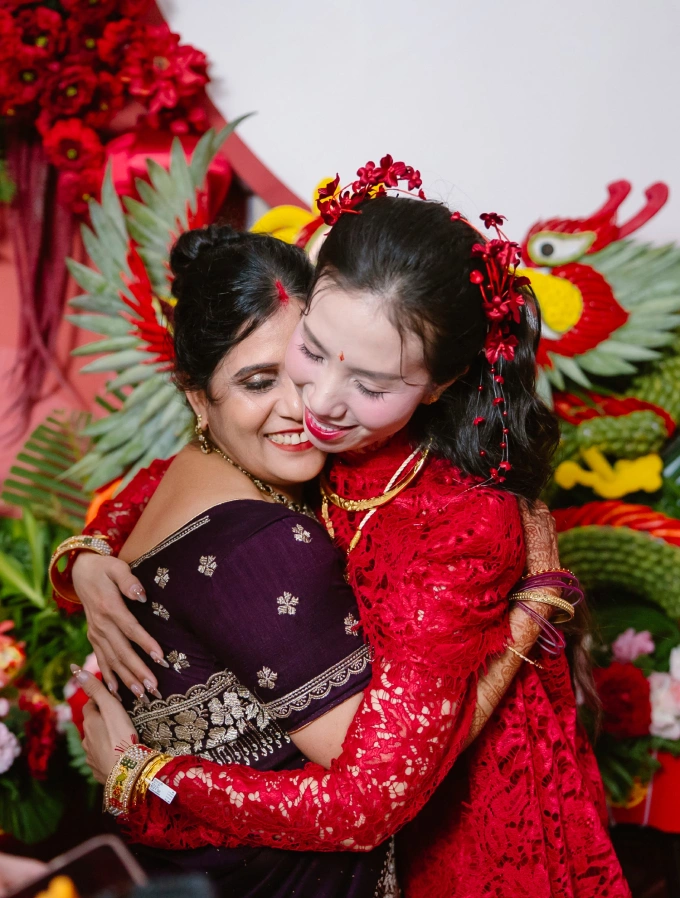 |
Nhu Y’s mother-in-law gives the bride a dowry and a big hug at the wedding in Mekong Delta City of Can Tho on Nov. 9, 2025. Photo courtesy of Nguyen Minh Tri |
It was only when leaving for India did she finally dare tell her family about her romance with the Indian man. Her mother kept asking: “Why did you choose such a thorny path?”
Nhu Y could not find a convincing explanation, but knew that if she had to choose it would always be Abhishek.
Her month in Bengaluru erased whatever misgivings his family may have had. She quickly integrated, learning things like how to clasp her hands together and say “Namaste,” Hindu temple rituals and the meaning of the red dot on a woman’s forehead.
Her naturally lovely disposition and eagerness to learn made her boyfriend’s family go from surprise to affection. The day she had to leave for Vietnam, his parents had tears in their eyes. “At that moment I truly knew I had another family,” she says.
A few months later Khandelwal came to Vietnam to meet her family. To impress his future in-laws, he even shaved his beard, these days a fashion statement for Indian men.
The top business executive became a simple son-in-law in the Mekong Delta, watching Doraemon cartoons and doing his best with Vietnamese, making Nhu Y’s parents “love him like their own child.”
With all barriers finally shattered his parents became more involved in organizing the wedding than anyone else.
They went through every detail of Vietnamese weddings online, even texting their future daughter-in-law about the meaning of each item to ensure everything was prepared correctly.
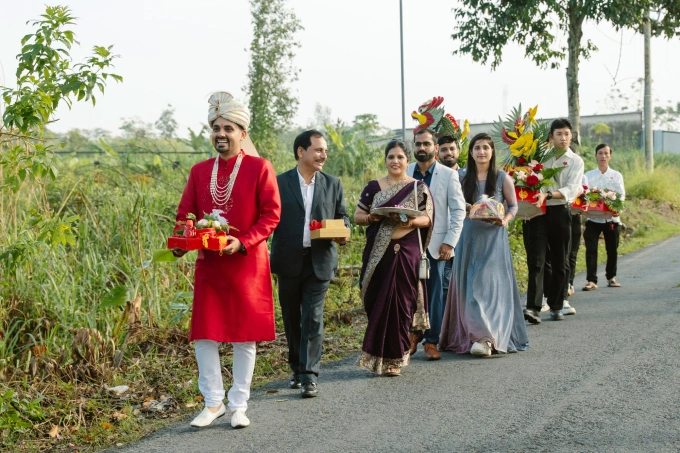 |
The groom Khandelwal, his parents and young people go in a procession to pick up the bride on the wedding day in Can Tho on Nov. 9, 2025. Photo by Nguyen Minh Tri |
The wedding in Can Tho on Nov. 9 was an unusual blend of cultures: Next to the traditional Vietnamese wedding arch, made of coconut leaves and with images of dragons and phoenixes, the groom’s family invited an Indian monk to perform a ceremony at a Hindu temple in Ho Chi Minh City.
In Hindu wedding style, the groom led the bride around the sacred fire seven times while promising the key principles of marriage: sharing food, building wealth together, hoping for children, and remaining eternally faithful.
An Indian meal after the ceremony erased any lingering concerns about cultural differences related to food. Y’s mother says: “Both sides felt closer. I am wholly content to let my daughter get married to someone from afar.”
The happiness continued with another wedding, this time a Hindu one in Patna a few days later. Following the rituals, the Vietnamese bride became an official member of the Khandelwal family.
For him, his family’s worries about a “foreign daughter-in-law” have completely vanished. “My smart and kind Vietnamese bride has completely won my family over,” he says, thanking both families, and especially her for co-authoring a beautiful love story.
“In a world filled with hate and instability, true love will always win. We are proof.”

Comments are closed.