
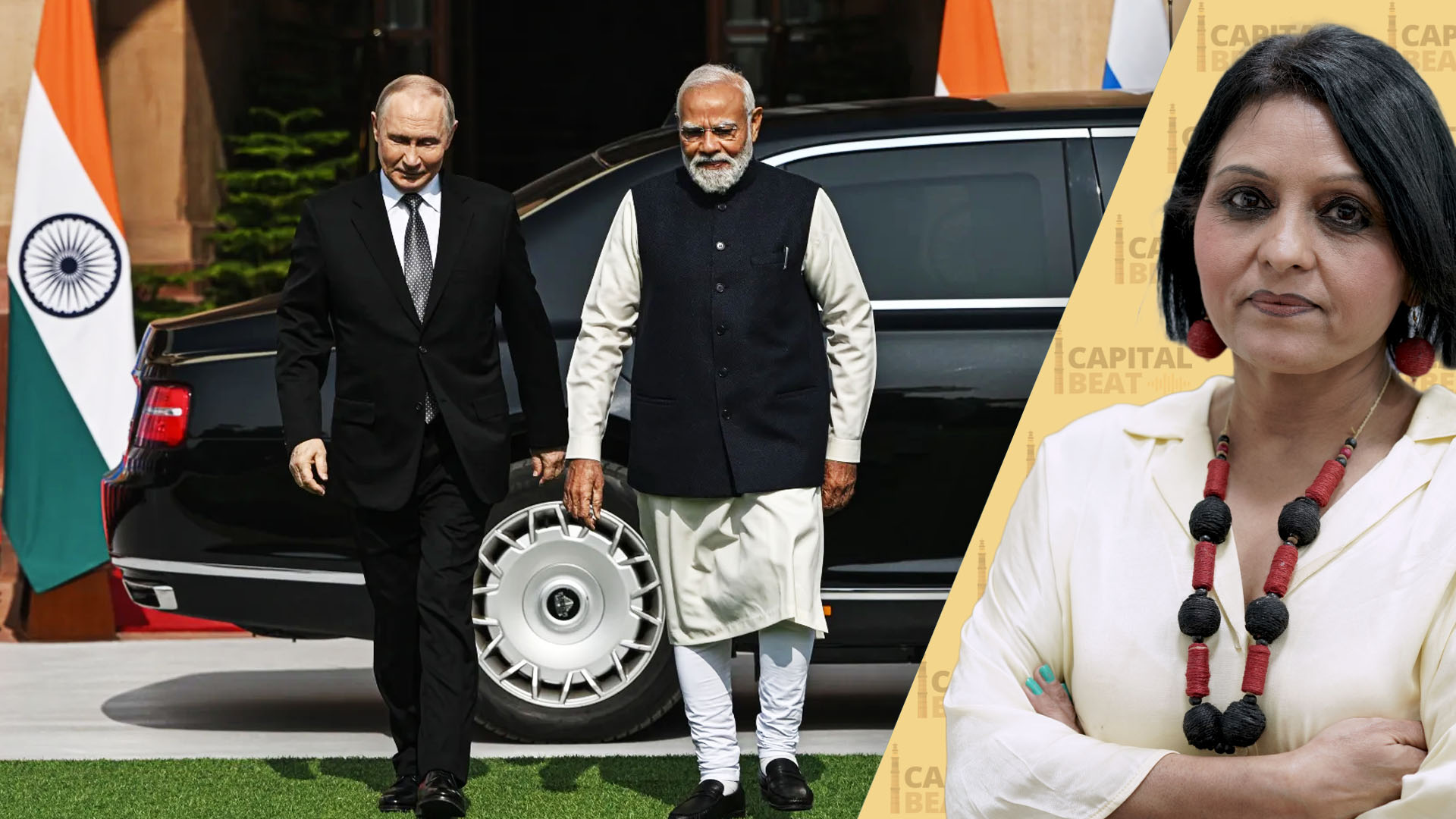

Russian President Vladimir Putin’s summit with Prime Minister Narendra Modi and its impact on India’s ties with the United States came under scrutiny on this episode of Capital Beatfeaturing KS Dakshina Murthy, Consulting Editor of The Federaland veteran journalist Sanjay Kapoor. The discussion focused on energy, trade targets, media cooperation and India’s effort to hold together key relationships with both Moscow and Washington under growing pressure.
Optics of the visit and pressure from Washington
The episode noted that Putin and Modi exchanged memorandums of understanding (MoUs) in areas such as trade and agriculture, without taking questions at their joint appearance. Modi announced that India had opened two new consulates in Russia and two new tourist visa schemes for Russian visitors.
Also read: Rare interview provides insights into Putin’s closely-held worldview
On Ukraine, Modi reiterated that India had “stood for peace since the beginning”, welcomed efforts towards a “lasting solution” and said India was ready to “contribute in the future”. On energy, Putin declared that Russia was prepared to continue “uninterrupted fuel shipments” to India and referred to a “flagship” nuclear plant being built with Russian cooperation.
Kapoor described the trip as “a very significant visit”, emphasising that this was Putin’s first visit to India after the Ukraine war, following a gap of “maybe four years” in annual summits. The discussion underlined that the visit came after the United States imposed a total 50 per cent tariff burden on Indian goods, leaving New Delhi “feeling very vulnerable”.
Sanctions, tariffs and Russian efforts to widen options
The panel observed that Russia appeared keen to share its experience of dealing with Western sanctions and tariffs, and to underline that “there is a world beyond” the Western economic system. Kapoor pointed to discussions around labour, describing Russia as “a labour-scarce country” and India as “a labour surplus country.”
Also read: Putin visit shows Russia-India ties on even keel, despite oil import setback
The programme highlighted that both sides spoke of raising bilateral trade to around USD 100 billion, alongside references to transport corridors, including a route from Chennai to Vladivostok and a corridor described as the India-Iran-Russia transport link that would reduce dependence on the Suez Canal. These were framed as attempts to ease what was described as a Western “stranglehold” on existing routes.
The discussion noted that India remains under pressure from the United States over Russian oil purchases. Kapoor referred to Washington’s warning that if India continued to buy more oil, it would “continue to face more sanctions”, and pointed out that an Indian company, Reliance, had begun to scale down its Russian crude imports.
Balancing Putin’s expectations and US red lines
The panel addressed whether Putin might have pushed Modi privately to increase Russian oil purchases. Kapoor argued that India’s reliance on Russian crude before 2022 was “just about 1 to 2 per cent”, and that India could technically revert to traditional suppliers in the Arab and Islamic world if necessary.
The discussion described Russia as urging India to keep buying oil as a way of signalling that New Delhi was “not really bothered” by sanctions, even as India weighed how far it wanted to “cock a snook” at US President Donald Trump. The programme underlined that Washington was unlikely to “back off even if India stops buying oil from Russia”, suggesting that tariffs and other measures were linked to a wider set of issues in the India-US relationship.
Also read: India, Russia stand shoulder to shoulder against terrorism: Modi
Kapoor characterised India’s use of Russia as a form of leverage, noting that New Delhi was attempting to send a message to Washington that it must “look at us afresh” and could not “really do whatever” it wished in terms of outreach to Pakistan or China.
Intent, continuity and managing fuel reductions
Murthy described the summit outcome as primarily about “intent”, stressing that “Russia and India do not want to let go each other, come what may”. He pointed out that both sides viewed the relationship as “very crucial” and that India saw Russia as having been “a huge support all these years”.
The discussion noted that treaties and agreements, including the logistics pact earlier ratified by the Russian Duma (lower House of Parliament), were part of this continuity. At the same time, Murthy underlined that India was adjusting its energy purchases to align with US sanctions on specific Russian companies.
He stated that India had “stopped buying oil from companies that have been sanctioned by the US” and was looking to source from Russian firms “that have not been sanctioned”.
He pointed out that Trump’s remarks themselves suggested a gradual reduction in Russian supplies rather than an abrupt halt, and noted media reports that “compared to last October, this October India’s oil buy from Russia was less by 30 per cent”.
The episode highlighted that, “on the ground”, India was implementing reductions in line with US expectations while avoiding a dramatic rupture with Moscow.
Anticipating US reaction and ongoing Ukraine diplomacy
On likely US reactions, Murthy said the purpose of the summit was partly “optics” and a signal that India would “not let go of Russia”. At the same time, he noted that any immediate response from Washington might not be “very sharp”, since Trump himself was in talks with Putin on ending the war in Ukraine.
The discussion suggested there had been “some kind of a patch up” between Trump and Putin around peace efforts, and that this could temper the tone of US statements following the Modi-Putin summit.
The panel reinforced that the Ukraine conflict remained central to the overall environment of sanctions, tariffs and diplomatic bargaining.
The programme underlined that India’s energy choices and Russia’s role in Ukraine peace discussions were intersecting issues that would continue to shape how Washington read India’s strategic posture.
Nuclear energy cooperation and clean energy goals
On nuclear energy, the panel recalled Russia’s longstanding role in India’s civil nuclear programme, particularly during the tenure of former Prime Minister Manmohan Singh. Kapoor noted that Singh had been “very adamant” that the nuclear process should go through despite protests against the Kudankulam project by anti-nuclear groups.
The discussion suggested that a new nuclear project “similar to Kudankulam” could emerge in another region, with nuclear energy framed as “clean energy” that would contribute to India’s “energy self-sufficiency”. Putin’s comments on continued cooperation in nuclear power were noted within this broader pattern.
The episode highlighted that Putin had, in a media interview, questioned US objections to India’s energy imports from Russia by pointing out that Washington itself purchased nuclear fuel from Moscow.
Trade targets, currency dilemmas
On trade, the panel examined the new target of USD 100 billion by 2030.
Murthy observed that Russia had expressed its willingness to import more from India in sectors such as pharmaceuticals and agricultural products, and argued that if such purchases materialised, “the volume of trade will go up” significantly.
He pointed to expectations that the Ukraine war would eventually end and suggested that, with five years until 2030, “the volume of trade is definitely going to expand”, even if the exact target was uncertain. He also noted that Russia appeared increasingly “comfortable” engaging with countries in the Global South, including India and China.
Kapoor was more sceptical about the ease of reaching USD 100 billion. He referred to Putin’s own remark that trade stood at “USD 63 billion” and that this was largely oil-driven, and recalled the example of Belarus, which Putin reportedly cited as having trade worth around “USD 50 billion” despite being a “tiny country”.
The panel stressed ongoing difficulties around settlement in national currencies. Kapoor noted that Russia had received large payments in Indian rupees and was “going around figuring out what they should do” with these holdings, including approaching China. He recalled past challenges with rupee–ruble trade and said the area was “fraught with many problems”.
Media cooperation and narrative competition
The panel also discussed media cooperation, including the launch of Russia Today (RT) in India and a memorandum of understanding between news agencies PTI and TASS. Kapoor described a visit to the RT office in India, where Russian journalists and producers appeared “very excited” about their expansion plans.
The discussion framed the move as an effort by Russia to “build their narrative” and ensure that “US and the West alone does not have a say” in how audiences perceive developments in the BRICS and Shanghai Cooperation Organisation (SCO) space. Kapoor said RT would rely substantially on Indian journalists, with content feeding English and other language channels.
The episode noted that this “competition of narratives” was already visible in joint opinion pieces by Western ambassadors and responses from other governments, and suggested that this dynamic was likely to intensify.
India’s challenge
In closing remarks, Murthy observed that once Putin departed, India would still “have to deal with the rest of the world”, including the West. He pointed out that India had recently signed agreements with the United Kingdom and reiterated that New Delhi’s “fundamental platform has not changed”, describing it as wanting “to be friends with everybody”.
He characterised the current environment as “polarise kind of a situation” and described it as a “challenge” for India to hold on to both East and West while making these relationships work in India’s favour.
He concluded that Putin’s visit and departure would place India’s effort “to hold on to the east and the west and try to make it work for India” under even sharper focus.
(The content above has been transcribed from video using a fine-tuned AI model. To ensure accuracy, quality, and editorial integrity, we employ a Human-In-The-Loop (HITL) process. While AI assists in creating the initial draft, our experienced editorial team carefully reviews, edits, and refines the content before publication. At The Federal, we combine the efficiency of AI with the expertise of human editors to deliver reliable and insightful journalism.)

Comments are closed.