

With its feet immovably stuck in espionage waters, Dhurandhar feels like the much-needed decoy for the Indian viewer of 2025. As audiences struggle to find a proper outlet to their real-life grievances — personal and political — it is increasingly apparent that they are seeking the big-screen dazzle as the perfect escape. The word “transport” has become operative in the latest discourse because the cinema hall couldn’t dare any longer to keep us tethered to the outer world, even if it were to, quite ironically, relay a story discussing our own history in a manufactured manner.
Aditya Dhar’s latest feature slickly (and timely) occurs to this trend to handhold us into a world where revenge is an emotion in every heart and on every lip, and where each human pulse pounds loud and intense in the name of love. The love, though, is of the territorial kind here. Dhar’s first of the two-part feature begins in the aftermath of the 1999 Kandahar Hijack and the Parliament attack in 2001, when India sought stiff and mandatory countermeasures to the terror spill from across the border. Indian Intelligence Bureau chief Ajay Sanyal (R. Madhavan) bears first-hand witness to both tragedies, and his immediate instincts, which are tactfully measured despite the agony felt deep down, urge him to draw a plan that would serve as a fitting long-term solution to the country’s woes against unsolicited bloodshed.
A barbaric power tussle
Indian top governance’s initial reticence to react causes Sanyal’s robust idea to see a delay of few years, but when it is eventually put into play in 2004, a major epicentre of Pakistan’s economic powerhouse and largest city, Karachi, comes into focus; Lyari, a locality also known as “Mother of Karachi”, is where the answers must be found by Sanyal & Co. Babu Dakait and his illegitimate son Rehman Dakait (Akshaye Khanna) lead two warring criminal gangs in Lyari at the time, with them submerging the entire neighbourhood in various black business like international arms manufacturing and trade, drug-trafficking and whatnot.
Ethnic tensions between Baloch (to which Rehman belongs), Pashtun and other communities, along with the national politics being hand-in-glove with the crime lords, are another undercurrent here that could set the status quo ablaze any moment. What does a lowly juice shop waiter named Hamza Ali Mazari (Ranveer Singh), then, have to do with this barbaric power tussle around him? And how does he see a sudden ascension in the place he knows very little about? Dhurandharin essence, traces this journey.
Two aspects define the narrative constructed by Aditya Dhar: the generic beats with which the story unfolds and the contrasting matter-of-fact approach in the narration. Hamza’s growth in Rehman and his cousin/main-man Uzair Baloch’s (Danish Pandor) shadows is evocative of landmark works of the past, such as Serpico (1973) and Infernal Affairs (2002), where acts of gaining trust become imperative to the infiltrator. While Sidney Lumet and Andrew Lau’s & Alan Mak’s respective films (John Frankenheimer’s French Connection II (1975), too, comes to mind) tested their protagonists by lending them a slippery slope of morality and distrust, Dhurandhar makes things glaringly easy for Hamza by allowing him to be the smartest guy in the room at all times.
A ‘vibe movie’
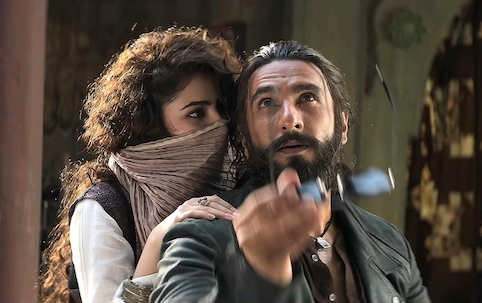
Rehman’s coalition with People’s Awam Party’s local bigwig Jameel Jamali (Rakesh Bedi) is left wanting in terms of scope and ambition for the gangster (whom Akshaye Khanna plays with a “Hmmm, interesting” smoulder). So, when Hamza enters the picture by offering his boss a few commonplace solutions that are largely clichés of their own, it doesn’t take long for him to start playing everyone in the gang as a pawn. He manages to lay traps for others at will, woo the local political kingpin’s much-younger daughter, Yaleena (Sara Arjun), without breaking a sweat, and also enter the deep chambers where the most dangerous attacks on India are being planned. Amidst all this, he successfully conceals his identity while maintaining relations with agents from his homeland to ultimately forge an emotionally-distant, larger-than-life image.
Also read: Tere Ishk Mein review: Dhanush and Kriti Sanon wade through a dense, chaotic drama
Dhurandhar uses the opportunity of breaking the mythos of a spy only fleetingly, and it instead sets its gaze on using the various facets of the setting to create a “vibe movie”, in which retro Hindi songs and Shashwat Sachdev’s overall sonorous soundtrack are used as devices to no great effect, but to simply break the monotony. Even other key decisions, such as splitting the film into various chapters and invoking multiple styles and sensibilities at once (the film suddenly merges a Guy Ritchie-like flamboyance with its otherwise heightened grunginess), don’t necessarily justify themselves.
Dhar’s filmmaking, bolstered by Vikash Nowlakha’s lucid cinematography and Saini S. Johray’s superb production design (with Yogesh Bansode and Choudhari Nilesh credited as art directors), is snazzy and effective when considered in isolation. Be it the way the action blocks are executed with finesse, the level to which the physical design of the world accentuate its grim and violent temperament (Lyari is shown in desaturated hues to elicit a grey ‘lifeless’ feeling), or the overall control over the visual grammar, there are enough suggestions that a lot has gone into realising the aesthetic value of the film.
‘Real elements’ flare up the drama
But those first impressions aside, the writing doesn’t match up to create the more crucial narrative tension. As predictable as the story might be at the outset, Dhurandhar is a whole lot of flash-and-bang that almost never reveals any admirable curiosities about its subject matter. It doesn’t desire to know its world from deep within, doesn’t really manage to create relatable ‘people’ out of its peripheral characters, nor does it truly strive an authentic portrait of a spy, whether it is the way they deal with perpetually being in the clutches of cruelty, the tools they use to keep the sense of duty and pride burning alive over long periods of time, or even the nihilism that simmers inside them.
Also read: 120 Bahadur review: Farhan Akhtar’s India-China war drama finds its footing in parts
A lot of the principal characters, too, are typified by the genre’s requirements. Arjun Rampal as ISI’s Major Iqbal is as stock as it gets, and it’d seem the ever-reliable Sanjay Dutt was made to essay his ruthless and corrupt SP Chaudhary Aslam following a description that perhaps said “a Sanjay Dutt-like character”. Sara Arjun is the only woman in this testosterone-dominant world who has any credible screen time, with practically no one else even managing to squeeze a line in for themselves.
So, when most else doesn’t work, Dhurandhar flares up the drama with a neat little trick involving ‘real elements’. The tragic 26/11 Mumbai terrorist attacks in 2008 become a major juncture in the film’s narrative, and it is noteworthy that Dhar switches from original footage to sound and video snippets from the live coverage of the event. The screen even turns red at one point to highlight the audio bytes featuring the terrorists, their handlers and the hostages held at the Taj Hotel. While the abrupt introduction of a documentary-like tone into fiction is very much a common occurrence, the choice to do so in the film’s context, where the viewer’s antipathy towards the ‘other party’ already seems high, feels manipulative. In other words, the use of real footage becomes a method to enhance the drama that the original writing couldn’t create in the first place.
Filmmaker Michael Haneke once said about cinema that its “responsibility entails enabling your audience to remain independent and free of manipulation”. Dhurandharas a voice, has every right to interpret history the way it wishes to and wholeheartedly offer its stance on it. But can it recycle it this way for the purpose of entertainment? Certainly not.

Comments are closed.