
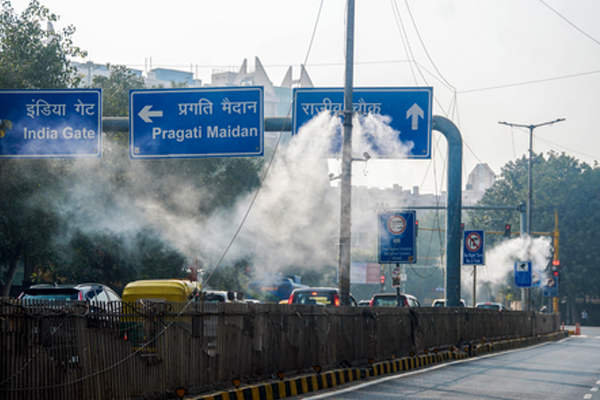

Noida, 6 December. The Air Quality Index (AQI) in the National Capital Region (NCR) has once again crossed dangerous levels. Air quality is being recorded in ‘severe’ category at almost every monitoring station in Delhi, Noida and Ghaziabad. At many places the AQI has reached between 350 to 400, while at some places it has even crossed 400. Data released by pollution control boards shows that from December 1 to December 5, the air quality remains in the very poor to severe category almost every day.
The AQI at stations located in Sector 125, 62 and 116 of Noida has been recorded at 381, 308 and 369 respectively. The situation is even more worrying in Knowledge Park-III and Knowledge Park-V of Greater Noida, where the index remained around 304 and 358. The situation in Ghaziabad was even worse—the AQI in Loni reached 403, while Indirapuram and Sanjay Nagar also recorded indices above 300. Many areas of Delhi—Mundka, Najafgarh, Nehru Nagar, Okhla, Punjabi Bagh and Patparganj—have recorded AQI ranging from 340 to 380. This level is considered a direct ‘serious threat to health’.
On the other hand, according to the Meteorological Department, there is no hope of relief from pollution in the coming days. There will be no significant change in temperature and morning fog will persist. From December 6 to December 11, the minimum temperature is expected to be between 10–12 degrees and the maximum temperature is expected to be around 23–24 degrees. The smog situation may worsen due to reduced wind speed and reduced ability of pollutant particles to rise upward. The direct effect of pollution is becoming visible on people’s health. Hospitals are reporting increased cases of eye irritation, sore throat, difficulty breathing and asthma.
Doctors say that this is a very risky time for children, elderly, pregnant women and people with respiratory diseases. Experts are advising that people avoid going out in the morning and evening. Pollution control agencies have increased strict monitoring of construction works, burning of garbage and dust-spreading activities, but improvement in air quality will be possible only when wind speed increases or there is any weather event like rain. Till then there is every possibility that the air of NCR will remain ‘poisonous’.

Comments are closed.